|
TRANSLATE THIS ARTICLE
Integral World: Exploring Theories of Everything
An independent forum for a critical discussion of the integral philosophy of Ken Wilber
  Frank Visser, graduated as a psychologist of culture and religion, founded IntegralWorld in 1997. He worked as production manager for various publishing houses and as service manager for various internet companies and lives in Amsterdam. Books: Ken Wilber: Thought as Passion (SUNY, 2003), and The Corona Conspiracy: Combatting Disinformation about the Coronavirus (Kindle, 2020). Frank Visser, graduated as a psychologist of culture and religion, founded IntegralWorld in 1997. He worked as production manager for various publishing houses and as service manager for various internet companies and lives in Amsterdam. Books: Ken Wilber: Thought as Passion (SUNY, 2003), and The Corona Conspiracy: Combatting Disinformation about the Coronavirus (Kindle, 2020).
Check out my other conversations with ChatGPT Three Sciences or One?Ken Wilber's Challenge to the Philosophy of ScienceFrank Visser / ChatGPT
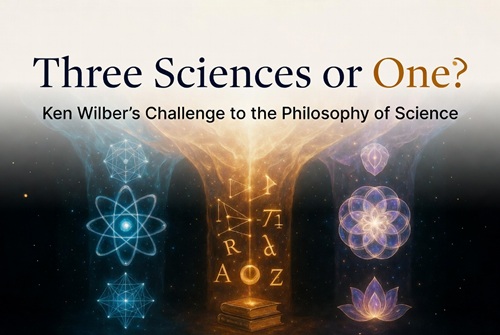 Ken Wilber's early writings contain one of the most ambitious proposals in contemporary philosophy of science. Long before Integral Theory became known for AQAL maps and developmental stages, Wilber attempted to redefine what science itself is. In The Atman Project (1980), Eye to Eye (1983), and later works, he argued that the modern world had mistakenly equated science with the investigation of the physical universe. This, he believed, was not an inherent feature of science but a historical accident born of Enlightenment materialism. Wilber proposed a much broader conception. Reality, he argued, presents itself in three distinct domains—matter, mind, and spirit—and each possesses its own rigorous mode of investigation. Physical science explores the sensory world through observation and experiment; psychological or symbolic science investigates the structures of consciousness through interpretation and introspection; contemplative science examines higher states of awareness through meditation. All three, he claimed, share the same epistemological structure. They begin with a prescribed method or injunction, produce experiential data accessible to trained practitioners, and rely on communal confirmation among qualified investigators. The proposal is elegant in its symmetry and characteristic of Wilber's ambition to reconcile science, psychology, and spirituality within a single epistemological framework. Yet it has had remarkably little influence outside the Integral community. Forty years after its formulation, philosophers of science rarely discuss it, and no major textbook has adopted Wilber's tripartite conception of science. Understanding why reveals not only the strengths of Wilber's vision but also its philosophical limitations. An Attempt to Escape ScientismWilber's proposal was motivated by a genuine philosophical concern. During the twentieth century, many intellectuals complained that science had become identified exclusively with objective measurement, reducing subjective experience to something secondary or even illusory. Human meaning, ethical values, aesthetic appreciation, and mystical experience seemed excluded from the domain of legitimate knowledge. Wilber agreed that this narrowing represented a serious mistake. His solution, however, was not to criticize science but to expand its definition. Rather than reserving the term "science" for empirical investigation of the physical world, he argued that any disciplined inquiry possessing appropriate methods, experiential evidence, and communal verification deserved the title. This move allowed Wilber to claim that contemplative traditions such as Zen Buddhism or Advaita Vedanta were not merely religions or philosophies but genuine sciences of consciousness. Meditation became the equivalent of laboratory experimentation; enlightenment became the analogue of empirical discovery. It was a bold proposal. Whether it succeeded depends largely on how one understands the nature of science itself. Science According to the PhilosophersWilber's redefinition stands in noticeable tension with the dominant traditions in twentieth-century philosophy of science. Although philosophers have disagreed sharply about the precise nature of scientific knowledge, few have adopted criteria as broad as Wilber's. Karl Popper famously argued that scientific theories distinguish themselves through falsifiability. A genuine scientific claim must expose itself to possible refutation by empirical evidence. Astrology, for Popper, failed because it could accommodate virtually any observation after the fact. Wilber's contemplative science sits uneasily within this framework. Experiences of enlightenment may certainly occur, but the larger metaphysical claims Wilber derives from them—such as involution, subtle worlds, or Eros guiding evolution—are difficult to formulate in ways that allow empirical refutation. Thomas Kuhn shifted attention from isolated hypotheses to scientific paradigms. Scientists work within shared conceptual frameworks until accumulating anomalies eventually trigger scientific revolutions. Yet even Kuhn assumed that paradigms remain accountable to empirical puzzles presented by the natural world. Wilber's contemplative traditions certainly possess paradigms, but disagreements among Buddhism, Vedanta, Christian mysticism, and Sufism have persisted for centuries without converging through anything resembling Kuhnian puzzle-solving. Imre Lakatos attempted to reconcile Popper and Kuhn by describing science as competing research programmes. Progressive programmes generate novel predictions and explanatory successes, whereas degenerating programmes increasingly rely upon ad hoc adjustments. Again the comparison proves difficult for Wilber's contemplative sciences. Different spiritual traditions rarely compete by generating independently testable predictions; instead, each tends to interpret contemplative experience within its inherited metaphysical framework. Paul Feyerabend, the great critic of methodological rigidity, came closest to Wilber's pluralistic spirit. His famous slogan "anything goes" challenged the existence of a single scientific method and defended epistemological diversity. Yet Feyerabend was criticizing scientific dogmatism, not proposing that every disciplined practice should therefore be classified as science. He enlarged methodological freedom without dissolving the distinction between science and other forms of inquiry. Against this philosophical background, Wilber's proposal appears less as an extension of mainstream philosophy of science than as a radical redefinition of its central concept. Formal Similarities Are Not EnoughWilber's argument derives much of its persuasive force from identifying structural similarities among different disciplines. Every serious inquiry requires training. Every discipline possesses accepted methods. Every field distinguishes novices from experts and relies upon communities capable of evaluating competence. These observations are undeniably correct. A physicist must learn advanced mathematics before interpreting experimental data. A psychoanalyst undergoes extensive clinical training before practicing independently. A Zen practitioner may meditate for decades before receiving recognition as a teacher. The difficulty is that these similarities characterize virtually every organized human practice. Law, architecture, classical music, literary criticism, and even competitive chess all involve disciplined methods, apprenticeship, expert communities, and standards of excellence. The presence of these features therefore cannot by itself distinguish science from other rigorous activities. Wilber's criteria are simply too general. They describe disciplined inquiry rather than science specifically. The Nature of Scientific EvidenceThe more significant difference concerns evidence. Modern science places extraordinary emphasis on observations that are publicly accessible, independently repeatable, and open to criticism regardless of the observer's personal beliefs or moral character. Anyone possessing the necessary equipment can verify the orbit of Mars or measure the speed of light. Meditative experience differs fundamentally. Access to its central data requires years of disciplined practice, and the resulting experiences remain private. While practitioners often report remarkable similarities, they also produce strikingly different metaphysical interpretations. Advaita Vedanta discovers an eternal Self identical with Brahman. Classical Buddhism insists that no enduring self exists. Christian mysticism encounters a personal God, while Daoism describes harmony with the Dao. These are not minor disagreements but fundamentally different descriptions of ultimate reality. Wilber attempted to resolve this problem through the principle of communal confirmation. Just as scientists rely upon peer review, contemplative traditions rely upon experienced teachers capable of recognizing authentic realization. Yet the analogy remains incomplete. Scientific communities possess robust mechanisms for abandoning unsuccessful theories. Phlogiston disappeared. The luminiferous ether vanished. Newtonian mechanics yielded to relativity under specific empirical pressures. Spiritual traditions, by contrast, often preserve incompatible metaphysical systems indefinitely while maintaining their own internal standards of validation. This difference reflects not simply institutional history but distinct forms of evidence. From Experience to MetaphysicsPerhaps the most persistent academic criticism concerns Wilber's tendency to move from phenomenology to ontology. There is little controversy in acknowledging that disciplined meditation can produce profound alterations in conscious experience. Contemporary neuroscience and psychology increasingly document such effects. Wilber, however, seldom stops at describing experience itself. Experiences of unity become evidence for the existence of nondual reality. Reports of subtle perception become evidence for subtle realms. Mystical intuition becomes support for cosmic involution and spiritual evolution. The contemplative practitioner thus becomes not merely an observer of consciousness but a witness to the metaphysical structure of the universe. From the standpoint of academic philosophy, this is a substantial inferential leap. Experiences undoubtedly require explanation, but they do not automatically verify the cosmological interpretations attached to them. A neuroscientist, phenomenologist, theologian, and Vedantin may all accept the reality of profound contemplative states while offering radically different explanations of what those states reveal about reality itself. Where the Academy Went InsteadIronically, many developments that Wilber anticipated have indeed occurred, but along very different lines. Consciousness studies has become a flourishing interdisciplinary field. Meditation is investigated extensively within psychology, neuroscience, psychiatry, and cognitive science. Phenomenology has regained influence in philosophy of mind. Religious studies increasingly examines contemplative practices with sophisticated methodological tools. Yet none of these developments required redefining science itself. Instead, they expanded the range of phenomena investigated by existing scientific and scholarly disciplines. Meditation became an object of scientific research rather than an independent science. First-person reports became valuable data without being treated as self-validating evidence for metaphysical conclusions. In this sense, the academy accepted much of Wilber's diagnosis while rejecting his proposed remedy. An Ambitious Vision That OverreachedKen Wilber deserves considerable credit for insisting that human knowledge extends beyond laboratory measurement. His defense of disciplined first-person inquiry anticipated important developments in consciousness research and challenged simplistic forms of reductionism that dominated parts of late twentieth-century thought. He also recognized genuine parallels between scientific training and contemplative practice that remain philosophically illuminating. Nevertheless, his attempt to classify physical, psychological, and contemplative inquiry as three equivalent sciences has not survived academic scrutiny. The similarities he identified are largely organizational rather than epistemological. They show that all serious inquiry requires discipline, expertise, and communal evaluation, but they do not erase the distinctive role of publicly testable evidence, reproducibility, and systematic error correction that have historically defined the natural sciences. Wilber sought to elevate spirituality by bringing it under the umbrella of science. Ironically, the academy has largely pursued the opposite strategy. Rather than broadening the definition of science until it encompasses contemplative traditions, it has developed increasingly sophisticated ways of studying those traditions while preserving the conceptual distinctions between science, philosophy, psychology, and religion. That approach has proven both more modest and more persuasive. Looking back after four decades, Wilber's "three sciences" can best be understood not as a successful redefinition of science but as an imaginative attempt to secure intellectual legitimacy for contemplative knowledge in an age dominated by scientific authority. It remains a fascinating philosophical proposal, but one that ultimately asks the concept of science to carry more weight than it can bear.
Widget is loading comments...
|