|
TRANSLATE THIS ARTICLE
Integral World: Exploring Theories of Everything
An independent forum for a critical discussion of the integral philosophy of Ken Wilber
  Frank Visser, graduated as a psychologist of culture and religion, founded IntegralWorld in 1997. He worked as production manager for various publishing houses and as service manager for various internet companies and lives in Amsterdam. Books: Ken Wilber: Thought as Passion (SUNY, 2003), and The Corona Conspiracy: Combatting Disinformation about the Coronavirus (Kindle, 2020). Frank Visser, graduated as a psychologist of culture and religion, founded IntegralWorld in 1997. He worked as production manager for various publishing houses and as service manager for various internet companies and lives in Amsterdam. Books: Ken Wilber: Thought as Passion (SUNY, 2003), and The Corona Conspiracy: Combatting Disinformation about the Coronavirus (Kindle, 2020).
Check out my other conversations with ChatGPT Not One Inch? The Promise, the Perception, and the Security DilemmaWhy the NATO Expansion Debate Is More Complex Than Either Side AdmitsFrank Visser / ChatGPT
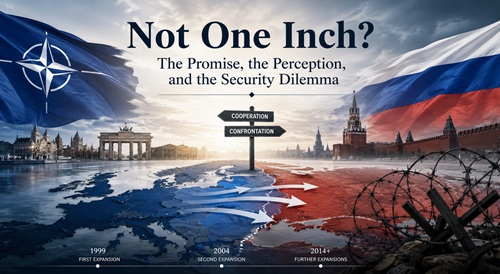 For more than three decades, one sentence has haunted relations between Russia and the West: "Not one inch eastward." Did the West promise the Soviet Union that NATO would never expand? Or is this a myth propagated by the Kremlin? The historical record suggests that both answers are incomplete. The famous phrase was indeed uttered during diplomatic discussions in early 1990. Yet it never became a formal treaty obligation, and it referred primarily to the stationing of NATO forces in what was then East Germany during German reunification. Later negotiations produced no legally binding commitment prohibiting NATO enlargement. On this narrow legal question, Western historians are largely correct. Yet focusing exclusively on the existence—or nonexistence—of a promise obscures the far larger geopolitical issue that has shaped Russian strategic thinking ever since: the transformation of Europe's balance of power. Understanding this distinction is essential if future European security is to rest on something firmer than competing historical myths. The Context of 1990When the Berlin Wall fell, Europe stood at an extraordinary crossroads. The Soviet Union still existed. The Warsaw Pact remained formally intact. No one seriously imagined that nearly every former Soviet satellite—and eventually several former Soviet republics—would join NATO. Negotiations therefore concentrated almost entirely on one practical question: How could a unified Germany remain inside NATO without threatening Soviet security? It was during these discussions that U.S. Secretary of State James Baker floated the famous "not one inch eastward" formulation. But diplomacy quickly moved beyond this wording. The final Two Plus Four Treaty contained no restriction on NATO enlargement beyond Germany itself. Legally speaking, the West kept the treaty it signed. Expectations Versus AgreementsHistory, however, is shaped as much by expectations as by legal texts. Many Soviet leaders believed they were witnessing the emergence of an entirely new European security architecture. The Cold War was ending. The Warsaw Pact would soon dissolve. Many assumed NATO itself would gradually transform into a broader political organization rather than continue expanding as the victorious military alliance. Even Western leaders frequently spoke about creating a "common European home." Those expectations proved mistaken. NATO survived. The Warsaw Pact disappeared. Russia lost its alliance system. NATO steadily incorporated the former members of that alliance. None of this violated international law. Yet it fundamentally altered Europe's strategic landscape. Three Waves That Changed EuropeThe geopolitical consequences came gradually. 1999Poland, Hungary and the Czech Republic entered NATO. These states had every reason to seek protection after decades of Soviet domination. From their perspective, membership represented liberation rather than provocation. From Moscow's perspective, however, NATO had crossed the former Cold War dividing line. 2004The second enlargement proved much more consequential. Seven additional countries joined, including Estonia, Latvia and Lithuania. For the first time NATO directly bordered Russia. The alliance also moved dramatically closer to St. Petersburg. Western policymakers viewed this as sovereign nations exercising free choice. Russian planners saw military geography. Subsequent enlargementsFurther expansion into Southeastern Europe reinforced a long-term trend. Whether individually significant or not, the cumulative effect was unmistakable: NATO had become Europe's dominant security architecture. Russia stood increasingly outside it. Security Is RelativeOne of international relations' oldest insights is that security is never absolute. Measures one state adopts for defensive purposes often appear offensive to another. Political scientists call this the security dilemma. The Eastern European states genuinely feared renewed Russian domination. Russia genuinely feared strategic encirclement. Both perceptions could coexist without either side acting irrationally. This is precisely what makes security dilemmas so dangerous. Each side increases its own security while unintentionally decreasing the other's. The result is an escalating spiral of mistrust. Why Russia Focuses on ExpansionWestern discussions often become trapped in a legal question: Was there a promise? Russian strategic thinking largely asks a different question: What happened to the military balance after the Cold War? From Moscow's perspective: • Russia withdrew from Eastern Europe. • Soviet military power collapsed. • NATO remained intact. • NATO expanded three times toward Russia. • Western military infrastructure moved steadily eastward. Whether this resulted from broken promises or sovereign choices is, strategically speaking, secondary. The observable shift in military geography is what matters. Great powers have historically reacted strongly when rival alliances approach their borders. The United States itself demonstrated this during the Cuban Missile Crisis. Recognizing this does not imply moral equivalence. It merely acknowledges a recurring feature of great-power politics. Why Eastern Europe Chose NATOAny balanced account must also acknowledge why enlargement occurred. It was not simply imposed by Washington. Countries such as Poland and the Baltic states actively sought membership. Their historical memory centered on occupations, invasions, and decades of Soviet domination. For them, NATO represented insurance against history repeating itself. To deny these countries agency would itself distort history. They were not passive pawns. They made deliberate strategic choices. Their security concerns were every bit as real as Russia's. The Tragedy of Mutual RationalityThis is the central irony. Eastern Europeans acted rationally. Russia reacted rationally. Western policymakers believed enlargement would stabilize Europe. Russian policymakers concluded that Europe was becoming less secure. Each side interpreted identical events through different historical experiences. The tragedy lies precisely here: Mutually understandable actions produced mutually reinforcing fears. Ukraine as the Breaking PointUkraine transformed this long-running tension into open confrontation. For Russia, NATO membership for Ukraine crossed a strategic threshold unlike previous enlargements. Ukraine is not simply another neighboring country. It occupies a central place in Russian history, identity and military geography. Western governments emphasized Ukraine's sovereign right to choose its alliances. Russia emphasized the strategic consequences of those choices. Neither argument cancelled the other. The collision became increasingly difficult to manage. Eventually diplomacy failed. War followed. Nothing in this observation justifies the invasion. It merely explains why Ukraine became qualitatively different from earlier rounds of enlargement. Understanding causation is not the same as assigning moral approval. Beyond the Broken-Promise DebateThe "Not One Inch" controversy has become something of a distraction. Supporters of NATO enlargement often argue: "There was no legally binding promise." Critics reply: "The West violated the spirit of what Soviet leaders believed they had been told." Both claims contain elements of truth. Yet neither addresses the deeper geopolitical reality. The decisive issue was not diplomatic wording. It was the transformation of Europe's post-Cold War balance of power. That transformation occurred regardless of whether one believes a promise was broken. Lessons for the FutureEurope's future security cannot be built upon competing historical narratives. Nor can it rest solely upon legal formalities while ignoring strategic perceptions. Three propositions should command broad agreement. First, sovereign states possess the right to choose their alliances. Second, great powers invariably react to major shifts in nearby military balances. Third, lasting peace requires acknowledging both principles simultaneously rather than pretending one eliminates the other. Ignoring sovereignty invites domination. Ignoring security perceptions invites confrontation. Stable diplomacy must accommodate both realities. Conclusion: History Without MythologyThe NATO enlargement debate has too often become polarized between legalism and propaganda. One side insists no promise existed. The other insists betrayal explains everything. History is rarely so simple. The documentary record does not establish a binding prohibition on NATO expansion. But neither does it support the notion that enlargement carried no strategic consequences for Russia. The Cold War ended without a comprehensive European security settlement acceptable to all major powers. Instead, one alliance expanded while another disappeared. Whether that outcome was inevitable remains debatable. Its geopolitical consequences, however, are undeniable. Recognizing this does not require endorsing Russian policy, nor rejecting the sovereignty of Eastern Europe. It requires only acknowledging an enduring truth of international politics: states respond not merely to intentions or legal documents, but to shifts in power, geography, and perceived vulnerability. The debate over "not one inch" may never be settled to everyone's satisfaction. The debate over Europe's security architecture, however, remains unfinished. And it is there—not in a single disputed phrase from 1990—that the real historical lesson lies.
Widget is loading comments...
|