|
TRANSLATE THIS ARTICLE
Integral World: Exploring Theories of Everything
An independent forum for a critical discussion of the integral philosophy of Ken Wilber
  Frank Visser, graduated as a psychologist of culture and religion, founded IntegralWorld in 1997. He worked as production manager for various publishing houses and as service manager for various internet companies and lives in Amsterdam. Books: Ken Wilber: Thought as Passion (SUNY, 2003), and The Corona Conspiracy: Combatting Disinformation about the Coronavirus (Kindle, 2020). Frank Visser, graduated as a psychologist of culture and religion, founded IntegralWorld in 1997. He worked as production manager for various publishing houses and as service manager for various internet companies and lives in Amsterdam. Books: Ken Wilber: Thought as Passion (SUNY, 2003), and The Corona Conspiracy: Combatting Disinformation about the Coronavirus (Kindle, 2020).
Check out my other conversations with ChatGPT The Return of Integral Mathematics?Bruce Alderman Revives One of Ken Wilber's Most Forgotten IdeasFrank Visser / ChatGPT
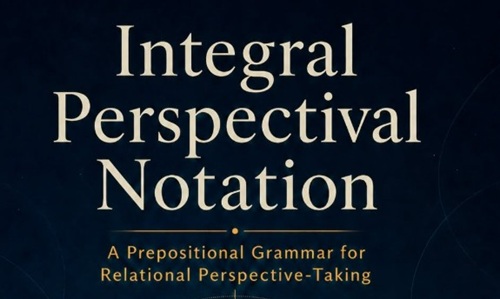 A Ghost from Integral Theory's PastAmong the many ambitious innovations introduced by Ken Wilber over the years, few have faded from view as completely as his "Integral Mathematics of Perspectives" (IMP). Unveiled in Integral Spirituality (2006), it was presented not as a curiosity but as a foundational advance—a symbolic language capable of expressing the relationships between perspectives with unprecedented precision. At the time, Wilber suggested that Integral Theory had reached a stage comparable to the invention of symbolic notation in mathematics or formal logic. The implication was clear: once this notation became widely adopted, integral discourse itself would become more rigorous. That future never arrived. Outside a small circle of enthusiasts, the notation quietly disappeared from view. Few authors employed it, almost no debates relied upon it, and it never developed into an active research program. Even within the Integral community, references to it became increasingly rare. Now Bruce Alderman has announced an attempt to revive—and substantially expand—the project.[1] The obvious question is: why now? From Perspectives to RelationsAlderman correctly identifies what he sees as a limitation of Wilber's original notation. While it could identify various perspectival positions, it had relatively little to say about how perspectives actually interact. His proposal introduces a richer vocabulary of relational operators, allowing one to symbolize influence, resonance, reciprocity, conflict, exclusion, emergence, integration, recursion, and other forms of interaction. Instead of merely indicating whose perspective is involved, the notation attempts to describe what happens between perspectives. Given today's concerns about polarization, dialogue, collective intelligence, and sensemaking, this is an understandable direction. Alderman argues that increasingly complex social realities require a correspondingly sophisticated grammar of relationships. It is an attractive aspiration. But does symbolic notation actually help? The Original Problem RemainsThe question confronting Alderman's project is essentially the same one that confronted Wilber's original effort. What problem does this notation solve that ordinary language does not? Consider Alderman's own illustrative examples. His symbolic expressions ultimately translate into statements such as: • Don't analyze someone while ignoring their lived experience. • Try to understand another person's perspective. • Enter into genuine mutual dialogue. These are perfectly intelligible ideas. The notation does not appear to make them clearer. If anything, the English translation is immediately more accessible than the symbolic expressions themselves. This points to a deeper issue. Mathematics—or Symbolic Shorthand?Mathematics succeeds because its symbols possess rigorous definitions and explicit rules of manipulation. Independent mathematicians applying the same rules arrive at the same conclusions. Wilber's perspectival notation never achieved that level of formalization. Its symbols resemble mathematical notation, but they function more like conceptual abbreviations. Bruce Alderman's additions raise the same question. Exactly what distinguishes "resonance" from "integration"? When does "co-presence" become "reciprocity"? Can different observers consistently code the same conversation and reach identical symbolic representations? Or are these operators simply labels for interpretive judgments? Without precise semantics and explicit inference rules, the notation risks remaining descriptive rather than analytical. It looks mathematical without actually functioning mathematically. Why Didn't Integral Mathematics Catch On?Looking back after nearly two decades, the historical verdict is difficult to ignore. If Integral Mathematics had fulfilled its promise, one might expect to find: • a growing body of published analyses employing the notation; • university courses teaching it; • software implementing it; • empirical studies comparing its usefulness with conventional approaches; • researchers extending and refining its formal properties. Instead, almost none of this occurred. The notation never escaped the relatively small Integral community, and even there it gradually faded from use. That suggests the obstacle was not merely a lack of relational operators. It may have been something more fundamental. Complexity Is Not Necessarily PrecisionIronically, expanding the notation may actually magnify its underlying weakness. Every new relational operator increases expressive power—but also interpretive flexibility. Influence, resonance, exclusion, conflict, emergence, recursion, integration... Each introduces another concept whose application requires human judgment. The notation becomes richer, but not necessarily more objective. One begins to wonder whether the symbolic language is simply reproducing the complexity of ordinary English in compressed graphical form. If every subtle social interaction requires its own operator, has one invented a formal language—or merely a symbolic thesaurus? A Worthwhile ExperimentNone of this means Alderman's project lacks value. As a heuristic device, a teaching aid, or a reflective practice for therapists, facilitators, coaches, and contemplative practitioners, it may prove genuinely useful. Having to explicitly identify different modes of relational engagement could sharpen awareness and improve dialogue. That is a perfectly respectable goal. But such usefulness differs from the stronger claim that this constitutes an emerging mathematical language of Integral Theory. The Real TestBruce Alderman deserves credit for revisiting one of Integral Theory's most neglected experiments instead of allowing it to disappear into history. His modifications are thoughtful and respond to genuine limitations in Wilber's original proposal. Yet the central question remains unchanged from 2006. Does this notation enable us to discover something we could not otherwise see? Can it produce analyses that are demonstrably more reliable, more rigorous, or more predictive than careful prose? Or does it simply translate familiar ideas into increasingly elaborate symbolic expressions? Nearly twenty years after Ken Wilber introduced Integral Mathematics, its relevance remains an open question. Alderman's revival may breathe new life into the project. Whether it can overcome the reasons the original never gained traction is another matter. That challenge lies not in inventing more symbols, but in demonstrating that the symbols genuinely increase understanding rather than merely giving it a more mathematical appearance. Appendix: Decoding Integral MathematicsFor readers unfamiliar with Ken Wilber's "Integral Mathematics of Perspectives" (IMP), a few examples may help illustrate both its ambition and its limitations. Wilber's notation attempts to symbolize not objects or quantities, but perspectives. The basic idea is deceptively simple: every act of knowing occurs from a particular point of view, and these points of view can themselves become objects of other perspectives. Thus, instead of merely saying "I see a tree," one can specify the perspectival structure involved. Some typical examples are: 1p - First-person perspective ("I") I experience my own thoughts or feelings. 2p - Second-person perspective ("You") I relate directly to another person. 3p - Third-person perspective ("It") I observe or analyze an object. Wilber then introduces nested expressions. 3p(1p) A third-person perspective applied to a first-person perspective. In plain English: Observing or analyzing someone else's subjective experience. A psychologist studying a patient's emotions might be described this way. 1p(3p) A first-person awareness of a third-person object. Simply: I observe a tree. Or: I look at a laboratory instrument. Things become increasingly elaborate. 3p(3p) An observer observing another observer. For example: A sociologist studying scientists. Or: A historian analyzing earlier historians. Wilber believed such expressions could systematically map increasingly complex acts of knowing. Bruce Alderman's examples go even further. For example, 3p(3-p) x 2p is glossed as someone objectifying another person while engaging them socially. He then proposes richer relational operators. Instead of merely stacking perspectives, he wants to distinguish relations such as: • influence • reciprocity • resonance • conflict • exclusion • integration • emergence Thus, 1p ↔ 2p might represent genuine mutual dialogue. While 3p ⊥ 1p might symbolize objectification that excludes subjective experience. These symbols certainly look more expressive than Wilber's original notation. But they also raise an obvious question. How precisely are these operators defined? In mathematics, symbols have exact meanings and explicit rules for combining them. Two mathematicians applying the same notation independently should arrive at the same result. Can the same be said here? Suppose two observers analyze the same difficult conversation. Would they independently agree that it exhibits "resonance" rather than "integration," or "conflict" rather than "mutual influence"? If not, the notation may function less like mathematics than like a specialized vocabulary for describing interpersonal dynamics. Perhaps the greatest irony of Integral Mathematics is that every symbolic expression ultimately requires translation back into ordinary English before its meaning becomes clear. That does not make the notation useless. It may serve as a valuable pedagogical device, encouraging people to become more aware of multiple perspectives and relational patterns. But after nearly twenty years, the burden of proof remains on its proponents to show that the notation adds analytical power rather than simply replacing familiar language with a more abstract symbolic code. In that respect, Integral Mathematics continues to occupy an ambiguous space somewhere between formal logic, conceptual shorthand, and philosophical aspiration. NOTES[1] Bruce Alderman, Post/Metaphysical Spirituality, Members-only Facebook group, April 29, 2026.
Widget is loading comments...
|