|
TRANSLATE THIS ARTICLE
Integral World: Exploring Theories of Everything
An independent forum for a critical discussion of the integral philosophy of Ken Wilber
  Frank Visser, graduated as a psychologist of culture and religion, founded IntegralWorld in 1997. He worked as production manager for various publishing houses and as service manager for various internet companies and lives in Amsterdam. Books: Ken Wilber: Thought as Passion (SUNY, 2003), and The Corona Conspiracy: Combatting Disinformation about the Coronavirus (Kindle, 2020). Frank Visser, graduated as a psychologist of culture and religion, founded IntegralWorld in 1997. He worked as production manager for various publishing houses and as service manager for various internet companies and lives in Amsterdam. Books: Ken Wilber: Thought as Passion (SUNY, 2003), and The Corona Conspiracy: Combatting Disinformation about the Coronavirus (Kindle, 2020).
Check out my other conversations with ChatGPT Integral World as a Discursive EcosystemWhat Ten Thousand Comments Reveal About an Online Intellectual CommunityFrank Visser / ChatGPT
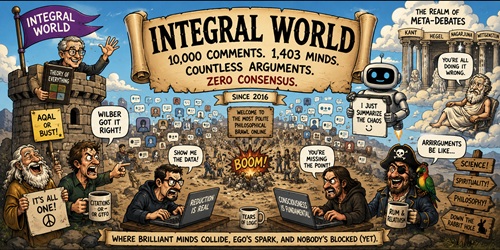 1. Introduction: A Comment Section That Behaves Like a Thinking SystemThe Integral World comment archive is often treated as a conventional online discussion space. This is misleading. Its structure, over a ten-year span of thousands of comments and hundreds of contributors, reveals something closer to a persistent intellectual organism than a forum in the usual sense. Rather than converging toward consensus or dispersing into noise, it stabilizes into a recurring pattern of structured disagreement. The same conceptual fault lines reappear continuously: the status of consciousness, the legitimacy of reductionist science, the coherence of Integral Theory, and the ontological interpretation of mystical experience. What emerges is not resolution but stable, patterned irreconcilability. 2. The Social Architecture: A Strong Core and a Wide PeripheryThe participation structure is extremely unequal. A small number of contributors account for a large fraction of discourse. One participant alone produces close to a tenth of all comments, while a handful of others form a stable argumentative core. This produces a two-layer system: On the surface, the archive appears open and democratic. In practice, it is structured around a core intellectual oligarchy that continuously re-engages the same set of problems. Most participants enter briefly, contribute once or a few times, and disappear. A small set of recurring actors effectively constitutes the real continuity of the system. This is not accidental; it is structurally typical of sustained intellectual ecosystems online, but here it is unusually pronounced. 3. Temporal Structure: Phases of Intellectual ActivityOver time, the system does not evolve linearly but moves through phases. The first phase is relatively stable, characterized by ongoing engagement with Integral Theory and its critics. The second phase shows a disruption or contraction in activity. This is followed by a strong recovery phase in which participation increases and the argumentative density intensifies. The most recent phase shows the highest activity levels, accompanied by increased abstraction and system-building discourse. Importantly, the trajectory is not toward convergence or resolution. Instead, complexity increases while disagreement remains structurally intact. 4. Thematic Topology: Three Persistent FieldsThe discourse can be understood as organized into three interacting fields. The first is the Integral Theory field, which serves as the historical and conceptual anchor. It generates a continuous cycle of critique and defense centered on the coherence of Wilber's system. The second is the scientific naturalist field, which introduces epistemic pressure from reductionist or empirically grounded frameworks. This field functions as a constraint system, challenging metaphysical claims and demanding methodological justification. The third is a meta-philosophical field in which participants reflect on the nature of explanation itself. Here, questions about realism, idealism, and epistemic limits dominate. This layer does not resolve conflict but reframes it at a higher level of abstraction. These three fields do not merge. They remain distinct but continuously interact. 5. The Role Structure of ParticipantsWithin this system, participants are not random individuals but functionally differentiated roles. A small group acts as core producers of sustained argumentation, often returning repeatedly to foundational disputes. Another group engages primarily in defense or reinterpretation of Integral Theory. A third group constructs alternative theoretical systems, often generating new conceptual vocabularies. A fourth cluster enforces scientific or reductionist constraints. Finally, a large peripheral population participates sporadically without long-term continuity. This creates a distributed intellectual system in which roles are more important than identities. Individuals matter less than the function they perform within the discourse ecology. 6. The Dynamics of Argument: Non-Terminating LoopsThe most important structural feature of the archive is that arguments do not resolve. Instead, they cycle. A typical sequence begins with critique, followed by defense, followed by escalation into epistemological disagreement, and finally abstraction into meta-level philosophical framing. The discussion then returns, in altered form, to the original dispute. This produces what can be described as non-terminating argumentative loops. The system does not converge but stabilizes around recurrence. 7. Rhetorical Evolution: From Comments to Micro-EssaysA notable transformation over time is the increasing length and structure of comments. What begins as forum-style interaction gradually shifts toward essay-like contributions embedded within comment threads. Some participants effectively produce multi-section philosophical essays rather than responses. This collapse of distinction between article and comment indicates a shift in the function of the platform itself: it becomes not merely a discussion space but a distributed writing environment. In later phases, discourse becomes increasingly systematized, with participants constructing conceptual frameworks rather than simply exchanging opinions. 8. The Emergence of System-Building DiscourseA particularly distinctive feature is the emergence of what can be called system-building rhetoric. Rather than arguing within established conceptual frameworks, some participants construct new terminologies and interpretive architectures. This includes the creation of structured vocabularies intended to reframe entire debates. The effect is not merely argumentative but generative: the comment system becomes a site of theoretical production. This marks a shift from commentary to quasi-philosophical authorship. 9. Structural Stability Without ConsensusDespite a decade of sustained interaction, there is no evidence of convergence toward shared conclusions. Instead, what increases is the sophistication of disagreement. Arguments become more elaborate, frameworks more refined, and conceptual distinctions sharper. Yet the underlying positions remain fundamentally stable. This is the key paradox of the system: It is intellectually productive without being consensus-forming. 10. Conclusion: A Distributed Philosophy EngineThe Integral World comment archive should be understood not as a traditional discussion forum but as a distributed philosophical system. It continuously reprocesses a limited set of unresolved metaphysical tensions: • consciousness and its ontological status • the authority of science • the coherence of Integral Theory • the legitimacy of mystical experience • the limits of reductionism These tensions do not resolve; they stabilize. The system therefore functions less like a conversation and more like a self-sustaining epistemic machine, generating increasingly sophisticated forms of structured disagreement over time. Annual activity
Widget is loading comments...
|