|
TRANSLATE THIS ARTICLE
Integral World: Exploring Theories of Everything
An independent forum for a critical discussion of the integral philosophy of Ken Wilber
  Frank Visser, graduated as a psychologist of culture and religion, founded IntegralWorld in 1997. He worked as production manager for various publishing houses and as service manager for various internet companies and lives in Amsterdam. Books: Ken Wilber: Thought as Passion (SUNY, 2003), and The Corona Conspiracy: Combatting Disinformation about the Coronavirus (Kindle, 2020). Frank Visser, graduated as a psychologist of culture and religion, founded IntegralWorld in 1997. He worked as production manager for various publishing houses and as service manager for various internet companies and lives in Amsterdam. Books: Ken Wilber: Thought as Passion (SUNY, 2003), and The Corona Conspiracy: Combatting Disinformation about the Coronavirus (Kindle, 2020).
Check out my other conversations with ChatGPT Three Hard ProblemsWhy Every Major Theory of Mind Faces Its Own MysteryFrank Visser / ChatGPT
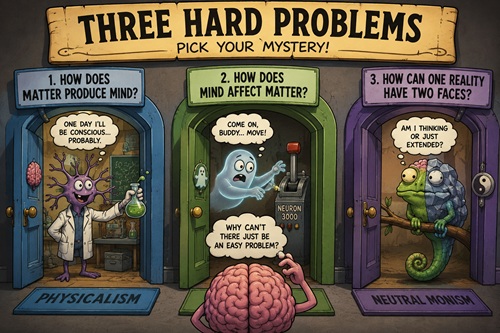 The so-called "hard problem of consciousness" has become one of the defining issues in contemporary philosophy of mind. Popularized by David Chalmers, it asks a deceptively simple question: How can physical processes in the brain give rise to subjective experience? How does electrochemical activity become the redness of red, the taste of coffee, or the feeling of pain? This challenge is often presented as a devastating problem for physicalism. If consciousness cannot be explained in purely physical terms, perhaps we need an entirely different metaphysics. But this framing can be misleading. Physicalism is not the only theory with an explanatory gap. Every major alternative inherits a hard problem of its own. Dualism must explain how mind and matter interact. Neutral monism must explain how a single neutral reality can manifest itself as two radically different domains. Instead of one hard problem, philosophy may actually face three. Hard Problem One: How Does Matter Produce Mind?Physicalism begins with an apparently straightforward assumption: everything that exists is ultimately physical. The brain is a physical organ, and consciousness somehow emerges from its activity. The mystery is that no one yet knows how. Neuroscience has become extraordinarily successful at identifying correlations between brain activity and conscious experience. Particular neural circuits are associated with visual perception, memory, emotion, and attention. Brain damage predictably alters consciousness. Anesthetics reliably switch consciousness off. Yet correlation is not explanation. Even if we could describe every neuron firing in exquisite detail, critics ask why these processes should be accompanied by subjective experience at all. Why isn't the brain merely an unconscious information processor? This is Chalmers' famous hard problem. Physicalists typically respond in several ways. Some argue that the explanatory gap reflects current scientific limitations rather than an ontological divide. Others suggest that consciousness will eventually be understood as an emergent property of sufficiently complex information processing. Still others question whether the hard problem is genuinely coherent. Nevertheless, the challenge remains formidable. Hard Problem Two: How Does Mind Affect Matter?Dualism appears to solve one problem by assuming that consciousness is fundamentally different from matter. Instead of trying to derive mind from brain, dualists regard mind as an independent substance or reality. Unfortunately, this immediately generates another puzzle. If mind and matter are fundamentally distinct, how can they influence one another? Everyday experience suggests constant interaction. We decide to raise an arm, and the arm moves. We stub a toe, and pain is experienced. Thoughts alter bodily behavior, while bodily events alter thoughts. But how? How can an immaterial mind exert force on physical neurons without violating physical laws? This interaction problem has haunted dualism since René Descartes. Descartes himself speculated that interaction occurred in the pineal gland, but merely identifying a location does not solve the conceptual difficulty. If mind lacks mass, energy, charge, or spatial extension, by what mechanism does it influence matter? Various solutions have been proposed. Some invoke divine coordination. Others appeal to psychophysical laws unknown to present science. Still others abandon causal interaction altogether in favor of parallelism. Each solution introduces new complications. The interaction problem is every bit as challenging as the hard problem facing physicalism. Hard Problem Three: How Can One Reality Have Two Faces?Neutral monism attempts to avoid both physicalism and dualism. Rather than beginning with matter or mind, it proposes that both emerge from a deeper, neutral reality that is neither mental nor physical. Versions of this idea have been defended by thinkers such as William James, Bertrand Russell, and, in different forms, Baruch Spinoza. At first glance this seems elegant. Instead of two fundamentally different substances interacting, there is only one underlying reality expressing itself in different ways. But a new explanatory gap immediately appears. How can one neutral reality become two apparently irreducible domains? If the underlying substance is genuinely neither mental nor physical, what determines whether it appears as consciousness in one context and matter in another? Why should one neutral essence possess these two radically different aspects at all? Simply introducing a mysterious third category does not automatically explain the relationship between the other two. Indeed, one might argue that neutral monism relocates the mystery rather than eliminating it. The hard problem becomes: What is this neutral reality, and how does it generate both subjective experience and objective matter? Trading MysteriesOne reason these debates persist is that each position solves one problem by creating another. Physicalism explains the unity of the physical universe but struggles to explain consciousness. Dualism preserves the uniqueness of consciousness but struggles to explain interaction. Neutral monism unifies mind and matter at a deeper level but struggles to explain differentiation. No position enjoys a monopoly on explanatory success. Nor does any position possess a monopoly on mystery. This observation is often forgotten in public discussions, where critics of physicalism sometimes imply that abandoning materialism immediately resolves the philosophical difficulties. It does not. Every metaphysical framework reaches a point where explanation gives way to fundamental assumptions. Science and MetaphysicsIt is also important to distinguish scientific questions from metaphysical ones. Neuroscience investigates how brain processes relate to cognition, perception, memory, and behavior. These are empirical questions that continue to yield remarkable discoveries. Whether those discoveries ultimately explain consciousness itself is a separate philosophical issue. Likewise, dualism and neutral monism are not scientific theories in the ordinary sense. They offer metaphysical interpretations of reality rather than experimentally testable models. This does not make them meaningless, but it does mean they operate under different standards of justification. A metaphysical theory should not merely relocate explanatory gaps while claiming victory over its competitors. Humility Before the UnknownThe philosophy of mind remains one of humanity's deepest intellectual frontiers. Perhaps consciousness will eventually receive a satisfying scientific explanation. Perhaps entirely new conceptual frameworks will emerge. Or perhaps some aspects of the relationship between mind and reality will remain permanently elusive. For now, intellectual honesty requires recognizing that all major positions confront profound explanatory challenges. Physicalism asks how matter becomes mind. Dualism asks how mind influences matter. Neutral monism asks how one neutral reality becomes both. These are not variations of the same puzzle. They are three distinct hard problems. Recognizing this broadens the debate. Instead of assuming that one theory alone bears the burden of explanation, we see that every comprehensive philosophy of mind must ultimately confront its own deepest mystery. Appendix: Idealism fares no better (mind creates body?)One way of reacting to the “Three Hard Problems” is to try to escape the entire triangle by flipping the direction of explanation. Instead of asking how physical processes give rise to mind, idealism proposes that mind is primary and that what we call “body” or “matter” is in some sense derivative—constructed, projected, or manifested within consciousness. At first sight, this looks like an elegant inversion. The explanatory burden seems to shift: instead of bridging a gap from matter to mind, we simply start with mind. But the apparent simplicity is deceptive, because the structural problem does not disappear; it is relocated. The first difficulty is the interaction problem in reverse form. If mind generates body, then we still need to explain why mental states exhibit the highly constrained, lawlike, and publicly stable behavior we associate with physical systems. Why does “mind” generate a world with persistent objects, conservation laws, and intersubjective agreement? The regularity of physical description is not something that dissolves simply by calling it “mental”; it becomes precisely what now demands explanation within the idealist framework. In classical dualism, mind and body are distinct and must interact. In idealism, there is only mind, but this “only” does not eliminate differentiation—it multiplies it. We now have to explain how a unitary or primordial consciousness gives rise to the structured appearance of spatial extension, causal closure, and resistant objecthood. The interaction problem becomes an internal-generation problem: how does mind generate its own apparent external constraints? The second difficulty is what might be called the stability problem. Physical reality is not merely a stream of private images; it is robustly shared, repeatable, and experimentally dependable. Idealism must therefore account for why different observers report consistent structures under controlled conditions. If everything is mind, why is there such stringent cross-perspectival invariance? Appeals to “collective mind,” “universal consciousness,” or “consensus reality” tend to restate the phenomenon rather than explain its mechanism. The invariance remains structurally unexplained. The third difficulty concerns explanatory economy. Idealism often presents itself as ontologically parsimonious: one substance instead of two. But this parsimony can be illusory if it reintroduces complexity at the level of mental architecture. To generate the full regularity of the physical world, idealism must posit highly structured forms of mind—rules, constraints, synchronization principles, and persistent object-generation mechanisms. The ontology becomes “one substance,” but functionally it risks becoming as elaborate as what it was supposed to replace. In this sense, idealism does not remove the explanatory burden; it internalizes it. The question “how does matter produce mind?” becomes “how does mind produce matter-like structure?” The direction of derivation changes, but the need for a generative account remains intact. There is also a conceptual inversion problem. In physicalism, consciousness is what must be accounted for within a world already described by spatiotemporal structure. In idealism, spatiotemporal structure is what must be accounted for within consciousness. But our explanatory tools—causality, lawfulness, structure—are themselves drawn from the very physical description that idealism is trying to derive. This creates a methodological tension: we use structure-laden concepts to explain the emergence of structure from something allegedly pre-structural. What emerges, across all three frameworks, is a symmetry of difficulty rather than a resolution. Dualism inherits the interaction problem. Physicalism inherits the hard problem of consciousness. Idealism inherits the hard problem of structure, stability, and intersubjectivity. Seen this way, idealism is not a solution to the hard problem; it is a relocation of the hard problem into the generative architecture of mind. The explanatory gap does not disappear when we reverse the direction of dependence. It simply reappears as the question of how mind, in whatever sense it is invoked, gives rise to the disciplined, persistent, and shared order we call the physical world.
Widget is loading comments...
|