|
TRANSLATE THIS ARTICLE
Integral World: Exploring Theories of Everything
An independent forum for a critical discussion of the integral philosophy of Ken Wilber
  Frank Visser, graduated as a psychologist of culture and religion, founded IntegralWorld in 1997. He worked as production manager for various publishing houses and as service manager for various internet companies and lives in Amsterdam. Books: Ken Wilber: Thought as Passion (SUNY, 2003), and The Corona Conspiracy: Combatting Disinformation about the Coronavirus (Kindle, 2020). Frank Visser, graduated as a psychologist of culture and religion, founded IntegralWorld in 1997. He worked as production manager for various publishing houses and as service manager for various internet companies and lives in Amsterdam. Books: Ken Wilber: Thought as Passion (SUNY, 2003), and The Corona Conspiracy: Combatting Disinformation about the Coronavirus (Kindle, 2020).
Check out my other conversations with ChatGPT Why 'Primitive' Life Still ExistsEvolution, Persistence, and the Myth of Biological ReplacementFrank Visser / ChatGPT
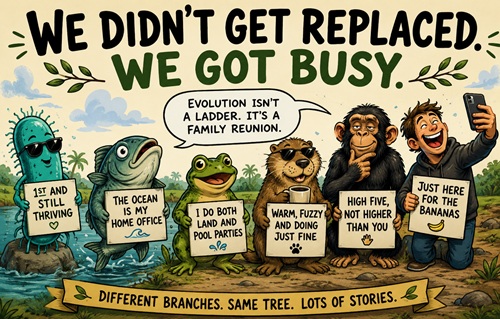 The Ladder Fallacy: Why Evolution Is Not Progress in a Straight LineA persistent misunderstanding of evolution treats it as a progressive ladder: bacteria → fish → amphibians → mammals → humans. On this picture, older forms should disappear once “higher” forms emerge. Since that clearly has not happened, people sometimes suspect a flaw in evolutionary theory. The problem is that this model misrepresents what evolution actually is. Evolution is not a linear ascent but a branching process of diversification. Lineages split, adapt to different conditions, and continue in parallel. There is no biological mechanism that systematically eliminates earlier forms simply because later ones appear. Bacteria: Not Primitive Survivors but Evolutionary PowerhousesBacteria are often mistakenly treated as evolutionary leftovers. In reality, they are among the most successful organisms on Earth by nearly every metric: population size, biomass, ecological reach, and metabolic diversity. Their persistence is not despite evolution but because of it. Their simple cellular organization is extremely adaptable and efficient across a vast range of environments. The rise of complex multicellular life did not displace bacteria; it created new ecological layers that bacteria colonized and integrated into, often as symbionts, decomposers, or pathogens. Fish and Amphibians: Niche Expansion, Not ReplacementFish did not disappear when vertebrates began colonizing land. The oceans remain the largest habitable environment on Earth, and fish remain exceptionally well adapted to it. Terrestrial evolution did not render aquatic life obsolete; it opened a new domain of ecological opportunity. Amphibians illustrate the same principle of ecological specialization. Their dual dependence on aquatic and terrestrial environments places constraints on their physiology, but those constraints are not evolutionary failures. They define a niche in which amphibians remain competitive—particularly in moist or transitional habitats where other vertebrates are less efficient. Mammals, Reptiles, and Birds: Parallel Radiations, Not Successive ErasuresMammals did not replace reptiles; they diversified alongside them after branching from a common ancestor. Reptiles continue to dominate many ecological roles, and birds—phylogenetically reptiles—represent one of the most successful vertebrate groups on the planet. Evolution does not operate by clearing earlier designs from the system. Instead, it generates multiple solutions to different environmental problems, many of which remain stable over vast timescales. Apes and Humans: One Branch Among ManyApes are not an endpoint of evolution but one branch within the primate lineage. Humans are a further subdivision of that branch. The survival and continued diversification of non-human primates, along with countless other mammals, demonstrates again that evolution does not converge toward a single privileged form. There is no biological principle that designates humans—or any organism—as the “goal” of evolution. There are only adaptations to specific ecological contexts. Why Older Forms Persist: Stability, Not FailureThe persistence of ancient lineages is best understood through ecological stability and evolutionary trade-offs. Once a species is well adapted to a stable niche, strong directional change is not necessarily favored. Instead, stabilizing selection maintains existing traits. This is why so many lineages show long periods of morphological continuity. Change does occur continuously at the genetic level, but it does not always translate into large-scale anatomical shifts. In many cases, remaining “the same” is the most successful evolutionary strategy available. Is Evolution the Exception to Stasis?If stasis is understood as long-term morphological stability, then it is actually the most common visible outcome of evolution. What appears as “no change” is often a state of equilibrium between organism and environment. However, evolution itself is never absent. Genetic variation, selection, drift, and gene flow continue constantly. What varies is whether these processes accumulate into visible morphological transformation or remain buffered by stabilizing selection. In this sense, stasis is not opposed to evolution. It is one of its typical expressions. Conclusion: A Branching Tree, Not a Discarded LadderEvolution does not replace older life forms with newer ones. It generates a branching tree in which most lineages persist, adapt, or stabilize in parallel. The existence of bacteria alongside mammals, or fish alongside amphibians, is not a challenge to evolution—it is one of its most direct predictions. Life does not move upward by discarding its past. It expands by retaining it. Appendix: Is there, or is there not, an evolutionary drive?This question goes to the heart of the disagreement between teleological and Darwinian views of evolution. Ken Wilber argues that evolution is propelled by an intrinsic drive—often called Eros—that pushes life toward greater complexity, consciousness, and spiritual realization. Mainstream evolutionary biology rejects any such built-in directionality. Evolution, it says, has no goal, no foresight, and no cosmic ambition. Interestingly, both views face a question—but only one faces a serious explanatory problem. The Problem for ErosSuppose there really is a universal evolutionary drive urging organisms toward higher complexity. Why, then, has that drive left most of life behind? After nearly four billion years, bacteria still constitute a massive proportion of Earth's biomass. Fish still dominate aquatic ecosystems. Insects remain the most diverse animal group. Even among mammals, humans are a tiny twig on the evolutionary tree. If Eros genuinely exerts a universal upward pull, why is virtually the entire biosphere not rushing in the same direction? One could reply that different lineages evolve at different speeds. But that merely postpones the question. Why would a universal force produce such overwhelmingly unequal outcomes? Why would it propel one lineage toward self-awareness while billions of others remain evolutionarily stable for hundreds of millions or even billions of years? The empirical pattern looks far less like a universal ascent than a patchwork of local adaptations. The Scientific View: No Drive Is NeededDarwinian evolution begins with a very different premise. There is no force pushing organisms toward complexity. There are only variation, inheritance, and natural selection operating in changing environments. Most mutations are neutral or harmful. Occasionally, one provides a reproductive advantage under particular ecological conditions. Those variants become more common, and populations gradually change. No organism is trying to become more complex. Complexity emerges only when it happens to improve reproductive success. Equally important, complexity is not inevitable. Many organisms become simpler over evolutionary time. Parasites frequently lose organs and metabolic pathways because simpler bodies are more efficient for their lifestyles. Evolution has no preference for "higher"; it favors whatever works. Why Did Anything Evolve at All?Critics sometimes ask: if there is no evolutionary drive, why did evolution occur in the first place? The answer is surprisingly straightforward. Because perfect replication does not exist. Every generation introduces genetic variation through mutation and recombination. Environments continually change. Organisms compete for limited resources. Those simple facts guarantee that some variants reproduce more successfully than others. Evolution is therefore not something that must be added to biology. It is the inevitable statistical consequence of imperfect inheritance combined with differential reproduction. No cosmic striving is required. Stability Requires No Special ExplanationIronically, the persistence of bacteria, fish, amphibians, and countless other ancient lineages fits the Darwinian model better than the teleological one. If there is no built-in pressure toward increasing complexity, then long-term stability is exactly what we should expect whenever organisms are already well adapted to their environments. Evolutionary change occurs when ecological circumstances favor it. Evolutionary stasis occurs when they do not. Both outcomes follow naturally from the same underlying process. A Useful ContrastThe contrast can be summarized in a single question: • If evolution is driven by an intrinsic cosmic impulse toward greater complexity, why has that impulse affected only a tiny fraction of life? • If evolution has no intrinsic direction, why has complexity appeared at all? Because local conditions sometimes rewarded it—but only where it happened to confer an advantage. The Darwinian answer is modest but remarkably successful. It explains both change and stability using the same natural mechanisms. Wilber's Eros, by contrast, seems capable of explaining the appearance of complexity, but struggles to explain the overwhelming persistence of simplicity. If a universal force is pulling life upward, the tree of life looks surprisingly content to keep most of its branches exactly where they are.
Widget is loading comments...
|