|
TRANSLATE THIS ARTICLE
Integral World: Exploring Theories of Everything
An independent forum for a critical discussion of the integral philosophy of Ken Wilber
  Frank Visser, graduated as a psychologist of culture and religion, founded IntegralWorld in 1997. He worked as production manager for various publishing houses and as service manager for various internet companies and lives in Amsterdam. Books: Ken Wilber: Thought as Passion (SUNY, 2003), and The Corona Conspiracy: Combatting Disinformation about the Coronavirus (Kindle, 2020). Frank Visser, graduated as a psychologist of culture and religion, founded IntegralWorld in 1997. He worked as production manager for various publishing houses and as service manager for various internet companies and lives in Amsterdam. Books: Ken Wilber: Thought as Passion (SUNY, 2003), and The Corona Conspiracy: Combatting Disinformation about the Coronavirus (Kindle, 2020).
Check out my other conversations with ChatGPT Mystical OnenessExperience, Interpretation, and the Problem of Metaphysical InflationFrank Visser / ChatGPT
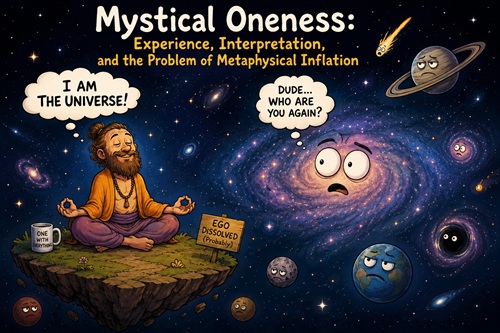 Mystical reports of “oneness with the universe” are among the most persistent cross-cultural claims in religious history, yet they are also among the most interpretively overloaded. The central issue is not whether such experiences occur, but what exactly they are experiences of, and how quickly they get translated into metaphysical conclusions. A disciplined analysis has to separate phenomenology (what is reported) from ontology (what is claimed about reality) and also from the cultural-linguistic frameworks that mediate interpretation. The ambiguity of “oneness”When mystics describe “oneness,” the term rarely refers to a clearly defined metaphysical identity claim in the literal sense of numerical identity with the cosmos. Instead, it typically points to a collapse or attenuation of ordinary subject-object structuring. The usual cognitive architecture that distinguishes “me here” from “world out there” becomes less salient or temporarily absent. This produces a phenomenological state that can be described in several ways depending on the conceptual resources available: undifferentiated awareness, non-dual awareness, ego dissolution, or immersive unity. None of these phrases is neutral. Each already begins to interpret the experience. Crucially, “oneness” is therefore not a description of the universe having been inspected and found to be metaphysically singular in the sense of identity theory. It is a report about a change in how differentiation is experienced. What did “the universe” even mean historically?A key source of confusion is anachronism. When medieval or ancient mystics speak of “the universe,” they are not referring to a post-Copernican, post-Hubble, cosmologically expanded universe populated by billions of galaxies. Their cosmology was typically hierarchical, finite, and often geocentric or spiritually stratified. So when a Neoplatonist, Sufi, or Vedantic writer says “all is One,” the referent of “all” is already conceptually bounded by the cosmology of the time. It is often closer to “all levels of being in this metaphysical schema” than to the modern physical universe as understood by astrophysics. This matters because modern readers routinely re-project contemporary cosmological magnitude back into these texts, producing a rhetorical inflation: a small, human-scale cosmology gets retrofitted into an infinite physical universe, making the claims sound far more empirically sweeping than they originally were. Experience versus interpretationA useful distinction is between raw phenomenological content and its subsequent interpretation. The experiential core in many reported mystical states appears to include: • Reduced or absent ego-boundary salience • Altered sense of time (timelessness or expansion) • Heightened affect (bliss, peace, awe, or neutrality) • Reduced conceptual differentiation between self and environment None of these features, taken individually or jointly, entails metaphysical conclusions such as “I am identical with the cosmos” or “the universe is a single mind.” Those are interpretive overlays. Interpretation begins immediately because the human cognitive system is not passive. It classifies, narrativizes, and integrates anomalous states into pre-existing belief systems. In a Christian context, the same experience becomes union with God. In Advaita Vedanta, it becomes realization of Atman-Brahman identity. In Buddhist frameworks, it becomes insight into emptiness and non-self. The experience may be similar in structure; the ontological claims diverge sharply. Why “oneness” feels like identityOne reason identity-language emerges is that the brain relies heavily on self-modeling. The “self” is not a simple object but a dynamic model constructed to coordinate perception, memory, and action. If that model relaxes or becomes less dominant, the boundary between self-model and world-model becomes less rigid. From the inside, this can feel like: • “I have expanded into everything” • “Everything is me” • “There is only consciousness” But these are metaphorical descriptions of boundary dissolution, not logically necessary conclusions. The mind is translating a reduction in segmentation into a positive statement of identity. This is similar to how loss of visual contrast might be described as “everything is white,” even though what is really happening is a breakdown of discriminative detail. Competing explanations of the same reportsSeveral explanatory frameworks can account for mystical “oneness” without assuming metaphysical identity claims. One approach is neurocognitive: altered activity in brain networks responsible for self-referential processing (often associated with the default mode network) can reduce autobiographical self-modeling, leading to diminished ego boundaries and increased global integration of perception. Another approach is phenomenological: certain meditative or contemplative practices systematically deconstruct habitual conceptual distinctions, producing stable non-dual awareness states that are experientially coherent but not necessarily ontologically informative. A third approach is constructivist: the experience is real as experience, but its meaning is socially and linguistically constructed after the fact. Religious traditions supply ready-made interpretive schemas that stabilize and valorize the experience. None of these explanations denies the occurrence of the experiences. They challenge the inference from experience to metaphysics. The problem of interpretive inflationThe danger you are pointing to—what can reasonably be called interpretive inflation—occurs when modest phenomenological shifts are re-described as cosmic revelations. The inflation typically follows a pattern: • A destabilization of ordinary self-experience occurs • The subject interprets it through available metaphysical language • The interpretation is retrospectively treated as insight into ultimate reality • The experiential ambiguity is lost, replaced by doctrinal certainty This is especially pronounced in traditions that valorize mystical authority. The experiential ambiguity that makes the state interesting is replaced by epistemic overreach: the claim that the experience discloses the fundamental structure of reality. What “oneness” can responsibly meanIf we strip away metaphysical extrapolation, “oneness” can be more carefully interpreted in at least three defensible ways: • First, as a phenomenological description of reduced subject-object partitioning. • Second, as an epistemic event in which representational structures temporarily lose dominance, allowing non-conceptual awareness to be foregrounded. • Third, as a psychological state of high integrative coherence, where sensory, affective, and cognitive processes are less fragmented. None of these requires the conclusion that the self is literally identical with the universe. That step is optional, not entailed. ConclusionMystical “oneness” is best understood as a real but interpretable shift in consciousness, not as direct metaphysical testimony. The experience appears to involve a relaxation of the cognitive boundaries that normally structure selfhood and worldhood. The leap from that relaxation to claims about ultimate reality is where interpretation overtakes description. The historical cosmology of mystics, the structure of human self-modeling, and the cultural availability of metaphysical narratives all contribute to why “oneness” so easily becomes “identity with the universe.” The philosophical discipline required is to resist collapsing experience into ontology, and to preserve the distinction between what is given in consciousness and what is later inferred about reality.
Widget is loading comments...
|