|
TRANSLATE THIS ARTICLE
Integral World: Exploring Theories of Everything
An independent forum for a critical discussion of the integral philosophy of Ken Wilber
  Frank Visser, graduated as a psychologist of culture and religion, founded IntegralWorld in 1997. He worked as production manager for various publishing houses and as service manager for various internet companies and lives in Amsterdam. Books: Ken Wilber: Thought as Passion (SUNY, 2003), and The Corona Conspiracy: Combatting Disinformation about the Coronavirus (Kindle, 2020). Frank Visser, graduated as a psychologist of culture and religion, founded IntegralWorld in 1997. He worked as production manager for various publishing houses and as service manager for various internet companies and lives in Amsterdam. Books: Ken Wilber: Thought as Passion (SUNY, 2003), and The Corona Conspiracy: Combatting Disinformation about the Coronavirus (Kindle, 2020).
Check out my other conversations with ChatGPT The Closed Loop of Integral DiscourseAuthority, Silence, and the Erosion of Critical ExchangeFrank Visser / ChatGPT
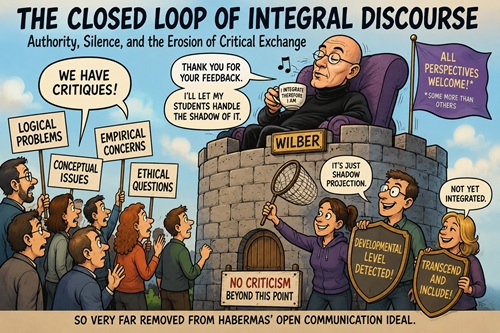 The Structural Absence of ReplyA recurring feature of the intellectual culture surrounding Ken Wilber's Integral Theory is not simply that it attracts criticism, but that it rarely metabolizes it through direct engagement from its originator. Wilber's long-standing pattern of not systematically responding to sustained critical arguments has had consequences beyond biography or temperament. It has shaped a discourse environment in which interpretive authority is effectively decentralized downward, to students, admirers, and informal gatekeepers who then become responsible for defending, translating, or policing the framework. In any theory that aspires to philosophical or quasi-scientific seriousness, the absence of reciprocal critique from its central author produces an asymmetry: arguments enter the system, but do not necessarily re-enter as revised positions, clarifications, or concessions. They instead circulate as fragments to be managed. Over time, this creates a kind of epistemic stasis, where critique becomes ambient noise rather than a catalyst for revision. From Dialogue to Defensive HermeneuticsIn a more conventional academic setting, criticism is not a threat to a theory's identity but part of its evolution. It is expected that foundational claims will be tested, reformulated, or abandoned in response to objections. In the integral ecosystem, however, criticism is often reclassified into psychological or developmental categories: misunderstanding, partial perspective, reductionism, or unintegrated “shadow material.” This shift is not merely rhetorical; it changes the function of disagreement. Instead of serving as an epistemic corrective, critique becomes a diagnostic signal about the critic. The result is a hermeneutic reversal: arguments are not primarily evaluated on their validity, but on the perceived developmental altitude or psychological integration of the person making them. That move protects the system from falsification while simultaneously lowering the incentive to engage in detailed rebuttal. The unintended effect is that students and secondary interpreters inherit a defensive posture. Without authoritative engagement from the source, they must stabilize the system themselves, often by converting epistemic critique into psychological framing. Shadow Language as a Substitute for ArgumentA particularly distinctive feature of this intellectual climate is the frequent invocation of “shadow” as a meta-explanatory device. In its clinical Jungian sense, shadow refers to disowned psychological content. In integral discourse, however, it often functions as a generalized dismissal category for external critique that is not easily assimilated. When criticism is labeled as shadow projection, the need to analyze its internal structure is reduced. The argument is no longer something to be answered; it is something to be “seen through.” This produces a subtle but significant epistemic inversion: instead of confronting the content of critique, the system reclassifies it as symptomatic of the critic's developmental limitations. This is not inherently illegitimate as a psychological observation, but its overextension into epistemology creates insulation. A framework that can indefinitely re-describe disagreement as psychological immaturity becomes increasingly resistant to falsification, not by argument, but by categorization. Habermas and the Missing Ideal of Rational DiscourseThe contrast with Jürgen Habermas' theory of communicative rationality is instructive. For Jürgen Habermas, the legitimacy of discourse depends on conditions of openness, symmetry, and the willingness of participants to revise claims in light of better arguments. Validity emerges through what he calls the “force of the better argument,” not through authority, charisma, or interpretive hierarchy. Within that framework, any systematic refusal to engage counterarguments would be a breakdown of communicative rationality. Not because disagreement is absent, but because the procedural conditions that allow disagreement to matter are weakened. If one participant in a discourse structure is not meaningfully revisable in response to critique, the symmetry condition is violated. The integral situation therefore appears structurally misaligned with this ideal. It is not simply that disagreement exists; it is that disagreement does not reliably feed back into the modification of central claims. Instead, it is redistributed into interpretive communities tasked with preserving coherence. The Emergence of a Distributed OrthodoxyWhen a central theorist does not act as a responsive node in the argumentative network, interpretive responsibility diffuses outward. Students become custodians. Blogs become informal tribunals. Online forums become arenas where doctrinal stability is negotiated rather than tested. This produces what might be called a distributed orthodoxy without a responsive center. Orthodoxy here does not mean institutional dogma in a formal sense, but a pattern of interpretive convergence maintained through repetition, framing, and boundary policing rather than through ongoing argumentative revision. The paradox is that Integral Theory often presents itself as post-dogmatic, pluralistic, and integrative. Yet in practice, the absence of a robust critical feedback loop can generate the opposite effect: a system that integrates difference conceptually while neutralizing it dialogically. The Cost of Non-ResponseThe deeper cost of this structure is not that critics remain unconvinced, but that the theory itself loses opportunities for internal refinement. Non-response is not neutral. It silently selects for interpretations that are compatible with existing commitments and filters out those that would require structural revision. Over time, this leads to intellectual entrenchment without explicit closure. The system appears open—because it can incorporate almost anything at the level of interpretation—but is effectively closed at the level of revision. The result is an intellectual climate where critique is omnipresent but structurally underpowered, and where defenders are incentivized to translate disagreement into psychological or developmental categories rather than argumentative engagement. Conclusion: Communication Without ReciprocityThe core issue is not disagreement between Wilber and his critics. Disagreement is the normal condition of philosophy. The issue is the asymmetry of response, and the compensatory interpretive practices that arise in its absence. In Habermasian terms, one might say that the conditions for undistorted communication are only partially met: speech acts occur, interpretations proliferate, and consensus language is available, but the recursive obligation to justify, revise, or concede is inconsistently activated. An intellectual system can survive such conditions for a long time. But it does so at a cost: it gradually shifts from a dialogical structure into an interpretive ecology, where meaning is managed more than it is tested.
Widget is loading comments...
|