|
TRANSLATE THIS ARTICLE
Integral World: Exploring Theories of Everything
An independent forum for a critical discussion of the integral philosophy of Ken Wilber
  Frank Visser, graduated as a psychologist of culture and religion, founded IntegralWorld in 1997. He worked as production manager for various publishing houses and as service manager for various internet companies and lives in Amsterdam. Books: Ken Wilber: Thought as Passion (SUNY, 2003), and The Corona Conspiracy: Combatting Disinformation about the Coronavirus (Kindle, 2020). Frank Visser, graduated as a psychologist of culture and religion, founded IntegralWorld in 1997. He worked as production manager for various publishing houses and as service manager for various internet companies and lives in Amsterdam. Books: Ken Wilber: Thought as Passion (SUNY, 2003), and The Corona Conspiracy: Combatting Disinformation about the Coronavirus (Kindle, 2020).
Check out my other conversations with ChatGPT The Myth of the Third EyeMeditation, Knowledge, and the Limits of Wilber's 'Three Eyes' DoctrineFrank Visser / ChatGPT
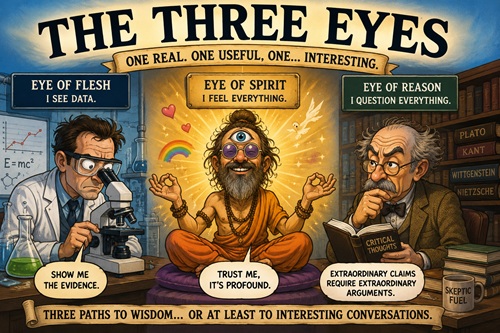 IntroductionOne of Ken Wilber's most influential philosophical ideas is his doctrine of the "Three Eyes of Knowing." Drawing inspiration from the medieval theologian St. Bonaventure, Wilber distinguishes between three modes of cognition: the Eye of Flesh, the Eye of Reason, and the Eye of Spirit. The Eye of Flesh apprehends the material world through the senses. The Eye of Reason grasps conceptual truths through logic and rational analysis. The Eye of Spirit, cultivated through contemplative practice, is said to disclose transcendent spiritual realities directly. This elegant framework has become a cornerstone of Integral Theory. It allows Wilber to argue that science, philosophy, and spirituality each possess their own legitimate methods of inquiry, their own domains of investigation, and their own criteria of validation. Science studies the sensory world, philosophy studies the world of ideas, and meditation studies the spiritual dimension. The appeal of this model is obvious. It appears to reconcile scientific naturalism with mystical religion without forcing either to surrender its claims. Yet the harmony is achieved only by granting meditation an epistemic status that deserves much closer examination. Does meditation actually provide knowledge comparable to that produced by science and philosophy, or does it provide something fundamentally different? The Eye of Flesh: Public KnowledgeThe first eye corresponds to empirical science. Through systematic observation, careful measurement, controlled experimentation, and continual criticism, science builds increasingly reliable models of the physical world. Scientific knowledge is often described as objective, but this objectivity does not arise because individual scientists are free from bias. Rather, it emerges through a social process. Experimental results must be independently replicated, competing explanations are debated, and findings are scrutinized by the wider scientific community before they become accepted. Community confirmation is therefore not an optional extra but an essential component of scientific knowledge. Individual observations become science only after surviving collective examination. Science is, in this sense, both empirical and communal. The Eye of Reason: Conceptual UnderstandingReason occupies a different but equally indispensable place. Mathematics, logic, and philosophy do not primarily depend on sensory observation but on conceptual analysis. They evaluate arguments, clarify concepts, identify contradictions, and construct coherent explanatory frameworks. Like science, philosophy is also profoundly communal. Philosophical arguments gain authority not through private insight but through public criticism. Every argument invites objections, counterarguments, refinements, and revisions. Even the greatest philosophers remain subject to continuing debate. Reason therefore differs from both perception and mystical experience because its conclusions are open to inspection by anyone capable of following the argument. The Alleged Eye of SpiritThe controversy begins with Wilber's third eye. According to Integral Theory, contemplative disciplines constitute a genuine method of inquiry comparable to scientific investigation. Just as microscopes reveal bacteria invisible to ordinary sight, meditation supposedly reveals dimensions of reality inaccessible to the ordinary mind. Wilber often describes meditation as an experimental discipline. The contemplative follows prescribed practices, undergoes specific experiences, and eventually arrives at direct insight into spiritual reality. The reports of mystics from different traditions are taken as evidence that these experiences disclose an objective domain rather than merely subjective states. Like science, Wilber argues, mysticism also involves community confirmation. One does not simply meditate for a week and declare oneself enlightened. Experienced teachers evaluate students, contemplative traditions compare reports, and communities develop shared descriptions of advanced realization. Spiritual traditions therefore possess their own forms of peer review. This parallel with science is one of the strongest aspects of Wilber's argument. Yet it is also where the analogy begins to weaken. Community Confirmation Is Not the Same as Public VerificationScience certainly depends on trained observers. A particle physicist is far better equipped than a layperson to interpret data from a particle accelerator. Likewise, experienced meditators may recognize subtleties of consciousness that beginners overlook. But there remains a crucial difference. Scientific observations eventually generate evidence that becomes publicly accessible. Other laboratories can repeat experiments. Instruments record measurable data. Competing theories make predictions that can be tested independently of the beliefs of those performing the experiment. Meditative experience, by contrast, remains private. A meditation teacher may judge whether a student's descriptions resemble traditional accounts, but no one can directly inspect another person's experience. Confirmation occurs through comparison of reports rather than through independent observation of the phenomenon itself. The contemplative community therefore validates narratives about experience, not the external reality supposedly disclosed by those experiences. Experience Does Not Establish OntologyThis distinction is easily overlooked because mystical experiences are often extraordinarily compelling. Those who undergo them frequently describe them as more real than ordinary perception itself. Yet the intensity of an experience tells us little about its ontological significance. Dreams can feel entirely real while they last. Psychedelic experiences often produce overwhelming certainty. Near-death experiences profoundly transform people's lives. Hallucinations can possess remarkable vividness. None of these examples automatically demonstrates that the perceived objects exist independently of consciousness. Meditation undoubtedly changes consciousness, sometimes dramatically. The critical question is whether altered consciousness provides access to hidden features of reality or merely reveals new aspects of the mind itself. The experience alone cannot answer that question. The Problem of InterpretationMystics frequently claim remarkable agreement across cultures, but the historical record presents a more complicated picture. Christian contemplatives encounter God. Advaita Vedantins realize Brahman. Buddhists describe emptiness or Buddha Nature. Sufi mystics speak of union with the Divine. Some report infinite love, others pure awareness, still others absolute nothingness. Integral Theory responds by arguing that these differences are largely matters of interpretation imposed upon a common experiential core. Perhaps so. But this merely shifts the problem. The claim that all mystics share the same underlying realization is itself an interpretation. It cannot simply be read off the experiences themselves. Indeed, if mystical reports require interpretation before they can support metaphysical conclusions, then the alleged directness of the Eye of Spirit begins to disappear. Meditation as Refined IntrospectionA more modest understanding of meditation avoids these difficulties. Meditation undoubtedly provides knowledge. It reveals habits of attention, emotional reactivity, patterns of thought, and the construction of the sense of self. Long-term practitioners often develop extraordinary introspective sensitivity. This is genuine knowledge, but it is first-person knowledge. It concerns the structure of conscious experience rather than the structure of the cosmos. There is nothing trivial about such knowledge. Understanding how anger arises, how craving operates, or how identification with thoughts can soften represents valuable psychological insight. Increasingly, these observations find support from psychology and neuroscience. But none of them requires positing a separate spiritual realm. From Phenomenology to MetaphysicsThe central weakness of the Three Eyes doctrine lies in a philosophical transition that often passes unnoticed. Meditation reveals certain features of experience. From this, Wilber concludes that meditation also reveals the ultimate nature of reality. This is a much larger claim. It moves from phenomenology—the study of experience—to ontology—the study of what ultimately exists. That transition requires argument, not merely experience. One may experience profound unity with all existence without thereby demonstrating that the universe is metaphysically nondual. One may experience timeless awareness without proving that time itself is illusory. Such conclusions remain philosophical interpretations rather than direct perceptions. The Appeal of the Third EyeThe enduring attraction of Wilber's doctrine is understandable. It offers spiritual practitioners something they naturally desire: reassurance that their deepest experiences are not merely psychologically meaningful but cognitively authoritative. It promises that meditation is not simply therapeutic but revelatory. Moreover, the doctrine places spirituality alongside science and philosophy as an equal partner in humanity's search for truth. This vision is intellectually generous and culturally attractive. Its weakness is that it grants contemplative experience an epistemic authority that exceeds what the evidence can support. ConclusionWilber's doctrine of the Three Eyes remains one of the most sophisticated attempts to integrate science, philosophy, and spirituality. It correctly recognizes that different forms of inquiry employ different methods, and it rightly emphasizes that contemplative traditions possess disciplined practices, standards of training, and communities capable of evaluating practitioners. In that limited sense, meditation is not simply a private hobby but a structured human practice. Yet the similarities with science should not obscure the decisive differences. Scientific communities validate claims by producing publicly accessible evidence that can be independently tested. Contemplative communities validate the consistency and authenticity of subjective reports, but they cannot independently verify the metaphysical realities those reports are taken to disclose. Meditation is therefore best understood as a disciplined method of investigating consciousness rather than as an independent faculty for perceiving the ultimate structure of reality. It yields genuine knowledge, but primarily knowledge of experience itself. The leap from transformed consciousness to cosmic ontology remains a philosophical inference, not a direct perception. The Eye of Spirit, then, is better conceived not as a third organ of knowledge standing alongside perception and reason, but as a refined capacity for introspection. Its insights into the human mind may be profound, even life-changing, without requiring us to conclude that meditation opens a privileged window onto the metaphysical architecture of the universe. Appendix: The Eye of Spirit and the Spiritualization of EvolutionOne of the most consequential applications of Wilber's Eye of Spirit doctrine concerns his interpretation of evolution. According to Wilber, evolution is not merely a biological process driven by mutation, selection, genetic drift, developmental constraints, and ecological interaction. It is also the outward expression of an intrinsic spiritual force—variously called Eros, Spirit-in-action, or the drive toward greater depth and consciousness. This conclusion is not presented as a scientific hypothesis. Wilber readily acknowledges that evolutionary biology does not recognize such a force. Instead, he argues that science, confined to the Eye of Flesh, can only describe the external mechanisms of evolution. To perceive evolution's deeper meaning requires the Eye of Spirit. Mystical realization allegedly discloses that Spirit is immanent within the evolutionary process, guiding the cosmos toward increasing complexity, consciousness, and self-awareness. This move is characteristic of the Three Eyes doctrine. Whenever science reaches the limits of empirical explanation, the Eye of Spirit is invoked to reveal a deeper metaphysical reality inaccessible to scientific observation. Evolution thus becomes not merely a biological history but a sacred narrative. The difficulty is that the spiritual interpretation does not arise from evolutionary evidence itself. Nothing in genetics, paleontology, comparative anatomy, developmental biology, or population genetics points to a cosmic Eros directing evolution. The empirical record documents branching lineages, extinctions, adaptations, and contingency. It reveals no detectable tendency toward spiritual realization, nor any measurable agency guiding evolutionary outcomes toward predetermined goals. Wilber replies that this objection simply illustrates the blindness of the scientific worldview. Science cannot detect Spirit because Spirit belongs to a different domain of knowledge. Only contemplative insight reveals evolution's true significance. But this defense is epistemically circular. The existence of Spirit-in-action is justified by the Eye of Spirit, while the authority of the Eye of Spirit is established by those who already accept its metaphysical revelations. There is no independent means of adjudicating between the claim that evolution is spiritually guided and the alternative view that mystical experience merely encourages practitioners to interpret natural processes symbolically. This circularity becomes particularly evident when different contemplative traditions generate different cosmologies. Some see evolution as divine unfolding, others regard the phenomenal world as illusion, still others emphasize cyclical creation and destruction without any progressive direction. The contemplative experience itself does not uniquely support Wilber's evolutionary metaphysics. The doctrine of Eros is an interpretation layered upon mystical experience, not a direct deliverance of it. A more parsimonious interpretation is that meditation transforms one's existential relationship to the world rather than revealing the hidden engine of biological evolution. One may emerge from contemplative practice with a profound sense that the universe is meaningful, interconnected, or sacred. These may be authentic dimensions of lived experience. But they do not constitute evidence that evolution is literally "Spirit-in-action." The Three Eyes doctrine therefore performs an important rhetorical function within Integral Theory. It shields Wilber's spiritual interpretation of evolution from empirical criticism by assigning it to a separate epistemological domain. If biology finds no evidence for Eros, that merely demonstrates biology's limitations. The claim is rendered effectively immune to scientific evaluation because its supposed evidence lies in private contemplative realization. Whether this strategy is philosophically legitimate is another matter. If claims about evolution concern the history and operation of the natural world, they inevitably overlap with the domain investigated by science. To exempt them from empirical scrutiny while continuing to make assertions about objective reality blurs the very distinction that the Three Eyes doctrine was meant to clarify. In the end, Wilber's appeal to the Eye of Spirit does not strengthen the case for Spirit-in-action. Rather, it relocates the debate from evolutionary biology to epistemology. The fundamental question is no longer whether evolution is guided by Eros, but whether mystical experience can legitimately serve as evidence for claims about the objective structure and history of the natural world. Unless that prior question can be answered affirmatively, the spiritualization of evolution remains an inspiring metaphysical vision—not an established form of knowledge.
Widget is loading comments...
|