|
TRANSLATE THIS ARTICLE
Integral World: Exploring Theories of Everything
An independent forum for a critical discussion of the integral philosophy of Ken Wilber
  Frank Visser, graduated as a psychologist of culture and religion, founded IntegralWorld in 1997. He worked as production manager for various publishing houses and as service manager for various internet companies and lives in Amsterdam. Books: Ken Wilber: Thought as Passion (SUNY, 2003), and The Corona Conspiracy: Combatting Disinformation about the Coronavirus (Kindle, 2020). Frank Visser, graduated as a psychologist of culture and religion, founded IntegralWorld in 1997. He worked as production manager for various publishing houses and as service manager for various internet companies and lives in Amsterdam. Books: Ken Wilber: Thought as Passion (SUNY, 2003), and The Corona Conspiracy: Combatting Disinformation about the Coronavirus (Kindle, 2020).
Check out my other conversations with ChatGPT Ervin Laszlo (1932-2026)A Visionary Between Science and SpiritualityFrank Visser / ChatGPT
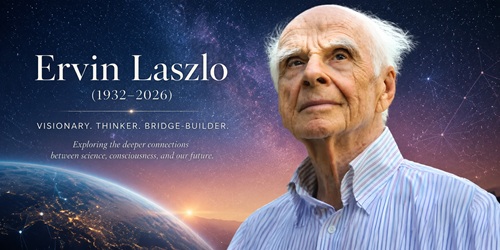 The Passing of a Systems ThinkerWith the death of Ervin Laszlo at the age of 94, the world has lost one of the twentieth and twenty-first centuries' most prolific advocates of holistic thinking. Philosopher, systems theorist, futurist, concert pianist, and founder of multiple international organizations, Laszlo spent decades arguing that humanity needed a new worldview—one capable of integrating science, ecology, ethics, and spirituality into a coherent vision. Although many of his more speculative ideas remain controversial, his broader contribution to systems thinking and global consciousness deserves serious attention. Few intellectuals worked as tirelessly to bridge disciplinary divides or to communicate the urgency of planetary interconnectedness. From Concert Pianist to PhilosopherLaszlo's career began far from academia. A child prodigy on the piano, he performed internationally before turning his attention to philosophy and systems theory in the 1960s. His timing proved fortunate. The rise of cybernetics, ecology, complexity science, and general systems theory created fertile ground for thinkers seeking alternatives to the reductionism that had dominated much of twentieth-century science. Laszlo quickly became one of the movement's most visible public intellectuals. Unlike many academic philosophers, he wrote for a broad audience. His dozens of books addressed not only specialists but policymakers, business leaders, environmentalists, and spiritually inclined readers searching for a larger picture. Systems Thinking Before It Was FashionableLaszlo's most enduring legacy lies in his advocacy of systems thinking. Rather than viewing organisms, societies, or ecosystems as collections of isolated parts, systems theory emphasizes relationships, feedback loops, emergence, and dynamic organization. Today these concepts are commonplace in ecology, climate science, economics, and network theory. When Laszlo began promoting them, they were still relatively unfamiliar outside specialized circles. His work consistently emphasized that global problems cannot be solved independently: • Environmental degradation • Economic inequality • Political instability • Population growth • Technological disruption These issues interact as parts of one planetary system. This insight has only become more relevant. The Club of BudapestPerhaps Laszlo's best-known institutional achievement was founding the Club of Budapest in 1993. Inspired partly by the earlier Club of Rome, the organization sought to foster dialogue among scientists, artists, religious leaders, and public intellectuals concerning humanity's long-term future. Rather than focusing solely on economic limits, the Club emphasized cultural evolution and consciousness as essential ingredients for solving global crises. Its membership included Nobel laureates, spiritual teachers, environmental advocates, and prominent public figures. Critics sometimes dismissed it as idealistic. Yet the underlying conviction—that global challenges require interdisciplinary cooperation—has become increasingly mainstream. Beyond Systems Science: The Akashic FieldWhere Laszlo became most controversial was his attempt to extend systems theory into metaphysics. Beginning around the early 2000s, he proposed the existence of what he called the "Akashic Field." Borrowing the Sanskrit word akasha, he suggested that the universe contains a universal information field connecting all things. According to Laszlo, this field could explain phenomena ranging from biological organization and consciousness to psychic experiences and even memories extending across space and time. The proposal was intended as a scientific hypothesis rather than merely a mystical belief. However, many physicists regarded it as speculative and unsupported by empirical evidence. Its vocabulary often borrowed concepts from quantum physics while applying them far outside their established scientific domain. Consequently, Laszlo became a leading figure in the contemporary science-and-spirituality movement. Walking the BoundaryLaszlo occupied an unusual intellectual position. Unlike traditional mystics, he wanted spiritual ideas to receive scientific legitimacy. Unlike mainstream scientists, he believed existing physics was too limited to explain consciousness and meaning. This balancing act earned him admirers and critics alike. Supporters viewed him as courageously expanding scientific horizons. Skeptics argued he blurred important distinctions between scientific hypotheses, philosophical speculation, and spiritual aspiration. The debate surrounding his work illustrates a recurring tension within contemporary culture: the desire for intellectual integration versus the need for empirical rigor. A Parallel with Ken WilberReaders familiar with Integral Theory will immediately recognize parallels between Laszlo and Ken Wilber. Both attempted grand syntheses. Both sought reconciliation between science and spirituality. Both criticized reductionism. Both envisioned humanity evolving toward greater levels of consciousness. Yet significant differences remain. Wilber built a comprehensive developmental philosophy grounded in psychology, contemplative traditions, and integral methodology. Laszlo began from systems science and expanded toward cosmology. Ironically, each eventually ventured into speculative metaphysical territory. Wilber proposed involution and Eros as cosmic evolutionary forces. Laszlo proposed the Akashic Field as a universal informational substrate. Neither proposal has gained acceptance within mainstream science. An Early Ecological VoiceWhere Laszlo was unquestionably ahead of his time was environmental thinking. Long before climate change became central to public debate, he argued that humanity must understand itself as part of Earth's interconnected ecological systems. His emphasis on planetary responsibility anticipated later discussions surrounding sustainability and global governance. While some of his proposed solutions may appear optimistic, the diagnosis itself has aged remarkably well. Human civilization is increasingly confronted by problems that ignore national borders. Systems thinking has become less a philosophical preference than a practical necessity. Why His Legacy MattersLaszlo's lasting importance does not depend on whether the Akashic Field exists. Rather, it rests on three enduring contributions. First, he popularized systems thinking for audiences far beyond academia. Second, he consistently emphasized global interconnectedness decades before globalization's unintended consequences became fully apparent. Third, he reminded both scientists and spiritual seekers that neither reductionism nor vague mysticism offers adequate guidance for understanding complex reality. His work stimulated conversations across disciplinary boundaries, even when his own conclusions remained debatable. The Cautionary LessonLaszlo's career also illustrates the risks facing ambitious synthesis. The broader one's intellectual vision becomes, the greater the temptation to fill explanatory gaps with speculative concepts. History shows that genuine scientific integration requires extraordinary evidential discipline. Elegant metaphors and holistic narratives are not substitutes for empirical confirmation. This does not diminish Laszlo's achievements. Rather, it places them within their proper context. He was an explorer operating at the frontier between established science and philosophical imagination. Some of his paths may ultimately prove dead ends. Others helped prepare the intellectual landscape for today's widespread appreciation of complexity, networks, emergence, and planetary systems. An Intellectual Who Refused Narrow BoundariesErvin Laszlo belonged to a generation of thinkers who believed humanity required not merely better technologies but better ways of thinking. Whether discussing ecology, civilization, ethics, or consciousness, he consistently challenged fragmented perspectives in favor of larger patterns. Even readers unconvinced by his metaphysical proposals can appreciate his determination to think across disciplinary borders. In an age increasingly defined by interconnected crises, that aspiration remains profoundly relevant. His legacy is therefore twofold: a respected pioneer of systems thinking and a controversial advocate of spiritual cosmology. The first has already entered mainstream intellectual life. The second will continue to inspire debate. Together they define one of the most ambitious attempts of the past half-century to reconnect science, philosophy, and humanity's search for meaning.
Widget is loading comments...
|