|
TRANSLATE THIS ARTICLE
Integral World: Exploring Theories of Everything
An independent forum for a critical discussion of the integral philosophy of Ken Wilber
  Frank Visser, graduated as a psychologist of culture and religion, founded IntegralWorld in 1997. He worked as production manager for various publishing houses and as service manager for various internet companies and lives in Amsterdam. Books: Ken Wilber: Thought as Passion (SUNY, 2003), and The Corona Conspiracy: Combatting Disinformation about the Coronavirus (Kindle, 2020). Frank Visser, graduated as a psychologist of culture and religion, founded IntegralWorld in 1997. He worked as production manager for various publishing houses and as service manager for various internet companies and lives in Amsterdam. Books: Ken Wilber: Thought as Passion (SUNY, 2003), and The Corona Conspiracy: Combatting Disinformation about the Coronavirus (Kindle, 2020).
Check out my other conversations with ChatGPT Why were many quantum physicists interested in mysticism?Looking Back on Ken Wilber's Quantum Questions (1984)Frank Visser / ChatGPT
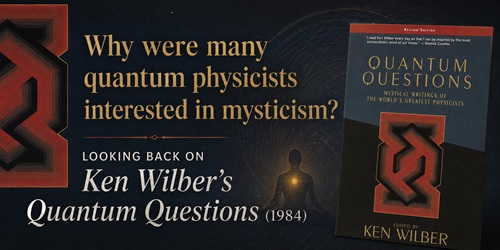 One of the enduring curiosities of twentieth-century intellectual history is that several pioneers of quantum physics expressed an interest in mysticism, religion, or Eastern philosophy. This fact is often cited as evidence that quantum mechanics somehow points toward a spiritual worldview. The historical reality, however, is more nuanced. The Psychological Shock of Quantum TheoryQuantum mechanics overturned centuries of classical intuition. Suddenly, certainty gave way to probability, particles behaved like waves, and reality seemed far stranger than anyone had imagined. For many physicists, this conceptual revolution naturally prompted broader philosophical reflection. If the foundations of physics had changed so dramatically, perhaps humanity's understanding of reality needed revision as well. This intellectual openness made some scientists receptive to philosophical and religious traditions outside the Western scientific canon. Different Scientists, Different MotivationsThe pioneers of quantum mechanics did not share a common metaphysical outlook. Niels Bohr remained cautious and emphasized the limits of language in describing quantum phenomena. His principle of complementarity was philosophical but not mystical. Werner Heisenberg occasionally compared modern physics to ancient Greek philosophy and expressed admiration for aspects of Eastern thought, yet he did not claim that quantum mechanics proved mysticism. Erwin Schrödinger was perhaps the most explicitly attracted to Eastern philosophy. Influenced by Advaita Vedanta, he argued that individual consciousness is ultimately one reality. These ideas shaped his personal worldview but were independent of his scientific work. Wolfgang Pauli became deeply interested in psychology through his collaboration with Carl Gustav Jung. Together they explored symbolism, archetypes, and the notion of synchronicity, but these investigations lay outside mainstream physics. By contrast, Albert Einstein consistently rejected quantum mysticism. Although he often spoke of "cosmic religious feeling," he meant awe before the rational order of nature, not belief in supernatural intervention or mystical consciousness. The Influence of Eastern PhilosophyThe mid-twentieth century saw growing Western interest in Hinduism, Buddhism, and Taoism. These traditions appeared to emphasize paradox, interconnectedness, and the limits of conceptual thinking—features that some readers felt resonated with quantum theory. Books such as The Tao of Physics popularized these comparisons, arguing that modern physics and Eastern mysticism pointed toward a common worldview. The book became enormously influential, especially among spiritual seekers. However, most physicists regarded these parallels as suggestive analogies rather than scientific conclusions. Analogy Is Not EvidenceThere is an important distinction between finding similarities and establishing scientific support. A Buddhist text may speak of interconnectedness, while quantum theory describes entanglement. Both involve relationships, but they concern entirely different domains. Likewise, mystical traditions often emphasize the unity of existence, whereas quantum mechanics is a mathematical framework for predicting experimental outcomes. Resemblance in language does not imply identity of concepts. Why the Myth PersistsThe idea that quantum physics validates mysticism remains attractive for several reasons. • First, quantum mechanics is genuinely counterintuitive. Its strangeness invites speculation. • Second, many people find it satisfying when science appears to confirm ancient spiritual traditions. • Third, quotations from famous physicists are often taken out of context. A scientist's private philosophical interests are easily mistaken for scientific conclusions. • Finally, popular books and documentaries frequently blur the line between established physics and metaphysical interpretation. Science and Personal BeliefScientists, like everyone else, have personal philosophies. A physicist may be a Christian, a Buddhist, an atheist, a Platonist, or a mystic. These commitments can inspire questions and shape perspectives, but they are distinct from the empirical content of physics itself. The validity of quantum mechanics rests on experiments and mathematical consistency—not on the spiritual beliefs of its founders. ConclusionThe fascination that some quantum physicists had with mysticism is historically real but scientifically limited. Their interests reflected a broader search for meaning following one of the greatest conceptual revolutions in science. It does not follow that quantum mechanics endorses mystical doctrines. Perhaps the most balanced conclusion is that quantum physics and mysticism may both encourage humility about the nature of reality. Beyond that, any deeper connection remains a matter of philosophy or personal belief rather than scientific demonstration. Appendix: Ken Wilber's Quantum Questions: A Valuable Anthology with a Questionable ThesisQuantum Questions occupies a curious place in the literature connecting science and spirituality. First published in 1984, the book assembles writings by major twentieth-century physicists—including Werner Heisenberg, Erwin Schrödinger, Albert Einstein, Louis de Broglie, Max Planck and Arthur Eddington—on philosophical and religious questions.[1] As an anthology, the book remains valuable. It gives readers direct access to what these scientists actually wrote about philosophy, consciousness, and religion, rather than relying on secondhand summaries. The controversy lies not in the selection of texts but in Wilber's interpretation. Wilber's Central ClaimWilber argues that the founders of modern physics eventually realized that science alone could not answer ultimate questions. According to him, many turned toward genuine mysticism—not because quantum mechanics proved mysticism, but because they independently discovered the limitations of scientific knowledge. This was, in part, a reaction against popular "quantum mysticism," represented by books like The Tao of Physics. Wilber criticized Capra for suggesting that quantum physics itself confirms Eastern mysticism. In this respect, Wilber's position was actually more restrained than Capra's. He insisted that physics and mysticism are separate domains and that mystical realization comes through contemplative practice, not laboratory experiments. Where the Book Becomes More DebatableAlthough Wilber rejects simplistic quantum mysticism, he goes further by claiming that the physicists' philosophical reflections point toward what he calls the "perennial philosophy"—the idea that all authentic mystical traditions converge on the same ultimate reality. This conclusion does not follow from the evidence. The physicists represented in the anthology held remarkably diverse views: • Einstein admired Spinoza's rationalism and rejected belief in a personal God. • Bohr remained philosophically cautious and avoided metaphysical conclusions. • Heisenberg explored philosophical questions without endorsing a single mystical tradition. • Schrödinger embraced Advaita Vedanta. • Pauli pursued Jungian psychology and symbolism. • Others remained religious in conventional ways or philosophically agnostic. There is no unified mystical worldview emerging from these writings. Selection BiasOne criticism often made of Quantum Questions is that Wilber emphasizes those passages that resonate with his own integral philosophy while downplaying the diversity—and sometimes incompatibility—of the authors' views. A physicist's occasional admiration for Buddhism or Vedanta does not necessarily imply endorsement of perennial philosophy, nor does philosophical speculation carry the same authority as scientific work. The contributors were experts in theoretical physics, not comparative religion. Historical SignificanceIronically, Quantum Questions is most valuable for the opposite reason many readers expect. Rather than demonstrating that quantum mechanics leads naturally to mysticism, it illustrates that brilliant scientists respond to the philosophical implications of their work in many different ways. Some became religious, some mystical, some skeptical, and some remained largely silent on metaphysical issues. Their diversity suggests that quantum physics itself underdetermines metaphysical conclusions. ConclusionQuantum Questions remains an excellent collection of primary sources and is still worth reading. Wilber deserves credit for resisting the simplistic claim that quantum mechanics scientifically proves mysticism—a position he explicitly rejected. Where his argument becomes less convincing is in suggesting that the physicists' philosophical reflections collectively validate the perennial philosophy. The historical record shows something more interesting: not a convergence on a single mystical worldview, but a rich plurality of personal responses to one of science's greatest revolutions. In that sense, the book is perhaps best read not as evidence for mysticism, but as evidence that scientific genius does not eliminate the human search for meaning—and that this search can lead in many different philosophical directions. NOTES[1] Niels Bohr was not included in this anthology because his heirs did not give permission (personal communication Wilber, 1997)
Widget is loading comments...
|