|
TRANSLATE THIS ARTICLE
Integral World: Exploring Theories of Everything
An independent forum for a critical discussion of the integral philosophy of Ken Wilber
  Frank Visser, graduated as a psychologist of culture and religion, founded IntegralWorld in 1997. He worked as production manager for various publishing houses and as service manager for various internet companies and lives in Amsterdam. Books: Ken Wilber: Thought as Passion (SUNY, 2003), and The Corona Conspiracy: Combatting Disinformation about the Coronavirus (Kindle, 2020). Frank Visser, graduated as a psychologist of culture and religion, founded IntegralWorld in 1997. He worked as production manager for various publishing houses and as service manager for various internet companies and lives in Amsterdam. Books: Ken Wilber: Thought as Passion (SUNY, 2003), and The Corona Conspiracy: Combatting Disinformation about the Coronavirus (Kindle, 2020).
Check out my other conversations with ChatGPT Basic Quantum PhysicsUnderstanding the Strange World Beneath RealityFrank Visser / ChatGPT
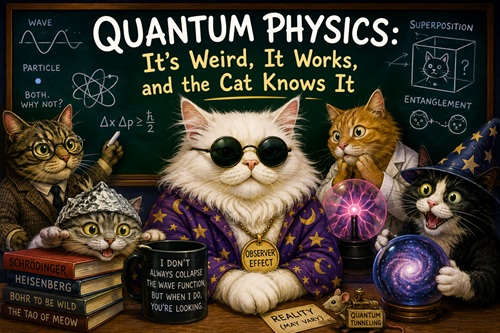 IntroductionQuantum physics is arguably the most successful scientific theory ever developed. It explains the behavior of matter and energy at the smallest scales—atoms, electrons, photons, and the subatomic particles that constitute the fabric of the universe. Nearly every modern technology, from smartphones to lasers and MRI scanners, depends on quantum mechanics. Yet quantum physics is also one of the most misunderstood branches of science. Its counterintuitive concepts have inspired countless philosophical speculations and spiritual appropriations, many of which extend far beyond what the theory actually says. Appreciating quantum physics requires distinguishing between its experimentally verified predictions and the metaphysical interpretations that have grown around it. Why Classical Physics Was Not EnoughAt the end of the nineteenth century, many physicists believed that the basic laws of nature had been discovered. Newton's mechanics and Maxwell's electromagnetism appeared capable of explaining almost everything. However, several experiments refused to fit classical theory. Heated objects emitted radiation in unexpected ways, atoms remained mysteriously stable, and light sometimes behaved like particles rather than waves. These puzzles culminated in the birth of quantum theory around 1900, beginning with Max Planck's proposal that energy comes in discrete packets, or quanta. Over the next three decades, Albert Einstein, Niels Bohr, Werner Heisenberg, Erwin Schrödinger, Paul Dirac, and others transformed this idea into modern quantum mechanics. The Quantum RevolutionQuantum physics departs from everyday intuition in several important ways. Energy is QuantizedUnlike classical physics, where energy can vary continuously, quantum systems can occupy only specific energy levels. Electrons in atoms, for example, jump between discrete orbits rather than moving continuously. This explains why atoms emit light at sharply defined wavelengths, giving each chemical element its unique spectral fingerprint. Wave-Particle DualityElectrons, photons, and many other particles display both particle-like and wave-like behavior. An electron can travel through space as a wave spread over many possible paths, yet when detected it appears at a single location as a particle. The famous double-slit experiment dramatically demonstrates this dual nature. Probability Replaces CertaintyClassical physics predicts exact outcomes. If one knows the initial conditions, one can calculate the future precisely. Quantum mechanics instead predicts probabilities. Rather than stating where an electron is, the theory describes the probability of finding it at different locations. This probabilistic description is represented mathematically by the wave function. Importantly, this does not necessarily mean that nature itself is fundamentally random—whether the probabilities reflect reality or merely our knowledge remains an open philosophical question. The Uncertainty PrincipleOne of the best-known ideas in quantum physics is Heisenberg's uncertainty principle. It states that certain pairs of properties—most famously position and momentum—cannot both be measured with unlimited precision simultaneously. This is not due to poor instruments but is a fundamental feature of quantum systems. The uncertainty principle places intrinsic limits on what can be known about microscopic objects. SuperpositionQuantum systems can exist in combinations of multiple possible states until an interaction occurs. A particle may simultaneously possess several possible positions or energies, described mathematically as a superposition. Schrödinger illustrated the apparent absurdity of this idea with his famous thought experiment involving a cat that is both alive and dead until observed. The example was intended as a criticism of simplistic interpretations rather than a literal description of cats. EntanglementPerhaps the strangest quantum phenomenon is entanglement. When two particles interact, they can become linked so that measurements on one are correlated with measurements on the other, even after they are separated by great distances. Einstein famously called this "spooky action at a distance." Modern experiments have repeatedly confirmed that entanglement is real, although it does not allow faster-than-light communication and therefore does not violate relativity. Different InterpretationsQuantum mechanics predicts experiments with extraordinary accuracy, yet physicists continue to debate what the mathematics actually means. Several major interpretations exist: • Copenhagen Interpretation: Measurement causes the wave function to assume one definite outcome. • Many-Worlds Interpretation: Every possible outcome actually occurs in branching universes. • Pilot-Wave Theory: Hidden variables guide particles along definite trajectories. • Objective Collapse Models: Wave functions spontaneously collapse under certain conditions. • Relational and Information-Based Interpretations: Quantum states describe relationships or information rather than objective properties. Remarkably, all these interpretations make essentially the same experimental predictions. The disagreement concerns ontology rather than empirical science. Everyday Technologies Built on Quantum PhysicsQuantum mechanics is not merely an abstract theory. It underlies much of modern civilization. Examples include: • Semiconductors and computer chips • Lasers • LEDs • Solar panels • Magnetic resonance imaging (MRI) • Atomic clocks • GPS timing systems • Electron microscopes • Quantum cryptography • Emerging quantum computers Without quantum physics, the digital age would simply not exist. Quantum ComputingQuantum computers exploit superposition and entanglement to perform certain calculations more efficiently than classical computers. Unlike ordinary bits, which are either 0 or 1, quantum bits—or qubits—can exist in superpositions of both. Although quantum computers are unlikely to replace conventional computers for everyday tasks, they may revolutionize fields such as cryptography, materials science, molecular chemistry, and optimization. Quantum Physics and PhilosophyQuantum mechanics raises profound philosophical questions. • Does reality exist independently of observation? • What is the nature of probability? • Can determinism survive? • How should we understand measurement? These questions remain active areas of research in both physics and philosophy. It is important to distinguish philosophical speculation from established science. Quantum mechanics itself does not prove idealism, consciousness-based reality, or free will. Neither does it refute them. The theory remains largely silent on such broader metaphysical claims. Quantum MysticismSince the 1970s, quantum theory has often been invoked in support of spiritual or mystical worldviews. Books have claimed that consciousness creates reality, that quantum physics validates Eastern mysticism, or that human thought can directly influence the physical world through quantum effects. Most physicists reject these conclusions. The mathematical formalism of quantum mechanics says nothing about reincarnation, cosmic consciousness, psychic phenomena, or divine intelligence. Such ideas may be philosophically interesting, but they are not consequences of quantum theory itself. The confusion often arises because words like observer, measurement, and uncertainty have precise technical meanings in physics that differ greatly from their everyday usage. Why Quantum Physics MattersQuantum mechanics transformed humanity's understanding of nature more radically than almost any previous scientific breakthrough. It demonstrated that reality at microscopic scales behaves according to principles that differ profoundly from everyday experience. At the same time, it revealed that simple mathematical laws can successfully describe even the strangest phenomena. Its practical impact has been enormous, driving much of modern technology, while its conceptual implications continue to inspire debates among physicists, philosophers, and the public. ConclusionQuantum physics teaches humility. The universe is stranger than common sense suggests, yet it is also remarkably comprehensible through careful experimentation and mathematics. Perhaps its greatest lesson is methodological rather than metaphysical. The success of quantum mechanics reminds us that nature is under no obligation to conform to human intuition. Scientific progress often requires abandoning familiar assumptions while resisting the temptation to read more into a theory than the evidence justifies. Quantum mechanics remains a triumph not because it solves every philosophical mystery, but because it provides an extraordinarily accurate description of the microscopic world—one whose applications have transformed modern civilization and whose deeper meaning continues to challenge our understanding of reality.
Widget is loading comments...
|