|
TRANSLATE THIS ARTICLE
Integral World: Exploring Theories of Everything
An independent forum for a critical discussion of the integral philosophy of Ken Wilber
  Frank Visser, graduated as a psychologist of culture and religion, founded IntegralWorld in 1997. He worked as production manager for various publishing houses and as service manager for various internet companies and lives in Amsterdam. Books: Ken Wilber: Thought as Passion (SUNY, 2003), and The Corona Conspiracy: Combatting Disinformation about the Coronavirus (Kindle, 2020). Frank Visser, graduated as a psychologist of culture and religion, founded IntegralWorld in 1997. He worked as production manager for various publishing houses and as service manager for various internet companies and lives in Amsterdam. Books: Ken Wilber: Thought as Passion (SUNY, 2003), and The Corona Conspiracy: Combatting Disinformation about the Coronavirus (Kindle, 2020).
Check out my other conversations with ChatGPT The West Through the Eyes of Its EnemiesA Review of Frédéric Martel's OccidentsFrank Visser / ChatGPT
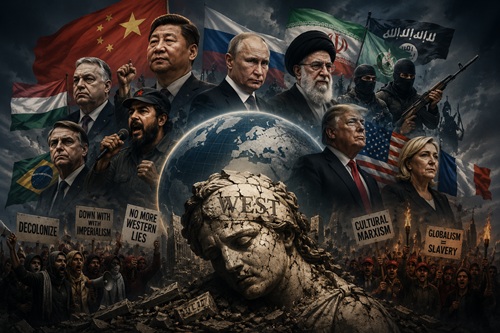 For more than two decades, Frédéric Martel has built a reputation for ambitious investigative journalism. After exploring the globalization of culture in Mainstream and the hidden world of the Vatican in Sodoma, he now turns to perhaps the defining ideological conflict of our age: the growing global hostility toward "the West." His latest book, Occidents: Enquête sur nos ennemis (not yet published in English), is the product of eight years of research across fifty-two countries and nearly two thousand interviews. Rather than writing another conventional geopolitical analysis, Martel attempts something more unusual: he asks the enemies of the West to explain themselves. The West as an Imagined EnemyMartel's central insight is deceptively simple. There is no single "West." Instead, there are many competing images of the West, each constructed by different political movements for their own purposes. For the leadership in China, the West represents liberal decadence. For Russian ideologues, it symbolizes moral decline and geopolitical domination. For Islamist movements, it embodies secularism and cultural corruption. For parts of the populist right—including some surrounding Donald Trump—it represents globalism, multiculturalism, and liberal elites. Each enemy attacks a different West. Ironically, these contradictory images often reinforce one another. This observation explains the book's French title: Occidents—plural rather than singular. An Extraordinary Reporting ProjectThe book's greatest strength lies in its reporting. Martel meets intellectuals close to Xi Jinping, advisers to Vladimir Putin, propagandists associated with Hamas, supporters of Viktor Orbán, followers of Jair Bolsonaro, advisers around Donald Trump, including Steve Bannon, and many others. Rather than caricaturing them, he allows them to present their own arguments before analyzing their underlying assumptions. This journalistic approach gives the book considerable intellectual credibility. Martel is not content with reading official statements or social media posts. He seeks direct conversations with influential thinkers inside competing ideological systems. The result is a panoramic survey of contemporary anti-Western thought. The Convergence of OppositesOne of Martel's more provocative conclusions is that ideological opposites increasingly converge. The radical left condemns Western capitalism. The radical right condemns liberal democracy. Authoritarian states condemn Western universalism. Religious extremists condemn secular freedoms. Although these movements disagree on almost everything else, they often share a common adversary. Martel argues that this convergence has become one of the defining characteristics of twenty-first century politics. The "West" functions as a symbolic enemy capable of uniting otherwise incompatible political projects. A Defense of Liberal DemocracyMartel does not pretend to be politically neutral. He openly defends liberal democracy, pluralism, freedom of speech, human rights, and constitutional government. Unlike many contemporary authors who emphasize the historical failures of Western societies, Martel argues that these shortcomings should not obscure the achievements of liberal institutions. His position is neither triumphalist nor apologetic. He readily acknowledges colonialism, military interventions, inequality, and hypocrisy. But he rejects the conclusion that these failures invalidate universal democratic values. In this sense, the book is both descriptive and normative. It seeks not merely to understand anti-Western ideology but also to explain why liberal democracy remains worth defending. Is the Concept of "the West" Too Broad?The book's greatest vulnerability follows directly from its ambition. Martel groups together remarkably diverse actors: Chinese Communist theorists, Russian Eurasianists, Islamist movements, Latin American anti-imperialists, American populists, and European national conservatives. These groups often disagree fundamentally about economics, religion, culture, nationalism, and the role of the state. Some critics therefore argue that Martel risks creating precisely the kind of oversized category that he criticizes his interview subjects for using. If "the West" is an oversimplification, perhaps "the enemies of the West" is as well. This criticism does not invalidate his argument, but it raises important methodological questions. More Journalism Than Political TheoryReaders expecting a systematic theory of international relations may be disappointed. Martel is primarily a reporter rather than a political philosopher. His strength lies in collecting voices, reconstructing networks, and revealing ideological landscapes through hundreds of conversations. The book therefore resembles a vast documentary more than a tightly argued academic monograph. Its richness comes from accumulation rather than formal theory. Why the Book MattersOne of Martel's most important contributions is reminding readers that ideological conflict did not end with the Cold War. Military competition remains important, but ideas increasingly shape geopolitical rivalry. Competing civilizations battle through narratives about history, identity, morality, democracy, colonialism, and sovereignty. Understanding these narratives requires listening carefully—even to those who fundamentally oppose liberal democracy. Martel performs exactly this task. ConclusionTegen het Westen is a remarkable achievement of investigative journalism. Whether or not one agrees with all of Martel's conclusions, the sheer scale of the project commands respect. Few contemporary authors have invested eight years interviewing such a broad spectrum of ideological opponents across so many countries. The book succeeds best as a global map of anti-Western thought. It is less convincing when it attempts to unify highly diverse movements under a single conceptual framework. Yet even this limitation reflects the complexity of the subject rather than a simple flaw in the author's analysis. At a time when democratic institutions face pressure from authoritarian states, religious extremism, populist nationalism, and geopolitical rivalry, Martel offers an important reminder: before defending liberal values—or criticizing them—we should first understand how they are perceived by those who reject them most vehemently.
Widget is loading comments...
|