|
TRANSLATE THIS ARTICLE
Integral World: Exploring Theories of Everything
An independent forum for a critical discussion of the integral philosophy of Ken Wilber
  Frank Visser, graduated as a psychologist of culture and religion, founded IntegralWorld in 1997. He worked as production manager for various publishing houses and as service manager for various internet companies and lives in Amsterdam. Books: Ken Wilber: Thought as Passion (SUNY, 2003), and The Corona Conspiracy: Combatting Disinformation about the Coronavirus (Kindle, 2020). Frank Visser, graduated as a psychologist of culture and religion, founded IntegralWorld in 1997. He worked as production manager for various publishing houses and as service manager for various internet companies and lives in Amsterdam. Books: Ken Wilber: Thought as Passion (SUNY, 2003), and The Corona Conspiracy: Combatting Disinformation about the Coronavirus (Kindle, 2020).
Check out my other conversations with ChatGPT Jean-Baptiste LamarckThe Evolutionary Pioneer Who Was Wrong - Yet ImportantFrank Visser / ChatGPT
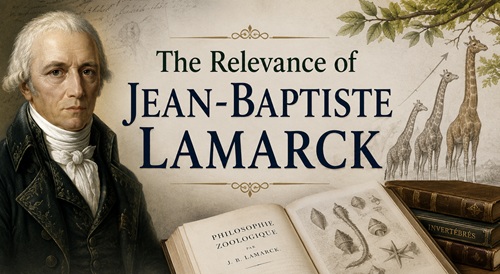
IntroductionFew figures in the history of biology have suffered a more paradoxical fate than Jean-Baptiste Lamarck. He is often remembered simply as the scientist who proposed that giraffes evolved long necks by stretching for leaves and then passing this acquired characteristic on to their offspring. Because this idea was largely rejected by later evolutionary biology, Lamarck is frequently portrayed as a misguided precursor to Charles Darwin. Yet this caricature obscures Lamarck's true significance. Although many of his specific mechanisms proved incorrect, he was among the first scientists to argue systematically that species evolve over time. In an age when most naturalists believed species were fixed and created separately, Lamarck dared to propose that life changes, adapts, and diversifies. In this respect, he helped prepare the intellectual ground on which Darwinian evolution would later flourish. The World Before EvolutionAt the beginning of the nineteenth century, the dominant view in European science was that species were immutable. Organisms were believed to have been created in their present forms and remained essentially unchanged throughout history. Lamarck challenged this assumption. Studying fossils and living organisms, he concluded that nature displayed a continuous process of transformation. Species did not remain fixed but gradually changed into new forms over immense periods of time. This was a revolutionary idea. Today evolution seems obvious, but in Lamarck's era it represented a direct challenge to prevailing scientific and religious beliefs. Lamarck's Theory of EvolutionIn his major work, Philosophie Zoologique, published in 1809, Lamarck proposed two main principles. Use and DisuseAccording to Lamarck, organs that were frequently used became stronger and more developed, while unused organs gradually deteriorated. A blacksmith's muscular arms or a mole's reduced eyesight seemed to support this principle. Lamarck believed that environmental demands directly shaped organisms through their habits and activities. Inheritance of Acquired CharacteristicsThe second principle was more controversial. Lamarck argued that characteristics acquired during an organism's lifetime could be inherited by its offspring. The classic example is the giraffe. Lamarck suggested that generations of giraffes stretched their necks to reach higher leaves. Over time, these acquired elongations accumulated and produced the modern giraffe's long neck. Modern genetics has shown that this mechanism does not explain evolution in most cases. Acquired bodily changes generally are not transmitted through DNA to offspring. Why Lamarck Was WrongThe rise of genetics in the late nineteenth and early twentieth centuries undermined Lamarck's theory. The work of Gregor Mendel demonstrated that hereditary information is transmitted through discrete units—genes—rather than through acquired bodily modifications. Later discoveries in molecular biology confirmed that environmental changes affecting an individual's body usually do not alter the genetic instructions passed to descendants. Meanwhile, Darwin's theory of natural selection provided a more powerful explanation. Rather than organisms actively transforming themselves, populations evolve because individuals with advantageous inherited traits leave more offspring. As a result, Lamarckism gradually became a scientific dead end. The Surprising Return of Lamarckian ThemesAlthough classical Lamarckism was rejected, some modern discoveries have revived limited aspects of Lamarck's intuition. Research in epigenetics has shown that environmental influences can sometimes alter patterns of gene expression, and under certain circumstances these changes may persist for several generations. Examples include effects of nutrition, stress, and environmental toxins. These findings do not vindicate Lamarck's original theory. Epigenetic inheritance is generally temporary, limited, and operates differently from Lamarck's proposed mechanism. Nevertheless, it demonstrates that the relationship between heredity and environment is more complex than once believed. Ironically, modern biology has rediscovered a small kernel of truth in Lamarck's broader intuition that life can sometimes carry traces of environmental experience across generations. Lamarck's Lasting ContributionsHe Introduced Evolution as a Scientific QuestionLamarck's greatest achievement was not providing the correct mechanism but recognizing that species evolve at all. Before Darwin could explain evolution, someone first had to establish that evolution occurs. Lamarck was among the earliest scientists to make this argument systematically. He Emphasized AdaptationLamarck recognized that organisms appear fitted to their environments. Although he explained adaptation incorrectly, he focused attention on one of biology's central questions: how organisms become suited to their ecological niches. He Advanced Invertebrate BiologyLamarck made important contributions to taxonomy and zoology. He was particularly influential in the study of invertebrates and helped classify many groups of animals that had previously received little scientific attention. In fact, Lamarck coined the term "invertebrate," which remains in use today. He Encouraged Historical ThinkingLamarck helped transform biology from a static science into a historical one. Instead of viewing nature as a fixed collection of species, he encouraged scientists to think in terms of processes, change, and deep time. This historical perspective became fundamental to modern evolutionary biology. Lamarck and DarwinThe relationship between Lamarck and Darwin is often misunderstood. Darwin did not simply replace Lamarck. Rather, he inherited a scientific landscape that Lamarck had helped create. Both men agreed that species evolve and adapt over time. Their disagreement concerned the mechanism responsible for these changes. Lamarck saw organisms as active agents shaping their own evolution through use and disuse. Darwin emphasized natural selection acting on inherited variation. In retrospect, Darwin provided the more successful explanation, but Lamarck deserves recognition for asking many of the right questions before the necessary evidence was available. ConclusionJean-Baptiste Lamarck occupies a unique position in the history of science. His specific theory of inheritance proved largely incorrect, and his name has often become synonymous with an evolutionary mistake. Yet focusing solely on his errors misses his deeper significance. Lamarck was one of the first thinkers to envision life as a dynamic, evolving process rather than a static creation. He challenged the doctrine of fixed species, introduced evolutionary thinking into biology, and helped pave the way for Darwin's later breakthrough. Science advances not only through those who provide the right answers but also through those who ask daring questions. Lamarck belongs firmly in that second category. His legacy reminds us that even mistaken theories can play a crucial role in the progress of knowledge. Appendix: Lamarck and Wilber on EvolutionAt first glance, Jean-Baptiste Lamarck and Ken Wilber appear to belong to entirely different intellectual worlds. Lamarck was an early nineteenth-century naturalist attempting to explain biological evolution, while Wilber is a contemporary philosopher concerned with consciousness, spirituality, and cosmic development. Yet there are intriguing parallels between their views of evolution, as well as important differences. Evolution as DirectionalOne of the most striking similarities is that both Lamarck and Wilber see evolution as directional rather than purely accidental. Lamarck believed that life possesses an inherent tendency toward greater complexity and perfection. Simple organisms continually arise through spontaneous generation and then gradually progress toward more complex forms. Evolution, in his view, is not merely adaptation but advancement. Wilber similarly argues that evolution exhibits a tendency toward increasing complexity, consciousness, and depth. Matter evolves into life, life into mind, and mind into spirit. Evolution is not simply a branching process of adaptation but a developmental ascent. In both cases, evolution is seen as moving somewhere rather than merely changing. The Role of AgencyLamarck emphasized the active role of organisms in shaping their own evolution. Animals respond to environmental challenges through their behavior, and these behavioral changes gradually become inherited traits. Wilber extends this notion much further. He argues that every entity possesses some degree of interiority or agency. Evolution is not simply something that happens to organisms; it is partially driven from within by what he calls "self-transcendence." This idea is encapsulated in his concept of Eros—a creative force pushing evolution toward greater complexity and awareness. In this respect, Wilber can be viewed as proposing a much grander version of Lamarck's belief that evolution contains an internal dynamic rather than being solely shaped by external forces. Darwin Against BothModern evolutionary biology largely rejected Lamarck's mechanism because acquired characteristics are generally not inherited. Darwin's theory of natural selection offered a different explanation. Evolution occurs because random variation arises and environmental selection filters these variations over time. No intrinsic drive toward perfection is required. Many critics argue that Wilber's evolutionary philosophy encounters a similar problem. Just as Lamarck introduced an internal striving to explain adaptation, Wilber introduces Eros to explain increasing complexity and consciousness. From a mainstream scientific perspective, both proposals are unnecessary. Natural selection, genetic drift, developmental constraints, and self-organization can explain many evolutionary patterns without invoking an inherent drive toward higher forms. Evidence and MechanismA crucial difference lies in testability. Lamarck proposed a concrete biological mechanism: acquired traits are inherited. This hypothesis was ultimately testable and largely falsified by genetics. Wilber's Eros is much harder to evaluate scientifically. It functions more as a metaphysical principle than a biological mechanism. There is no clear way to measure it, quantify its effects, or distinguish its operation from ordinary evolutionary processes. As a result, Lamarck's theory was vulnerable to empirical testing, whereas Wilber's evolutionary vision often remains insulated from direct scientific refutation. Spiritual EvolutionAnother major difference is that Lamarck remained a naturalist. Although he believed in a progressive tendency within nature, his theory concerned biological organisms. Wilber extends evolution into the spiritual domain. Human consciousness is not merely another evolutionary adaptation but part of a cosmic unfolding that ultimately culminates in spiritual realization. Thus Wilber transforms evolution from a biological process into a universal metaphysical narrative. An IronyThere is a curious irony in comparing the two thinkers. Lamarck is remembered today largely because his theory was superseded by Darwinian evolution. Yet Lamarck's central intuition—that evolution contains an intrinsic tendency toward greater complexity—has remained attractive to many philosophers, spiritual thinkers, and theorists of development. Wilber can be seen as one of the most elaborate modern heirs to that intuition. His Integral Theory retains the idea that evolution is progressive, directional, and driven from within. The difference is that Wilber relocates the driving force from biological inheritance to a cosmic principle of self-transcending Spirit. ConclusionIf Darwin represents the mainstream scientific understanding of evolution, then Lamarck and Wilber occupy a parallel tradition that sees evolution as inherently progressive and purposive. The difference is that Lamarck attempted to explain this purpose through a biological mechanism, while Wilber explains it through a metaphysical one. Lamarck's mechanism proved scientifically inadequate. Whether Wilber's cosmic Eros fares any better depends largely on whether one regards it as a scientific hypothesis or as a philosophical interpretation of evolution. From a critical perspective, Wilber's evolutionary spirituality can be viewed as a sophisticated revival of a very old temptation: the desire to find intention, direction, and purpose woven into the fabric of nature itself. In that sense, Lamarck may be one of Wilber's more distant intellectual ancestors than either of them would have realized.
Widget is loading comments...
|