|
TRANSLATE THIS ARTICLE
Integral World: Exploring Theories of Everything
An independent forum for a critical discussion of the integral philosophy of Ken Wilber
  Frank Visser, graduated as a psychologist of culture and religion, founded IntegralWorld in 1997. He worked as production manager for various publishing houses and as service manager for various internet companies and lives in Amsterdam. Books: Ken Wilber: Thought as Passion (SUNY, 2003), and The Corona Conspiracy: Combatting Disinformation about the Coronavirus (Kindle, 2020). Frank Visser, graduated as a psychologist of culture and religion, founded IntegralWorld in 1997. He worked as production manager for various publishing houses and as service manager for various internet companies and lives in Amsterdam. Books: Ken Wilber: Thought as Passion (SUNY, 2003), and The Corona Conspiracy: Combatting Disinformation about the Coronavirus (Kindle, 2020).
Check out my other conversations with ChatGPT 'Bodhisattvas are going to have to become politicians'A Critical Review of the 1995 Fax-Interview with Ken WilberFrank Visser / Grok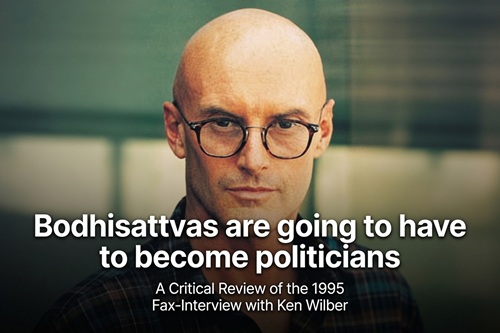 Introduction: Context and SignificanceThirty years ago, in 1995, Frank Visser conducted a fax-interview with Ken Wilber around the publication of his seminal Sex, Ecology, Spirituality (SES). Titled "Bodhisattvas are going to have to become politicians," the exchange captures Wilber at a pivotal moment: transitioning from transpersonal psychology toward a grand "theory of everything" via his Kosmos trilogy. The interview is articulate, wide-ranging, and characteristic of Wilber's style—sweeping historical narratives, integration of disciplines, and bold claims about transcending limitations in psychology, philosophy, and society. It remains a valuable primary source for understanding Wilber's mid-1990s thought. However, a critical review reveals both enduring strengths and persistent weaknesses in his approach, many of which have become more apparent with hindsight. Strengths: Lucid Mapping and Interdisciplinary AmbitionWilber's responses shine in their clarity and integrative power. He traces a logical progression from psychotherapy's focus on individual unhappiness to the necessity of sociology, anthropology, philosophy, and ultimately politics. This "chain" argument is compelling: defining mental health requires a vision of a healthy society, which demands cross-cultural and historical analysis, leading inevitably to normative philosophical commitments. His vision of transpersonal studies expanding beyond psychology into a broader "transpersonal studies" framework was prescient. Referencing influences like Maslow, Walsh/Vaughan, and Murphy, Wilber positions the field as poised for impact akin to psychoanalysis's cultural ripple effects. This emphasis on "transcend and include" (retaining valuable earlier insights while expanding scope) demonstrates intellectual humility and evolutionary thinking. The interview also humanizes Wilber. He acknowledges critics like Stan Grof and Michael Washburn respectfully while defending his "evolutionary" (vs. regressive) model of spirit. His comfort with his earlier works (Spectrum of Consciousness, Atman Project, etc.) while pushing forward reflects genuine continuity rather than reinvention. Promoting A Brief History of Everything as an accessible companion to the dense SES shows strategic communication. Limitations: Overconfidence, Selectivity, and Empirical GapsDespite these strengths, the interview exemplifies Wilber's tendency toward totalizing synthesis that can border on overreach. He aims for a "coherent, plausible, believable vision" tying physics to politics, but the execution often relies on selective mapping of existing theories rather than original empirical contributions. Critics have long noted that Wilber excels at chart-making and quadrant models (later formalized as AQAL) but sometimes forces disparate traditions into his framework, downplaying incompatibilities. His dismissal of regressive views (Grof/Washburn) as secondary to forward growth is philosophically tidy but psychologically reductive. Repression and return-to-source motifs in spiritual traditions (e.g., many mystical paths) receive short shrift. The claim that early works remain "very solid" with minor tuning underplays evolutions and controversies in his thought, such as shifts in handling postmodernism or specific cultural critiques. Politically, the call for "Bodhisattvas" to engage politics is inspiring but vague. Wilber gestures toward enlightened society (Kant, Marx) without grappling deeply with power structures, economics, or implementation challenges. Hindsight shows Integral Theory's limited mainstream political traction; its influence remained more niche in coaching, business, and personal development than transformative societal change. Stylistically, Wilber's rhetorical flair—Lily Tomlin quotes, categorical imperatives—makes for engaging reading but can mask unsubstantiated leaps, such as broad anthropological generalizations ("there are no answers in anthropology"). Legacy and Relevance TodayThirty years on, this interview highlights Wilber's lasting contribution: a holistic map urging integration across "waking up, growing up," quadrants, lines, states, and stages. Many of his diagnoses—of cultural fragmentation, the need for post-postmodern integration—resonate amid ongoing polarization and crises. Yet, limitations persist. Integral Theory has faced accusations of insufficient rigor, cultural bias (despite claims of East-West inclusion), and limited falsifiability. Its "theory of everything" ambition invites both admiration and skepticism: it organizes knowledge impressively but doesn't always generate novel predictions or resolve underlying tensions between traditions. Your interview, as questioner, effectively draws out Wilber's vision without excessive deference, foreshadowing your later critical scholarship (e.g., Ken Wilber: Thought as Passion and IntegralWorld.net). It serves as a time capsule of optimism in the transpersonal movement's potential. Conclusion: Enduring Value with Critical DistanceThis 1995 exchange remains a strong introduction to Wilber's integrative project—insightful, ambitious, and motivational. Its strengths lie in mapping complexity and calling for engaged spirituality. Weaknesses include overconfidence in synthesis, selective engagement with alternatives, and gaps between vision and verifiable impact. Readers today benefit most by approaching it as Wilber himself might advise: transcend and include its insights, while rigorously testing them against evidence, diverse perspectives, and real-world outcomes. In an era still needing bridges across divides, Wilber's call for comprehensive thinking endures, even if the full Kosmos remains aspirational.
Comment Form is loading comments...
|