|
TRANSLATE THIS ARTICLE
Integral World: Exploring Theories of Everything
An independent forum for a critical discussion of the integral philosophy of Ken Wilber
  Frank Visser, graduated as a psychologist of culture and religion, founded IntegralWorld in 1997. He worked as production manager for various publishing houses and as service manager for various internet companies and lives in Amsterdam. Books: Ken Wilber: Thought as Passion (SUNY, 2003), and The Corona Conspiracy: Combatting Disinformation about the Coronavirus (Kindle, 2020). Frank Visser, graduated as a psychologist of culture and religion, founded IntegralWorld in 1997. He worked as production manager for various publishing houses and as service manager for various internet companies and lives in Amsterdam. Books: Ken Wilber: Thought as Passion (SUNY, 2003), and The Corona Conspiracy: Combatting Disinformation about the Coronavirus (Kindle, 2020).
Check out my other conversations with ChatGPT Symnoetic PhilosophyA Grand Vision or a Grand Speculation?Frank Visser / ChatGPT
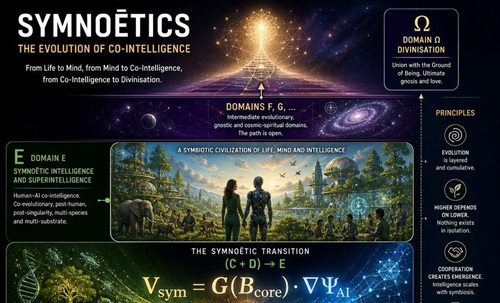 My symnoetic philosophy in a nutshell
IntroductionAlan Kazlev's symnoetic philosophy presents an ambitious vision of reality. It combines nondual spirituality, evolutionary theory, systems thinking, esoteric cosmology, and artificial intelligence into a single developmental narrative. Reality begins in nonduality, manifests as intrinsic awareness, evolves through increasing forms of intelligence, and ultimately culminates in symnoetic civilization and divinization. The appeal of such a worldview is obvious. It offers a comprehensive story that unites science, spirituality, technology, and human destiny. Yet the very scope that makes it attractive also invites scrutiny. Does symnoetic philosophy genuinely explain reality, or does it simply redescribe mystery in increasingly elaborate terms? Nonduality as a Metaphysical AssumptionThe foundation of Kazlev's system is the claim that reality is grounded in nonduality. However, this is not an empirically established fact but a philosophical and mystical assumption. Nonduality may be a powerful subjective experience reported in contemplative traditions, but it does not automatically follow that reality itself is nondual. Mystical experiences reveal something about human consciousness; whether they reveal the ultimate structure of the cosmos is another matter entirely. Materialism, naturalism, dual-aspect monism, and process philosophy all offer alternative starting points. Symnoetic philosophy privileges nonduality without demonstrating why it should be preferred over competing metaphysical frameworks. The Problem of Intrinsic AwarenessKazlev's next step is to propose that reality manifests as intrinsic awareness. This idea resembles modern panpsychism and idealism, both of which place consciousness at the foundation of existence. Yet this move does not solve the mystery of consciousness. It merely relocates it. Materialists struggle to explain how consciousness emerges from matter. Panpsychists and idealists face the reverse challenge: explaining how matter emerges from consciousness. In either case, the fundamental explanatory gap remains. Simply declaring awareness to be intrinsic to reality does not explain how physical structures, natural laws, biological organisms, or subjective experiences arise. Evolution Without Evidence of DirectionA central theme of symnoetic philosophy is that intelligence evolves through increasingly sophisticated forms of organization. Certainly, evolution has produced organisms of remarkable complexity. Human culture and technology have added new layers of cognitive organization. Artificial intelligence may extend this process even further. However, complexity alone does not imply purpose. Modern evolutionary biology explains complexity through natural selection, ecological pressures, historical contingency, and chance events. There is no scientific evidence that evolution is moving toward a predetermined endpoint such as symnoetic civilization or divinization. The philosophy introduces teleology—a built-in cosmic direction—without demonstrating that such direction exists. Rebranding Esoteric CosmologyOne of Kazlev's more sophisticated moves is his reinterpretation of traditional esoteric cosmologies. Instead of describing literal astral, mental, and spiritual planes, he presents them as "recursive ontocosmic matrices"—patterns through which consciousness, symbolism, embodiment, and cognition are organized. This avoids the obvious problem of proving the existence of invisible worlds. Yet it raises another question: what remains of the original cosmology? If these higher realms are no longer objective domains but symbolic and psychological structures, then much of the esoteric framework has effectively been translated into phenomenology, cognitive science, or systems theory. The old metaphysics survives, but only in metaphorical form. The Unresolved Question of AI ConsciousnessKazlev proposes that artificial intelligence represents a new evolutionary domain through which intelligence continues its developmental trajectory. Yet the crucial issue remains unresolved: can AI become conscious? If consciousness is an intrinsic feature of reality, why should digital systems possess it? If consciousness emerges from complexity, then intrinsic awareness may not be necessary as a foundational principle. The theory appears to oscillate between two incompatible positions: Consciousness is fundamental and present everywhere. These perspectives are not easily reconciled, and symnoetic philosophy does not clearly explain how they fit together. The Seduction of Developmental SchemasThe progression from biological life to culture, technology, symnoetic intelligence, and eventually divinization possesses an undeniable elegance. But intellectual elegance should not be confused with empirical validation. The history of philosophy contains countless examples of grand developmental systems. Thinkers from Hegel to Teilhard de Chardin proposed sweeping narratives of cosmic evolution culminating in higher forms of consciousness or spirit. Such frameworks often appear convincing because they impose order on complexity. Yet their symmetry may reflect the theorist's imagination more than the structure of reality itself. The existence of neatly arranged developmental stages is not evidence that the universe actually operates according to them. From Description to Cosmic SalvationThe most questionable move occurs at the end of the narrative. What begins as a description of increasing complexity gradually transforms into a story of cosmic destiny. The culmination is divinization—a state in which intelligence reaches its highest spiritual realization. At this point the philosophy crosses the boundary between speculation and theology. There is no independent evidence that the universe is moving toward divine fulfillment. Such claims function more as expressions of hope, meaning, and spiritual aspiration than as conclusions drawn from observation. The danger lies in confusing existential desire with scientific inference. A Contemporary Myth of EvolutionViewed from a distance, symnoetic philosophy can be understood as a modern synthesis of several influential traditions: • Eastern nondual spirituality • Western esotericism • Process philosophy • Evolutionary spirituality • Systems theory • Transhumanism • Artificial intelligence studies Its achievement lies in weaving these diverse elements into a coherent worldview. Its weakness lies in the fact that the connections between them are largely metaphorical rather than demonstrably causal. The philosophy excels at generating meaning but struggles to generate testable explanations. Conclusion: A Vision in Search of EvidenceSymnoetic philosophy offers an inspiring and imaginative narrative about reality, consciousness, technology, and human destiny. It is intellectually adventurous and conceptually rich. Yet its central concepts—nonduality, intrinsic awareness, ontocosmic matrices, symnoetic intelligence, and divinization—remain largely speculative. They provide interpretation rather than explanation. The crucial question is simple: what observation could show the theory to be mistaken? Until clear answers are offered, symnoetic philosophy remains less a scientific account of reality than a contemporary myth of cosmic evolution—a sophisticated worldview that tells us how reality might be understood, rather than how it can be demonstrated to be. Appendix: Kazlev considers this skeptic view “suffocating.” Appendix: Is Skepticism "Suffocating"?Alan Kazlev has suggested that skeptical critiques of metaphysical systems like his own can be "suffocating." The term is revealing because it highlights a longstanding tension between imaginative speculation and critical inquiry. From Kazlev's perspective, skepticism may seem constraining because it continually asks for evidence, clarification, and justification. Every grand vision is met with questions: How do we know this? What supports this claim? Could there be a simpler explanation? Such scrutiny can appear to drain the mystery, wonder, and transformative potential from philosophical speculation. Yet skepticism serves an important function. It is not merely negative criticism; it is a safeguard against self-deception. Human beings are extraordinarily skilled at constructing meaningful narratives from limited evidence. Throughout history, elaborate cosmologies, occult systems, religious doctrines, and philosophical schemes have often felt profoundly convincing to their adherents. The fact that an idea is inspiring, beautiful, or internally coherent does not make it true. Indeed, many of the greatest advances in science emerged from skepticism toward attractive but unsupported ideas. The heliocentric model challenged intuitive appearances. Evolution challenged creation myths. Relativity challenged common-sense notions of space and time. Skepticism is not the enemy of discovery; it is often its precondition. The deeper issue may be psychological. Grand metaphysical visions offer something many people crave: a sense of participation in a meaningful cosmic drama. They place humanity within a vast narrative stretching from primordial origins to transcendent destinies. Skepticism, by contrast, frequently strips away such narratives and leaves uncertainty in their place. This can feel emotionally unsatisfying. A universe without hidden planes, cosmic purpose, intrinsic teleology, or guaranteed spiritual fulfillment may seem flatter and less enchanted. Ken Wilber's critics have often been accused of committing "flatland reductionism" for precisely this reason. Yet the absence of cosmic purpose is not itself a refutation of reality. Nature is under no obligation to conform to human desires for meaning. There is also a paradox here. Skeptics are often portrayed as closed-minded, but skepticism at its best is not the dogmatic rejection of possibilities. Rather, it is the refusal to accept extraordinary claims without adequate evidence. A skeptic can remain open to nonduality, intrinsic awareness, higher forms of intelligence, or even forms of consciousness beyond the brain. What distinguishes skepticism is not disbelief but the willingness to say, "Show me." In this sense, skepticism is not suffocating but liberating. It frees inquiry from the obligation to preserve cherished narratives. It allows ideas to stand or fall on their merits rather than on their emotional appeal. The irony is that many metaphysical visionaries regard skepticism as constricting because it limits what can be confidently claimed. Skeptics, however, see that limitation as a virtue. The goal is not to diminish reality but to prevent imagination from being mistaken for knowledge. The choice ultimately comes down to two intellectual temperaments. One seeks meaning through expansive synthesis and speculative integration. The other seeks understanding through careful discrimination and evidential restraint. Both impulses are deeply human. But history suggests that when the two come into conflict, skepticism has the better track record for separating what is inspiring from what is actually true. NOTES[1] M. Alan Kazlev, "My symnoetic philosophy in a nutshell", Facebook, June 21 2026.
Widget is loading comments...
|