|
TRANSLATE THIS ARTICLE
Integral World: Exploring Theories of Everything
An independent forum for a critical discussion of the integral philosophy of Ken Wilber
  Frank Visser, graduated as a psychologist of culture and religion, founded IntegralWorld in 1997. He worked as production manager for various publishing houses and as service manager for various internet companies and lives in Amsterdam. Books: Ken Wilber: Thought as Passion (SUNY, 2003), and The Corona Conspiracy: Combatting Disinformation about the Coronavirus (Kindle, 2020). Frank Visser, graduated as a psychologist of culture and religion, founded IntegralWorld in 1997. He worked as production manager for various publishing houses and as service manager for various internet companies and lives in Amsterdam. Books: Ken Wilber: Thought as Passion (SUNY, 2003), and The Corona Conspiracy: Combatting Disinformation about the Coronavirus (Kindle, 2020).
Check out my other conversations with ChatGPT The Mystery of 1/137Physics' Most Enigmatic NumberFrank Visser / ChatGPT
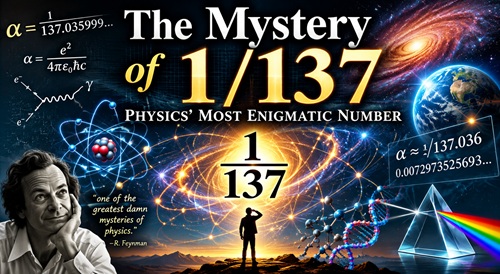 Introduction: A Number That Shouldn't Matter—But DoesAmong all the numbers that appear in physics, few have inspired as much fascination as the number 137. Unlike constants such as the speed of light or the mass of the electron, which have units attached to them, 137 emerges as a pure number. It is dimensionless, independent of any human system of measurement. Whether one uses meters or inches, kilograms or pounds, the number remains the same. For nearly a century, physicists have wondered whether this seemingly innocent number conceals a profound secret about the structure of reality. Nobel Prize winners, quantum pioneers, and even mystically inclined thinkers have all been captivated by it. Yet despite decades of investigation, nobody knows why nature chose this particular value. The mystery centers on a quantity known as the fine-structure constant. The Fine-Structure ConstantThe number 137 appears as the reciprocal of the fine-structure constant, usually denoted by the Greek letter alpha (a). Its value is approximately: α ≈ 1/137.036 or α ≈ 0.007297 The fine-structure constant measures the strength of the electromagnetic force—the force responsible for light, electricity, magnetism, chemistry, and ultimately the stability of atoms. Without electromagnetism: • Atoms would not exist. • Molecules could not form. • Stars would behave differently. • Life as we know it would be impossible. Alpha determines how strongly electrons interact with photons and atomic nuclei. It governs everything from the color of stars to the chemistry of DNA. The remarkable thing is that α is dimensionless. It is a pure ratio woven into the fabric of nature itself. Why 137 MattersMost physical constants depend on units. For example: The speed of light is 299,792,458 meters per second. The numerical value changes when the units change. Not so for a. The fine-structure constant combines several fundamental quantities: • the electron charge, • the speed of light, • Planck's constant, • and the vacuum permittivity. Yet all the units cancel out. What remains is simply: 0.007297... This suggests that α may reveal something deeper than ordinary physical measurements. It may be one of nature's most fundamental pieces of information. The Discovery of the ConstantThe mystery began in the early twentieth century. Physicists studying atomic spectra noticed that spectral lines appeared split into closely spaced pairs. This phenomenon became known as "fine structure." In 1916, the German physicist Arnold Sommerfeld introduced a new constant into his equations to explain these tiny splittings. To his surprise, the constant's value turned out to be approximately 1/137. At first it seemed merely a technical detail. But as quantum mechanics matured, physicists realized that the same number appeared everywhere electromagnetic interactions occurred. It was not an accident. Nature seemed to have chosen this value deliberately. Feynman's Famous ChallengeFew physicists expressed the mystery more vividly than Richard Feynman. He called the fine-structure constant: "one of the greatest damn mysteries of physics." Feynman emphasized that physicists could measure α with extraordinary precision, but they could not derive it from any deeper principle. Why 1/137? No one knew. As he put it, physicists simply had to accept that nature had chosen this value. For Feynman, this represented a profound gap in our understanding. A complete theory of nature ought to explain such a fundamental number. Yet no theory has succeeded. Numerology and MysticismThe peculiar appearance of 137 has inevitably attracted mystical speculation. The physicist Wolfgang Pauli became famously obsessed with the number. Influenced by his friendship with Carl Jung, Pauli wondered whether deep connections might exist between mathematics, psychology, and physics. Some religious traditions have also discovered intriguing numerical coincidences involving 137: • Certain interpretations of Kabbalah emphasize the number. • Some biblical calculations produce 137. • Various esoteric systems claim symbolic significance. Yet none of these associations have yielded scientific explanations. Physicists generally regard such connections as examples of pattern-seeking rather than evidence of hidden laws. Could the Value Have Been Different?One reason physicists care about α is that the universe appears highly sensitive to its value. If the fine-structure constant were significantly larger: • Electrons would bind more tightly to nuclei. • Stellar processes would change dramatically. • Chemistry could become unstable. If it were significantly smaller: • Atoms might not form complex molecules efficiently. • Biological complexity could become impossible. Some calculations suggest that even modest changes could radically alter the universe's habitability. This observation has made α a central topic in anthropic reasoning. The question becomes: Did the universe have to choose a value near 1/137, or do we observe this value simply because universes with different values cannot support observers? The answer remains unknown. Grand Unified TheoriesPhysicists have long hoped that deeper theories would explain a. In Grand Unified Theories (GUTs), electromagnetism is viewed as one aspect of a larger force that existed shortly after the Big Bang. These theories predict that force strengths change with energy and may converge at extremely high energies. While this framework explains some relationships among forces, it has not yet produced an exact derivation of 1/137. The value still has to be inserted into the equations rather than emerging naturally from them. String Theory and the Search for an ExplanationModern candidates for a "Theory of Everything," such as String Theory, have also attempted to explain fundamental constants. In principle, string theory could derive values like α from the geometry of extra dimensions. In practice, however, the theory currently allows an enormous number of possible solutions, each yielding different constants. Instead of uniquely predicting 1/137, string theory presently accommodates countless alternatives. The mystery therefore remains unresolved. Could 137 Be an Accident?Some physicists suspect that the quest itself may be misguided. Perhaps α simply has the value it has. Just as Earth's distance from the Sun is not mathematically inevitable, perhaps the fine-structure constant is a contingent fact about our universe. In this view, there may be no deeper reason for 1/137. The number could be analogous to a cosmic initial condition—a parameter that nature happened to select. Many physicists find this possibility unsatisfying, but it remains entirely plausible. The Current StatusToday the fine-structure constant is measured more precisely than ever before. Experimental physicists know its value to astonishing accuracy, exceeding one part in a billion. Yet despite this precision, the fundamental question remains exactly where it stood in Feynman's time: Why this number? Not 1/100. Not 1/200. Not 1/1000. Why approximately 1/137.036? No accepted theory provides an answer. Conclusion: A Window into the UnknownThe mystery of 1/137 illustrates a striking paradox of modern science. Physics can describe nature with extraordinary precision, predict phenomena across billions of light-years, and probe conditions fractions of a second after the Big Bang. Yet one of its most fundamental numbers remains unexplained. The fine-structure constant occupies a curious position between knowledge and ignorance. We know exactly how to use it. We know what it does. We know where it appears. But we do not know why it exists. Whether the answer lies in a future unified theory, a multiverse of possibilities, or a deeper mathematical structure not yet imagined, the number 137 continues to stand as a reminder that even our most successful scientific theories still rest upon mysteries. In that sense, 137 is not merely a number. It is a symbol of the unfinished nature of physics itself.
Widget is loading comments...
|