|
TRANSLATE THIS ARTICLE
Integral World: Exploring Theories of Everything
An independent forum for a critical discussion of the integral philosophy of Ken Wilber
  Frank Visser, graduated as a psychologist of culture and religion, founded IntegralWorld in 1997. He worked as production manager for various publishing houses and as service manager for various internet companies and lives in Amsterdam. Books: Ken Wilber: Thought as Passion (SUNY, 2003), and The Corona Conspiracy: Combatting Disinformation about the Coronavirus (Kindle, 2020). Frank Visser, graduated as a psychologist of culture and religion, founded IntegralWorld in 1997. He worked as production manager for various publishing houses and as service manager for various internet companies and lives in Amsterdam. Books: Ken Wilber: Thought as Passion (SUNY, 2003), and The Corona Conspiracy: Combatting Disinformation about the Coronavirus (Kindle, 2020).
Check out my other conversations with ChatGPT Life at the SummitKen Wilber's One Taste RevisitedFrank Visser / ChatGPT
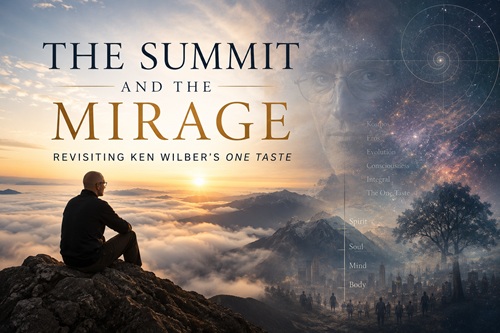 Ken Wilber's One Taste (1999), based on journal entries from 1997, is one of the most revealing books he ever wrote. Unlike his grand theoretical works, it offers a glimpse into the lived reality of someone who believed he had permanently stabilized a nondual realization. The result is fascinating, inspiring, occasionally moving—and sometimes unintentionally revealing in ways that raise uncomfortable questions. You visited him twice during that very year, which adds an unusual historical perspective. You encountered not merely the architect of Integral Theory but the man inhabiting what he considered the culmination of human development. The Man Who Had Reached the SummitThroughout One Taste, Wilber experiences himself as someone who has essentially solved the central existential problem of human life. Ordinary consciousness, with its fears, desires, anxieties, ambitions, and emotional dramas, has been seen through. The separate self is regarded as a useful fiction. Reality is experienced as a seamless, radiant unity in which subject and object dissolve into what he calls "the One Taste." The world appears not as a collection of separate entities but as manifestations of a single, timeless Awareness. Trees, clouds, birds, traffic, conversations—all arise within the same ever-present field of consciousness. The tone is strikingly confident. Wilber rarely presents his realization as tentative or exploratory. Instead, he writes as someone reporting from the summit after the climb is over. For him, the ultimate spiritual search has ended. The cosmic game has been solved. Living in a World of Enlightened CertaintyThis certainty permeates every aspect of the diary. While others struggle with identity, meaning, and purpose, Wilber portrays himself as standing outside these concerns. The entries often alternate between descriptions of nondual awareness and commentary on the intellectual shortcomings of others. • Politicians are trapped in lower stages. • Academics are trapped in rationalism. • Religious believers are trapped in mythology. • Environmentalists are trapped in flatland. • Postmodernists are trapped in relativism. Everyone is trapped somewhere. Only a rare handful seem to understand the larger picture. This creates a curious atmosphere. The book is ostensibly about nonduality and transcendence, yet much of it revolves around evaluating where people stand on developmental hierarchies. The cosmic perspective and the developmental perspective become fused. Enlightenment and ranking coexist side by side. The World as Evolution's Sacred DramaOne of the most distinctive features of Wilber's experience is that he sees evolution itself as a spiritual process. The universe is not merely changing; it is unfolding toward greater consciousness. • Matter becomes life. • Life becomes mind. • Mind becomes soul. • Soul becomes Spirit. The entire cosmos is portrayed as a vast drama of awakening. This is where Wilber differs from classical Advaita or Zen. Traditional nondual teachers often regard the world as ultimately empty of direction and purpose. Wilber, by contrast, sees a profound evolutionary trajectory. • The universe is going somewhere. • History has a hidden meaning. • Spirit is pulling evolution toward ever-higher forms of realization. This vision gives his worldview enormous grandeur. Every scientific discovery, every cultural advance, every psychological breakthrough becomes part of a cosmic narrative. The Strange Blind SpotYet this is also where a major limitation appears. Wilber experiences evolution as meaningful because he interprets it through a spiritual lens. The difficulty is that nature itself never announces such intentions. Evolutionary biology describes adaptation, selection, contingency, extinction, and historical accident. It does not detect a cosmic drive toward enlightenment. In One Taste, however, Wilber often writes as if his spiritual intuition provides direct insight into the hidden purpose of evolution. This creates an ambiguity. Is he reporting an experience? Or is he interpreting an experience? The experience itself—a sense of unity with all things—is undeniable as a psychological event. The evolutionary metaphysics layered on top of it is another matter. The leap from "I experience oneness" to "the cosmos is driven by Eros toward Spirit" is enormous. Yet Wilber often treats the second claim as if it follows naturally from the first. The Solipsism of the Cosmic WitnessA further limitation emerges from the diary format itself. The world often appears primarily as a mirror reflecting Wilber's own realization. • People become examples of developmental levels. • Events become illustrations of Integral Theory. • Nature becomes evidence of Spirit. • The universe becomes a stage upon which his metaphysical vision is continuously confirmed. There is remarkably little doubt. Very little uncertainty. Few moments when reality genuinely resists the framework. This gives One Taste an oddly closed quality. • Everything fits. • Everything confirms. • Everything reinforces the same conclusions. The danger of such comprehensive systems is not that they explain nothing. The danger is that they explain too much. A theory that can account for every possible observation risks becoming unfalsifiable. Enlightenment as IdentityPerhaps the deepest irony of the book is that the separate self, supposedly transcended, sometimes seems to return in a subtler form. Not the ordinary ego. The enlightened ego. The one who knows. The one who sees. The one who occupies a perspective unavailable to most people. The old identity dissolves only to be replaced by a new one: the realized integral sage. This may explain why critics often sense an undercurrent of spiritual elitism in Wilber's writing. The language of transcendence frequently coexists with an unmistakable awareness of occupying the highest available viewpoint. A Remarkable Human DocumentDespite these criticisms, One Taste remains an extraordinary book. It is one of the few detailed first-person records of a contemporary intellectual attempting to live from what he regards as stable nondual awareness. Its value lies not merely in what it reveals about enlightenment but in what it reveals about the human tendency to construct meaning. Reading it today, nearly thirty years later, one encounters both a genuine spiritual practitioner and a master system-builder. The two are inseparably intertwined. The practitioner experiences profound states of unity. The system-builder transforms those experiences into a grand metaphysical narrative about evolution, consciousness, and Spirit. Whether one sees that narrative as revelation or projection largely determines how one reads the book. For admirers, One Taste is the diary of a realized sage living in the radiance of nondual awareness. For skeptics, it is the diary of an extraordinarily intelligent man whose mystical experiences gradually became the foundation for an increasingly elaborate cosmology. The enduring question is not whether Wilber had profound experiences. Few readers doubt that he did. The question is whether the universe truly looks the way he thought it did from the summit. And that is a question that no mystical experience, however profound, can settle by itself.
Widget is loading comments...
|