|
TRANSLATE THIS ARTICLE
Integral World: Exploring Theories of Everything
An independent forum for a critical discussion of the integral philosophy of Ken Wilber
  Frank Visser, graduated as a psychologist of culture and religion, founded IntegralWorld in 1997. He worked as production manager for various publishing houses and as service manager for various internet companies and lives in Amsterdam. Books: Ken Wilber: Thought as Passion (SUNY, 2003), and The Corona Conspiracy: Combatting Disinformation about the Coronavirus (Kindle, 2020). Frank Visser, graduated as a psychologist of culture and religion, founded IntegralWorld in 1997. He worked as production manager for various publishing houses and as service manager for various internet companies and lives in Amsterdam. Books: Ken Wilber: Thought as Passion (SUNY, 2003), and The Corona Conspiracy: Combatting Disinformation about the Coronavirus (Kindle, 2020).
Check out my other conversations with ChatGPT The State of the Art in Evolutionary TheoryAccomplishments, Controversies, and FrontiersFrank Visser / ChatGPT
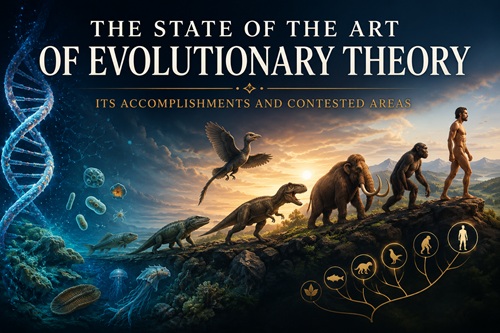 IntroductionFew scientific theories have been as successful, influential, and extensively tested as evolutionary theory. Since Charles Darwin proposed natural selection in 1859, evolution has transformed from a bold hypothesis into the central organizing framework of modern biology. Today, evolution explains phenomena ranging from antibiotic resistance and viral adaptation to the emergence of complex organs and the diversification of life across billions of years. Yet evolutionary theory is not static. Like all mature sciences, it continues to evolve. While the basic fact of evolution is accepted by virtually all professional biologists, debates remain about mechanisms, levels of selection, developmental constraints, the role of chance, and the origins of major evolutionary innovations. These debates do not challenge the reality of evolution itself; rather, they concern how evolution operates and which processes deserve greater explanatory weight. The current state of evolutionary theory is therefore characterized by both remarkable consensus and vigorous disagreement. The broad framework is secure, but many details remain contested. The Modern Synthesis: Biology's Grand UnificationThe foundation of contemporary evolutionary biology remains the Modern Synthesis, developed between the 1930s and 1950s. This synthesis united Darwin's theory of natural selection with Mendelian genetics. Key architects included Ronald Fisher, J.B.S. Haldane, Sewall Wright, Theodosius Dobzhansky, Ernst Mayr, and George Gaylord Simpson. The central principles were straightforward: • Genetic variation arises through mutation and recombination. • Natural selection sorts among variants. • Evolution is fundamentally a change in gene frequencies within populations. • Large-scale evolutionary changes emerge through the accumulation of small-scale changes. • Speciation results from reproductive isolation and divergence. For much of the twentieth century, this framework proved extraordinarily successful. It integrated genetics, ecology, systematics, and paleontology into a coherent explanatory system. Evolution's Greatest AccomplishmentsExplaining Biological DiversityOne of evolution's greatest achievements is explaining why living organisms exhibit nested patterns of similarity. Species naturally form hierarchical groupings. Mammals share characteristics absent in reptiles; primates share features absent in rodents; humans share traits with chimpanzees. This pattern is precisely what one would expect if species descend from common ancestors. The discovery of molecular genetics strengthened this conclusion dramatically. DNA comparisons independently reconstruct the same evolutionary relationships that had been inferred from anatomy and fossils. The convergence of multiple lines of evidence is among the strongest achievements of modern science. The Fossil RecordDarwin worried about gaps in the fossil record. Since his time, many of those gaps have been partially filled. Famous transitional forms include: • Archaeopteryx between non-avian dinosaurs and birds. • Tiktaalik between fishes and land vertebrates. • Ambulocetus in whale evolution. • Numerous hominin fossils documenting human evolution. The fossil record is still incomplete, but it consistently supports descent with modification. Molecular EvolutionModern genomics has provided overwhelming confirmation of common ancestry. Shared pseudogenes, endogenous retroviruses, chromosomal structures, and genetic sequences reveal patterns difficult to explain under separate creation models. Perhaps the most striking example is human chromosome 2, which bears evidence of an ancestral chromosome fusion corresponding to two separate chimpanzee chromosomes. For critics of evolution, including many creationists, chromosome 2 remains a major challenge. Evolution in Real TimeEvolution is no longer observed only through fossils. Researchers directly observe evolutionary change in: • Bacterial populations • Laboratory fruit flies • Viral evolution • Insecticide resistance • Antibiotic resistance Perhaps the most famous example is Richard Lenski's long-term bacterial evolution experiment, which has tracked evolutionary changes across tens of thousands of generations. Evolution is now experimentally observable. The Rise of Evo-DevoOne of the most important developments since the 1980s has been evolutionary developmental biology, or "evo-devo." Researchers discovered that vastly different organisms share surprisingly similar developmental genes. The most famous are the Hox genes, which help organize body plans across animals. This discovery revealed that evolutionary innovation often occurs not by inventing entirely new genes but by modifying existing developmental programs. The work of figures such as Sean Carroll demonstrated how small changes in gene regulation can generate large anatomical differences. Evo-devo expanded evolutionary theory beyond simple gene frequency changes and highlighted the importance of developmental processes. The Neutral Theory RevolutionDuring the 1960s, molecular data revealed something unexpected. Many genetic changes appeared neither beneficial nor harmful. This led Motoo Kimura to propose the Neutral Theory of Molecular Evolution. According to this view, much evolutionary change at the molecular level results from random genetic drift rather than natural selection. The resulting debate between adaptationists and neutralists reshaped evolutionary biology. Today, most biologists recognize that both natural selection and genetic drift play major roles. The question is not which process exists, but which dominates in particular contexts. Major Contested AreasThe Relative Importance of Natural SelectionDarwinian natural selection remains central, but disagreements persist regarding its explanatory reach. Some researchers emphasize adaptation as the primary driver of evolution. Others argue that chance events, developmental constraints, and historical contingencies often play equally important roles. The late Stephen Jay Gould famously criticized excessive adaptationism, arguing that not every biological feature is an adaptation. This debate continues today. The Extended Evolutionary SynthesisA major contemporary controversy concerns the proposed Extended Evolutionary Synthesis (EES). Advocates argue that the Modern Synthesis underestimates several factors: • Developmental bias • Phenotypic plasticity • Niche construction • Epigenetic inheritance • Organism-environment feedback Important contributors include Kevin Laland, Massimo Pigliucci, and Eva Jablonka. Critics counter that these processes are already compatible with standard evolutionary theory and do not require a theoretical revolution. The dispute is therefore largely about emphasis rather than the reality of evolution. EpigeneticsEpigenetics has attracted enormous public attention. Chemical modifications can influence gene expression without altering DNA sequences. Some epigenetic effects may persist across generations. This has led some commentators to proclaim a revival of Lamarckian inheritance. Most evolutionary biologists remain cautious. While epigenetic inheritance undoubtedly exists, its long-term evolutionary significance remains unclear. At present, genetic inheritance remains overwhelmingly dominant. Developmental ConstraintsEvolution does not operate on an unlimited range of possibilities. Developmental systems constrain which forms can arise. For example, certain body plans may be easier to generate than others because of underlying developmental architecture. This insight shifts attention away from selection alone toward the structure of biological systems themselves. The question becomes not merely "What survives?" but also "What can arise in the first place?" Major Evolutionary TransitionsOne of the deepest unresolved questions concerns the origin of biological complexity. How did life repeatedly transition to higher levels of organization? Examples include: • Molecules to cells • Cells to multicellular organisms • Individuals to eusocial colonies • Primate groups to human societies Researchers such as John Maynard Smith and Eors Szathmary identified these as "major transitions." Understanding these transitions remains an active research frontier. The Role of ContingencyA profound philosophical issue concerns the balance between necessity and accident. If Earth's history were replayed, would intelligence evolve again? Would humans appear? Gould famously argued that contingency dominates. Tiny historical accidents can redirect evolutionary trajectories. Others, including Simon Conway Morris, emphasize evolutionary convergence, suggesting that certain solutions repeatedly emerge because natural selection channels evolution toward them. The debate remains unresolved. Human Evolution: A Continuing RevolutionHuman evolution has undergone remarkable transformation over the past few decades. Ancient DNA studies have revealed: • Interbreeding with Neanderthals. • Interbreeding with Denisovans. • Complex population movements. • Multiple waves of migration. The simple image of a linear march from ape to human has been replaced by a branching network of interacting populations. Human evolution now appears far more intricate than previously imagined. What Evolutionary Theory Does Not ExplainEvolutionary theory explains adaptation and diversification. It does not directly explain: • The origin of life itself. • Why physical laws permit life. • The ultimate nature of consciousness. • Why the universe exists. These questions often become points of confusion in public debates. Evolution begins once self-replicating entities already exist. The origin of those entities belongs primarily to research on abiogenesis. Creationism and Intelligent Design: Scientific StatusDespite continuing public controversy, creationism and intelligent design have not gained acceptance within mainstream biology. Their primary difficulty is explanatory productivity. Scientific theories generate predictions, stimulate research programs, and unify observations. Evolutionary theory has done all three for over a century. Creationist alternatives have not produced comparable research achievements. This does not mean every detail of evolutionary theory is settled. It means that no rival framework currently approaches its explanatory success. Conclusion: A Mature but Evolving ScienceThe current state of evolutionary theory resembles other mature scientific disciplines. Its central framework is secure, while its frontier questions remain open. The evidence for common ancestry, natural selection, and evolutionary change is overwhelming. Evolution has successfully unified genetics, paleontology, ecology, molecular biology, and developmental biology into a single explanatory framework. At the same time, scientists continue to debate the relative importance of selection, drift, development, epigenetics, contingency, and organism-environment interactions. These disputes are signs of intellectual vitality, not weakness. The picture that emerges is neither the simplistic Darwinism sometimes presented by popularizers nor the revolutionary overthrow imagined by critics. Instead, evolutionary biology today is a dynamic and expanding field, continually refining its understanding of how life's astonishing diversity arose from humble beginnings over nearly four billion years of Earth history. Its greatest accomplishment may be that every major discovery—from genomics to evo-devo to ancient DNA—has not undermined evolution, but enriched it. The theory has repeatedly demonstrated an unusual capacity to absorb new findings, incorporate new mechanisms, and emerge stronger and more comprehensive than before. Appendix: How Creationists and Integralists Misuse Evolutionary TheoryIt is sometimes said that evolution is controversial. This statement is both true and false. It is false in the sense that the basic reality of evolution is no longer scientifically controversial. The evidence for common ancestry, natural selection, genetic change, and deep evolutionary history is overwhelming. Yet it is true that evolution remains controversial in cultural, religious, and philosophical circles. Interestingly, two groups that otherwise have little in common—creationists and integral theorists—often misrepresent evolutionary biology in remarkably similar ways. Both tend to treat evolution not merely as a scientific theory but as a battleground in a larger metaphysical struggle. As a result, both frequently misunderstand what evolutionary theory actually claims and where its genuine scientific uncertainties lie. Creationism: Manufacturing DoubtModern creationism typically operates through a strategy of selective skepticism. Whenever evolutionary biology encounters an unresolved problem—whether concerning the origin of life, the emergence of complexity, or the details of major evolutionary transitions—creationists often present these open questions as evidence against evolution itself. This is a fundamental misunderstanding of how science works. Scientific theories are never complete. Every mature field contains unresolved questions. Physicists do not abandon gravitation because dark matter remains mysterious. Likewise, biologists do not abandon evolution because some aspects of macroevolution remain under investigation. Creationists often conflate several distinct questions: • Did evolution occur? • How did evolution occur? • How did life originate? • Why does the universe exist? Evolutionary theory addresses only the second question. Yet creationist literature frequently treats uncertainty in one domain as if it invalidates all the others. The "Gaps" StrategyA recurring creationist tactic is the appeal to gaps. Whenever the fossil record is incomplete, whenever a molecular mechanism is not fully understood, or whenever a historical reconstruction remains tentative, the gap itself becomes evidence for design. The problem is that gaps have consistently shrunk over time. The history of anti-evolution arguments is largely a history of retreating objections: • No transitional fossils. • Too few transitional fossils. • Transitional fossils exist, but not enough. • Fossils exist, but genetics disproves evolution. • Genetics confirms evolution, but information theory disproves it. • Information theory fails, but irreducible complexity remains. The target continually shifts because the underlying issue is rarely scientific. The conclusion is fixed in advance. The Information MythPerhaps the most sophisticated modern creationist argument concerns biological information. The claim is that genetic information requires an intelligent source and therefore points to a designer. The difficulty is that evolutionary biology has repeatedly demonstrated mechanisms that generate novel information: • Gene duplication • Divergence • Recombination • Horizontal gene transfer • Regulatory evolution Creationists often define information so vaguely that no conceivable biological explanation could satisfy them. The debate frequently becomes theological rather than scientific. Integral Theory's Different MistakeIntegral theorists generally accept evolution. Indeed, many celebrate evolution enthusiastically. Their problem lies elsewhere. Where creationists try to diminish evolution, integral theorists often inflate it. For many integral thinkers, evolution becomes not merely a biological process but a cosmic drama driven by intrinsic purpose, direction, creativity, or spiritual aspiration. This tendency is especially visible in the work of Ken Wilber. From Biology to MetaphysicsWilber accepts standard evolutionary science when discussing mechanisms such as mutation and selection. However, he frequently argues that these mechanisms are insufficient to explain evolutionary creativity. The result is the introduction of concepts such as: • Eros • Spirit-in-action • Self-transcendence • Evolutionary drive • Cosmic directionality These concepts are not scientific explanations. They are metaphysical interpretations layered on top of scientific findings. Nothing in contemporary evolutionary biology requires such principles. The Mystery Inflation ProblemIntegral thinkers often commit what might be called mystery inflation. A genuine scientific puzzle becomes transformed into evidence for spiritual agency. Examples include: • The emergence of consciousness. • The evolution of complexity. • The appearance of symbolic thought. • Major evolutionary transitions. Instead of treating these as research questions, they are frequently presented as signs of a deeper cosmic intentionality. The logic closely resembles the creationist appeal to design, even if the theological conclusions differ. Where creationists see God, integralists often see Spirit. Where creationists invoke divine creation, integralists invoke Eros. The explanatory structure is surprisingly similar. Evolution Does Not Point AnywhereA central claim in many integral writings is that evolution exhibits a progressive direction toward greater consciousness, complexity, and spiritual realization. There is some truth here. Over time, some evolutionary lineages have indeed become more complex. Humans are more cognitively sophisticated than bacteria. Yet this observation does not establish a universal evolutionary law. Most organisms remain simple. Bacteria continue to dominate Earth's biomass. Evolution has produced parasites, cave fish, tapeworms, and countless examples of simplification. Natural selection optimizes local adaptation, not cosmic progress. The tree of life resembles a sprawling bush rather than a ladder ascending toward enlightenment. The Seduction of Human ExceptionalismBoth creationists and integral theorists frequently place humans at the center of the evolutionary story. Creationists see humanity as the intended goal of creation. Integral theorists often see humanity as the leading edge of cosmic self-awareness. Modern evolutionary biology offers a more modest perspective. Humans are extraordinary in certain respects, particularly language, symbolic cognition, and cumulative culture. But we remain one branch among millions. Nothing in evolutionary theory implies that Homo sapiens was destined to appear. Our existence may depend upon a long chain of contingent historical events. Genuine Critiques Versus Ideological CritiquesIronically, the strongest criticisms of evolutionary theory come not from creationists or spiritual theorists but from evolutionary biologists themselves. Debates about: • Developmental constraints • Evo-devo • Multilevel selection • Niche construction • Epigenetics • Evolutionary contingency are genuine scientific controversies. These critiques seek to improve evolutionary theory while preserving its empirical foundations. Creationist and integral critiques often move in the opposite direction. Instead of increasing explanatory rigor, they introduce supernatural or metaphysical assumptions that cannot be independently tested. Conclusion: Science Versus Meaning-MakingThe deepest difference may be psychological rather than scientific. Evolutionary biology seeks causal explanations. Creationism seeks divine purpose. Integral theory seeks cosmic meaning. These are not identical enterprises. The frustration felt by both creationists and integralists often stems from the same source: evolutionary theory is remarkably successful without invoking ultimate purpose. It explains adaptation, complexity, and diversification through natural processes that are often blind, contingent, and undirected. For those who long for evidence of divine design or spiritual destiny, this can feel unsatisfying. Yet the power of evolutionary theory lies precisely in its restraint. It does not claim to reveal the ultimate meaning of existence. It seeks only to explain how living systems change through time. That modest ambition has proven extraordinarily successful—and may be the very reason both creationists and integralists continue trying to turn evolution into something it is not.
Widget is loading comments...
|