|
TRANSLATE THIS ARTICLE
Integral World: Exploring Theories of Everything
An independent forum for a critical discussion of the integral philosophy of Ken Wilber
  Frank Visser, graduated as a psychologist of culture and religion, founded IntegralWorld in 1997. He worked as production manager for various publishing houses and as service manager for various internet companies and lives in Amsterdam. Books: Ken Wilber: Thought as Passion (SUNY, 2003), and The Corona Conspiracy: Combatting Disinformation about the Coronavirus (Kindle, 2020). Frank Visser, graduated as a psychologist of culture and religion, founded IntegralWorld in 1997. He worked as production manager for various publishing houses and as service manager for various internet companies and lives in Amsterdam. Books: Ken Wilber: Thought as Passion (SUNY, 2003), and The Corona Conspiracy: Combatting Disinformation about the Coronavirus (Kindle, 2020).
Check out my other conversations with ChatGPT 'The Lectical Scale' by Brendan Graham DempseyA Critical ReviewFrank Visser / Claude
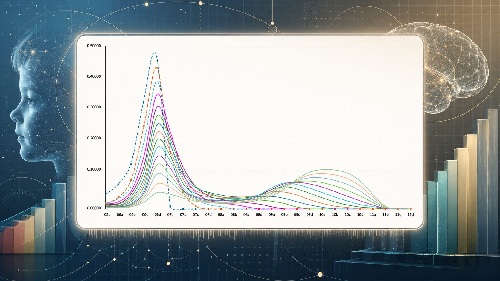 "The Lectical Scale" by Brendan Graham Dempsey[1] is a chapter excerpt from what appears to be Dempsey's book-in-progress on symbolic learning and developmental psychology—essentially a promotional précis of Theo Dawson's Lectical Assessment System (CLAS). Here's a pointed critical review: What the essay does wellThe exposition is competent and clearly written. Dempsey traces a credible lineage from Piaget through Fischer and Commons to Dawson, and the footnotes are genuinely substantive—unusual for Substack. The core empirical claim he summarizes (that hierarchical complexity underlies multiple domain-specific stage models, as demonstrated via Rasch analysis and factor analysis) is a real finding in the psychometrics literature, not a confection. The density-distribution scoring method is explained clearly enough that a non-specialist can grasp it. The central critical problem: advocacy masquerading as synthesisThe essay's main failure is that it presents one research program—Lectica's—as though it were the settled culmination of an entire scientific tradition. Dempsey describes Lectica's measurement capabilities as “the cutting-edge in cognitive-developmental psychometrics” and “the culmination of the constructivist tradition in psychology to date.” This is promotional language, not scholarly assessment. No competing approaches are even mentioned, let alone evaluated. There is no acknowledgment of the substantial critiques of stage theory itself—from situated cognition theorists, cultural psychologists, or dynamic systems researchers who question whether “hierarchical complexity” is a domain-general psychological reality or a methodological artifact. The validity of the core construct goes unexaminedDempsey leans heavily on the correlation between CLAS scores and human rater scores as evidence of validity. But this confuses reliability with validity. If trained human raters already share the same theoretical assumptions as the scoring system, high inter-rater agreement and high CLAS-to-human correlation tells you the system is internally consistent—not that it's measuring something real in the world. The question of construct validity—whether “hierarchical complexity” maps onto anything psychologically meaningful outside the scoring framework—is never posed. The lexical inference problemThe claim that vocabulary distribution can reliably index cognitive complexity deserves more skepticism than it gets. CLAS analyzes texts to see what range of complexity levels is represented by their language use, with the algorithm awarding precise numerical scores based on density distribution curves. But vocabulary sophistication is heavily confounded with education, socioeconomic background, cultural exposure, and domain expertise. A philosopher who uses abstract vocabulary fluently because of disciplinary training may score “higher” than a skilled practical reasoner whose domain doesn't require that vocabulary. The system could be measuring discursive register rather than cognitive structure. Dempsey doesn't engage this at all. The metaphor of the “millimeter” ruler is epistemically misleadingDempsey argues that if Piaget gave us a yardstick and Fischer and Commons gave us feet, then Dawson's Lectical Scale gives us millimeters. This is rhetorically effective but conceptually confused. Precision of measurement is only meaningful if you've established that the thing being measured is real and that the scale is interval rather than merely ordinal. A thermometer before the development of kinetic theory was precise but theoretically ungrounded. The Lectical Scale's 1,000-point numerical precision creates an illusion of physical-science-grade measurement for a domain where the ontological status of the underlying construct remains contested. Cultural and linguistic universalism assumed, not arguedThe system is built on approximately 100,000 scored texts, with the Lectical Dictionary containing over 40,000 items based on those texts. One obvious question: what is the cultural and linguistic distribution of that corpus? Developmental stage theory has a long and troubled history with cross-cultural universalism—Kohlberg's model famously showed systematic variation across cultures that was interpreted as developmental deficit rather than difference. If the training corpus is predominantly English-language and Western, CLAS may be encoding cultural-linguistic norms as universal developmental stages. This problem is entirely invisible in Dempsey's account. The broader framing imports unearned metaphysicsDempsey's enclosing framework—“Symbolic Learning,” “the evolution of meaningful knowledge”—suggests that CLAS is being recruited into a larger project where “hierarchical complexity” becomes a universal axis of cosmic development, not just a psychometric instrument. He frames the progression as showing that “hierarchical complexity measures Symbolic Learning” and positions the discussion as leading toward “the evolution of meaningful knowledge as it develops in the human psyche.” Given that Dempsey is a known advocate of Wilberian and post-Wilberian frameworks, there is a real risk that Lectica's empirical tool is being smuggled into a metaphysical agenda it cannot legitimately support. ConclusionThis is a well-written but uncritical promotional summary of Lectica's work. As a chapter in a book arguing for a grand theory of symbolic development, it is doing theoretical groundwork—establishing that something like hierarchical complexity can be measured. But it reads more like a literature review written by a true believer than a rigorous evaluation. The hard questions—about construct validity, cultural bias in the corpus, the conflation of linguistic register with cognitive structure, and the gap between psychometric precision and explanatory depth—are simply absent. Readers should treat it as a useful introduction to an interesting research program, not as the authoritative verdict Dempsey frames it as. Appendix: CLAS denies the concept of a "centre of gravity"That's a sharp catch, and it's more significant than it might first appear. Wilber's “center of gravity” concept is load-bearing in Integral Theory“it's the mechanism by which a self is said to have a characteristic “altitude,” a home base stage that organizes its overall functioning across domains. Without it, you lose the theoretical basis for claims like “this person is operating at Teal” or “second-tier consciousness,” and with it much of the practical application apparatus of Integral (the Integral Life Practice framework, the AQAL assessments, the organizational development consulting). If Dawson's own CLAS documentation explicitly rejects the center of gravity model, this creates a serious problem for Dempsey's essay—and for the broader Integral project's appropriation of Lectica's work. The essay presents CLAS as the empirical vindication of neo-Piagetian stage theory, and Integral enthusiasts routinely cite Lectica as scientific support for Wilber's altitude model. But if Dawson herself is repudiating one of that model's central organizing concepts, then the appropriation is running directly against the source. The more precise finding from Lectica's data—which the center-of-gravity rejection reflects—is that people show significant intra-individual variability across domains and tasks. Your “level” isn't a stable global property of the self; it's a dynamic, context-sensitive performance characteristic. This is exactly what Fischer's dynamic skill theory predicts, and it's incompatible with Wilber's essentially vertical, self-as-locus model. This deserves a footnote in any serious critique of Dempsey's piece: he's using Lectica to build toward a framework that Lectica's own methodology undermines. Worth tracking down that slide deck and citing it directly if you write this up. 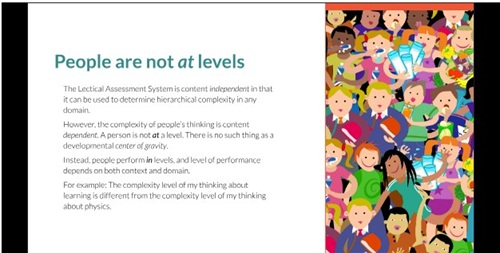 That's the smoking gun. Slide 11, verbatim: “A person is not at a level. There is no such thing as a developmental center of gravity.” “Instead, people perform in levels, and level of performance depends on both context and domain.” This is Dawson explicitly, in plain English, on her own platform, repudiating the central organizing concept of Wilberian altitude theory. It's not an academic aside buried in a methods paper—it's a public-facing explainer slide designed for non-specialists. The critical implication for your Dempsey review is precise and damaging: Dempsey is building toward a “Symbolic Learning” framework that will almost certainly deploy Lectical scores as evidence of developmental altitude—a global property of persons or cultural productions. But the instrument's own creator says that's a misuse of the tool. The tool measures performances in domains, not persons. You can't read Lectical scores as evidence that someone “is at” a given level of consciousness any more than you can say someone “is at” the complexity level of their weakest subject. For your write-up, the citation would be: Theo Dawson, “About Skill Levels,” lectica.org/about/skill-levels, slide 11. Direct, citable, authoritative, and fatal to the Integral appropriation of this research.
NOTES[1] Brendan Graham Dempsey, "The Lectical Scale, The Cutting-Edge in Developmental Psychometrics", brendangrahamdempsey.substack.com, Jun 15, 2026.
Widget is loading comments...
|