|
TRANSLATE THIS ARTICLE
Integral World: Exploring Theories of Everything
An independent forum for a critical discussion of the integral philosophy of Ken Wilber
  Frank Visser, graduated as a psychologist of culture and religion, founded IntegralWorld in 1997. He worked as production manager for various publishing houses and as service manager for various internet companies and lives in Amsterdam. Books: Ken Wilber: Thought as Passion (SUNY, 2003), and The Corona Conspiracy: Combatting Disinformation about the Coronavirus (Kindle, 2020). Frank Visser, graduated as a psychologist of culture and religion, founded IntegralWorld in 1997. He worked as production manager for various publishing houses and as service manager for various internet companies and lives in Amsterdam. Books: Ken Wilber: Thought as Passion (SUNY, 2003), and The Corona Conspiracy: Combatting Disinformation about the Coronavirus (Kindle, 2020).
Check out my other conversations with ChatGPT Finding Radical WholenessAnd the Modern Quest for SalvationFrank Visser / ChatGPT
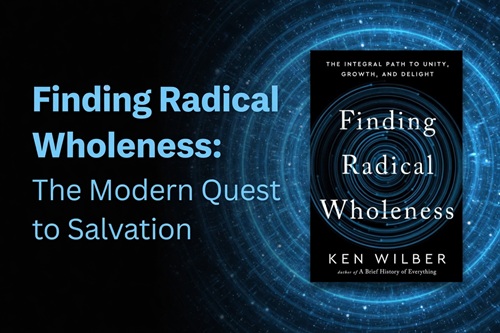 Introduction: A Gospel for the Psychologically SophisticatedWhen Ken Wilber published Finding Radical Wholeness, he presented it primarily as a practical guide to human development and spiritual awakening. The book introduces his updated "AQAL" framework, developmental stages, shadow work, meditation, and what he calls the realization of "radical wholeness." Yet beneath its psychological language lies something much older: a vision of salvation. Indeed, the book can be read as a contemporary expression of humanity's perennial longing to overcome fragmentation, suffering, alienation, and mortality. What makes it distinctive is that it translates traditional religious aspirations into the language of developmental psychology, systems theory, and consciousness studies. It is salvation without sin, enlightenment without monastery walls, and transcendence without traditional theology. The result is a particularly modern form of religiosity—one adapted to an audience that is scientifically educated, psychologically aware, and suspicious of conventional religion, yet still deeply attracted to spiritual fulfillment. The Structure of SalvationReligions throughout history have typically offered answers to four fundamental questions: • What is wrong with the human condition? • What is the ultimate reality? • What path leads to liberation? • What is the final goal? Wilber's answers fit this structure remarkably well. What is wrong? Human beings are identified with partial perspectives, trapped in developmental limitations and fragmented by unintegrated psychological material. What is ultimate reality? Reality is an evolving Kosmos whose deepest nature is nondual Spirit. What is the path? Integral practice: meditation, shadow work, developmental growth, ethical cultivation, and perspective-taking. What is the goal? Realization of radical wholeness—the recognition that individual consciousness and ultimate reality are already one. This structure closely resembles classical religious systems, even though the terminology differs. Instead of salvation from sin, Wilber offers liberation from fragmentation. Instead of union with God, he offers realization of nondual Spirit. Instead of conversion, he offers developmental transformation. The underlying pattern remains surprisingly familiar. Mysticism as the CoreAmong the many varieties of religion, Wilber's approach belongs most clearly to the mystical tradition. Mystical religions emphasize direct experience of ultimate reality rather than obedience to doctrine or ritual. The highest truth is not believed but realized. This places Wilber closer to figures such as Meister Eckhart, Shankara, and Jalal al-Din Rumi than to traditional theologians. Like many mystics, Wilber argues that ordinary consciousness creates the illusion of separation. Liberation comes through awakening to a deeper unity already present. What distinguishes him from earlier mystics is his insistence that mystical realization must be supplemented by psychological development. Enlightenment alone is insufficient; one must also grow through developmental stages and integrate shadow material. Thus his spirituality is not merely mystical but psycho-mystical. The Therapeutic TurnPerhaps the most striking feature of Finding Radical Wholeness is its fusion of spirituality and psychotherapy. • Classical Christianity focused on sin. • Classical Buddhism focused on suffering. • Modern psychology focuses on trauma, repression, projection, and emotional dysfunction. Wilber increasingly interprets spiritual growth through this therapeutic lens. Personal wounds become obstacles to awakening. Psychological integration becomes part of the spiritual path. This reflects a broader transformation in contemporary spirituality. Many people today seek healing rather than redemption. They speak of trauma rather than sin, authenticity rather than holiness, integration rather than obedience. Wilber's vision fits naturally within this cultural shift. His ideal human being resembles a spiritually awakened psychotherapist's client more than a medieval saint. The Religion of DevelopmentAnother defining characteristic is developmentalism. Many religions divide humanity into believers and unbelievers, saved and unsaved, enlightened and unenlightened. Wilber instead organizes humanity according to developmental stages. People are seen as occupying different levels of cognitive, moral, and spiritual complexity. Growth involves ascending through increasingly comprehensive forms of consciousness. This creates a spiritual hierarchy that differs from traditional religion but serves a similar function. • Traditional Christianity distinguished saints from sinners. • Traditional Hinduism distinguished enlightened sages from ordinary persons. • Integral Theory distinguishes higher developmental stages from lower ones. The language changes, but the aspiration toward higher forms of being remains. Critics have often noted that this developmental hierarchy can create a subtle spiritual elitism, in which advanced stages function as a new aristocracy of consciousness. Comparison with Other Religious TypesTraditional ChristianityChristianity centers on humanity's estrangement from God and the need for divine grace. Wilber shifts the focus from dependence on God to realization of one's deeper identity with Spirit. Christianity emphasizes salvation through relationship. Wilber emphasizes awakening through realization. The former is fundamentally theistic; the latter is fundamentally nondual. Classical BuddhismWilber's vision has strong Buddhist affinities. • Both see suffering as rooted in mistaken identification. • Both seek liberation through awakening. • Both emphasize contemplative practice. Yet traditional Buddhism is generally more cautious about grand narratives of cosmic evolution. Wilber's vision incorporates a vast evolutionary story moving toward increasing consciousness and complexity. In this respect he adds a distinctly modern layer absent from much traditional Buddhism. New Age SpiritualityWilber frequently criticizes New Age thinking, yet shares important features with it. • Both emphasize personal transformation. • Both privilege direct experience over authority. • Both draw eclectically from multiple traditions. The difference lies in intellectual sophistication. Wilber attempts to provide philosophical and developmental frameworks that many New Age approaches lack. One might call Integral Theory the graduate-school version of New Age spirituality. GnosticismPerhaps the most intriguing comparison is with ancient Gnosticism. Gnostics believed salvation came through special knowledge—gnosis—that revealed humanity's true nature. Wilber similarly emphasizes transformative insight into the nature of consciousness and reality. Of course, he rejects the dualistic cosmology of ancient Gnosticism. Yet the underlying conviction remains similar: ignorance is the fundamental problem, and awakening is the solution. In this sense, Integral spirituality may be understood as a modernized, psychologically informed form of gnosis. A Spirituality for Secular IntellectualsThe enduring appeal of Wilber's work lies partly in its ability to satisfy spiritual longings without requiring traditional religious belief. Many contemporary seekers no longer find literal heavens, miracles, divine interventions, or scriptural authority convincing. Yet they still seek meaning, transcendence, purpose, and transformation. Wilber offers a framework that preserves these aspirations while clothing them in the language of psychology, evolution, systems theory, and consciousness studies. His audience is often composed of people who have left conventional religion but remain unconvinced by materialism. Integral spirituality occupies the middle ground between church and laboratory. Conclusion: Salvation ReimaginedViewed sociologically and historically, Finding Radical Wholeness represents a distinctive form of modern religiosity: mystical, therapeutic, developmental, and evolutionary. Its promise is ancient. Human beings have always longed to overcome fragmentation and participate in a larger reality. What changes from age to age is the language in which that longing is expressed. • Medieval Christianity spoke of salvation. • Buddhism spoke of enlightenment. • Ancient Gnostics spoke of gnosis. • Wilber speaks of radical wholeness. The vocabulary differs, but the existential aspiration remains remarkably constant: the hope that human beings can transcend their limitations, discover a deeper identity, and find ultimate meaning within a greater whole. Whether one regards Integral Theory as profound insight or sophisticated metaphysics, its emotional and spiritual appeal derives from this enduring promise. It offers not merely a theory of consciousness, but a contemporary path to redemption—one tailored for the psychologically minded seeker of the twenty-first century. Appendix: A Skeptical Look at the Whole EnterpriseA skeptical reading of Finding Radical Wholeness and the broader Integral framework begins by questioning not its psychological insights, but its metaphysical ambition.[1] The core issue is not whether meditation, shadow work, or developmental psychology are useful—they often are—but whether they legitimately add up to the kind of unified theory of consciousness and reality that is being implied. The first point of critique concerns explanatory overreach. The framework tends to assemble heterogeneous domains—neurology, developmental psychology, contemplative practice, systems theory, and metaphysical claims about “Spirit”—into a single hierarchical architecture. Each domain has its own methods, evidential standards, and internal debates. The skeptical worry is that integration here may sometimes function less as synthesis and more as compression: differences are absorbed into a prior schema that already knows where everything belongs. This produces a second issue: theoretical immunity. Because the model is so expansive, almost any counterexample can be reinterpreted as a “partial truth” at a lower or narrower level of the spectrum. This makes the framework difficult to falsify in a strict sense. It is not merely a theory of consciousness; it can behave like a meta-language that reclassifies objections rather than engaging them on equal footing. From a philosophy-of-science perspective, this shifts it closer to metaphysical system-building than to empirical theory construction. A third concern is the subtle reintroduction of teleology. Although framed in developmental and evolutionary language, the model often implies directional movement toward greater integration, awareness, or “wholeness.” This can be read as a secularized form of spiritual progress narrative. The risk here is that descriptive accounts of cognitive development and cultural complexity are quietly fused with normative claims about higher and lower stages of consciousness. The result is an implicit value hierarchy that can be difficult to disentangle from empirical description. A fourth skeptical line focuses on psychological substitution. What appears in Wilber's work as a comprehensive map of reality can also be read as a sophisticated meaning-management system. In this reading, metaphysical claims about nondual Spirit and cosmic evolution function less as ontological discoveries and more as existential consolations—ways of organizing uncertainty, mortality, and fragmentation into a coherent narrative of ultimate reconciliation. This does not make them false by definition, but it relocates them into the domain of meaning-making rather than knowledge in a strict epistemic sense. There is also a sociological dimension. Integral discourse tends to attract individuals who are highly educated, philosophically inclined, and dissatisfied with both reductive materialism and traditional religion. This positioning creates a niche culture with its own internal forms of authority: developmental rankings, access to “integral” insight, and interpretive privilege for those fluent in the system. Critics sometimes argue that this can generate a soft form of epistemic enclosure, where disagreement is reframed as evidence of lower-stage cognition. Finally, there is the question of what is lost in the attempt to totalize. Fragmentation, contingency, and irreducible pluralism are not necessarily problems to be solved; they may be structural features of human cognition and culture. From a more pluralist or pragmatist standpoint, the aspiration to “radical wholeness” risks smoothing over precisely those tensions that generate intellectual and ethical vitality. A skeptical conclusion, then, would not dismiss the entire project, but would reclassify it. Rather than a unified theory of consciousness or a map of ultimate reality, it may be more accurate to see it as a powerful contemporary mythos: psychologically sophisticated, spiritually resonant, but still operating within the classic religious function of offering coherence, orientation, and existential consolation in the face of fragmentation. The key question is not whether such a mythos is valuable—it clearly is for many—but whether one mistakes its integrative elegance for ontological finality. NOTES[1] See: Frank Visser, "The Search for a 'Big Wholeness', Review of Ken Wilber's Finding Radical Wholeness", www.integralworld.net, July 2024.
Widget is loading comments...
|