|
TRANSLATE THIS ARTICLE
Integral World: Exploring Theories of Everything
An independent forum for a critical discussion of the integral philosophy of Ken Wilber
  Frank Visser, graduated as a psychologist of culture and religion, founded IntegralWorld in 1997. He worked as production manager for various publishing houses and as service manager for various internet companies and lives in Amsterdam. Books: Ken Wilber: Thought as Passion (SUNY, 2003), and The Corona Conspiracy: Combatting Disinformation about the Coronavirus (Kindle, 2020). Frank Visser, graduated as a psychologist of culture and religion, founded IntegralWorld in 1997. He worked as production manager for various publishing houses and as service manager for various internet companies and lives in Amsterdam. Books: Ken Wilber: Thought as Passion (SUNY, 2003), and The Corona Conspiracy: Combatting Disinformation about the Coronavirus (Kindle, 2020).
Check out my other conversations with ChatGPT Matthew Kneale's Atheist History of ReligionBelief as Humanity's Greatest InventionFrank Visser / ChatGPT
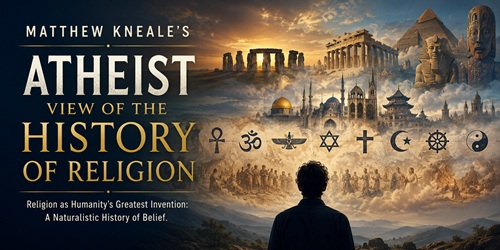 Few recent writers have attempted a grand narrative of religion from an explicitly atheist perspective as ambitiously as Matthew Kneale. In his book An Atheist's History of Belief (2013), he sets out to explain not merely the history of particular religions but the origin and evolution of religious belief itself. His central claim is strikingly simple: gods are human creations, religion is a human invention, and the history of belief can be understood entirely in naturalistic terms. Unlike the confrontational style associated with the "New Atheists" such as Richard Dawkins or Christopher Hitchens, Kneale presents himself as a storyteller tracing humanity's long effort to cope with uncertainty, fear, suffering, and death. Yet beneath this relatively calm narrative lies a radically reductionist interpretation of religion. Religious traditions become, in essence, successive psychological technologies designed to comfort human beings in an unpredictable world. The result is an engaging but controversial account that raises important questions about both religion and atheism. Religion Begins with FearKneale's starting point is prehistoric humanity. He asks why early humans first imagined spirits and supernatural beings. His answer is psychological rather than theological. Primitive people confronted a world filled with danger, disease, death, storms, predators, and inexplicable events. Faced with these threats, they naturally sought hidden agents behind them. According to Kneale, belief in spirits emerged because human beings are predisposed to detect agency everywhere. A rustle in the bushes might be a predator. A drought might be caused by an angry spirit. A dream might reveal a separate soul. The supernatural was born from attempts to explain and control an uncertain environment. In this view, religion was not revealed from above but invented from below. It was an adaptive response to existential anxiety. This argument aligns with contemporary cognitive science of religion, which often explains religious belief as a byproduct of evolved mental mechanisms. However, Kneale places less emphasis on cognitive theory than on emotional need. For him, religion's primary function is consolation. Gods Evolve as Humans EvolveOne of Kneale's most interesting themes is that gods change as societies change. Religious ideas are not fixed revelations but evolving cultural products. As human societies became larger and more complex, their gods became larger and more complex as well. Tribal spirits gave way to national deities. Agricultural civilizations developed fertility gods. Empires produced universal gods. Monotheism reflected political centralization. The history of religion therefore becomes a mirror of human social development. Kneale sees this process not as divine guidance but as cultural evolution. Gods survive because they meet human needs. Religious systems compete with one another much as political ideologies compete. Those beliefs that provide the greatest psychological reassurance or social cohesion often spread most successfully. This evolutionary perspective echoes earlier thinkers such as David Hume, Ludwig Feuerbach, and Sigmund Freud, all of whom interpreted religion as a projection of human needs rather than a response to divine reality. The Invention of Heaven and HellFor Kneale, one of humanity's most powerful religious innovations was the afterlife. Early religions often focused on immediate concerns such as fertility, weather, and survival. Over time, however, religions increasingly addressed the problem of death itself. Paradise, heaven, salvation, and eternal life emerged as solutions to humanity's deepest fear. Likewise, hell provided a mechanism for enforcing moral behavior and social conformity. Kneale views these doctrines not as discoveries about cosmic reality but as inventions that made religious systems more compelling. A religion that promises eternal reward or threatens eternal punishment possesses enormous motivational power. This perspective treats religious doctrines as functional rather than factual. The question is not whether heaven exists but why humans found the concept appealing. Judaism, Christianity, and IslamKneale devotes substantial attention to the Abrahamic traditions. He interprets their development historically rather than theologically. Ancient Israel's religion is presented as a gradual construction shaped by political crises, exile, and national identity. Christianity is understood as an outgrowth of Jewish apocalyptic hopes, transformed by the beliefs of Jesus' followers after his death. Islam is interpreted as another historical synthesis, responding to the social and religious circumstances of seventh-century Arabia. Throughout, Kneale rejects supernatural explanations. Miracles, revelations, prophecies, and divine interventions are treated as human stories rather than historical realities. His emphasis falls on social, political, and psychological forces. Religious movements succeed not because they are true but because they satisfy needs and solve problems for their adherents. Religion as ComfortPerhaps the most important idea in Kneale's work is that religion functions primarily as comfort. People believe because belief alleviates fear. Religions provide explanations for suffering, assurances about death, moral frameworks, and a sense of cosmic significance. They transform a frightening universe into a meaningful one. Kneale repeatedly returns to this theme. Whether discussing prehistoric shamans, medieval Christianity, or modern spiritual movements, he sees the same underlying pattern: human beings constructing narratives that help them endure life's uncertainties. In this sense religion is not merely an error. It is a creative achievement. Kneale often describes belief as one of humanity's greatest inventions, reflecting our remarkable imaginative capacities. The Strengths of Kneale's ApproachKneale's greatest strength is his insistence that religion belongs within human history. Rather than treating religious traditions as isolated revelations, he places them within broader social and cultural developments. This approach highlights the undeniable fact that religions change over time, absorb influences, and respond to historical circumstances. His narrative is also accessible. Unlike many academic studies of religion, Kneale writes for general readers. He offers a sweeping overview that connects ancient myths, organized religions, and modern movements within a single explanatory framework. Furthermore, his emphasis on existential anxiety captures an important truth. Fear of death, suffering, and uncertainty undoubtedly plays a major role in religious life. The Limits of ReductionismYet Kneale's interpretation has attracted significant criticism. Critics argue that he reduces religion to a single cause: psychological comfort. Both reviewers and scholars have noted that religious life is far richer and more diverse than this explanation allows. Religion is not only consolation. It is also wonder, moral aspiration, communal identity, aesthetic experience, intellectual inquiry, mystical practice, and social transformation. Moreover, many religious traditions emphasize difficult truths rather than comforting illusions. The prophets of ancient Israel, the Buddha's teachings on suffering, and Christian calls to self-sacrifice often challenge rather than soothe believers. Kneale also tends to treat religious doctrines primarily as strategic inventions. This can create the impression that religious leaders consciously manipulated followers, whereas historical reality is usually more complex. Most founders and reformers appear to have sincerely believed what they taught. A further weakness is his limited engagement with theology itself. To explain why beliefs emerged is not necessarily to explain why they persuaded millions of people across centuries. An Alternative ReadingA more balanced interpretation might combine Kneale's insights with those of scholars such as Mircea Eliade, William James, and Charles Taylor. From this perspective, religions are indeed human creations shaped by historical circumstances. Yet they are also attempts to engage profound questions about meaning, morality, consciousness, and existence. Even if one rejects supernatural claims, religion need not be understood merely as collective wish-fulfillment. It can also be viewed as humanity's ongoing effort to interpret reality itself. ConclusionMatthew Kneale's atheist history of religion offers a bold and compelling narrative. Religion, in his account, is neither revelation nor divine truth. It is humanity's most ambitious imaginative project—a vast cultural invention designed to confront fear, explain mystery, and provide comfort in the face of mortality. His book succeeds in reminding us that religious ideas have histories and that those histories can be studied without invoking the supernatural. Yet his explanation often becomes too narrow. By treating religion primarily as a response to fear and insecurity, he risks overlooking the intellectual, moral, aesthetic, and mystical dimensions that have made religion such a persistent feature of human civilization. The enduring challenge for both believers and atheists remains the same: to explain why religious ideas have exercised such extraordinary power over the human imagination for tens of thousands of years. Kneale offers one answer. It is an important answer, but it is unlikely to be the final one. Appendix: Matthew Kneale versus Ken Wilber on ReligionIf Matthew Kneale and Ken Wilber were placed in the same room, they would likely agree on only one thing: religion has played a central role in human history. Beyond that, their interpretations diverge dramatically. Kneale sees religion as a human invention. Wilber sees it as a human response to a genuine spiritual reality. The contrast illustrates two fundamentally different ways of understanding religion: one naturalistic and skeptical, the other developmental and spiritual. Religion: Human Projection or Spiritual Discovery?For Kneale, religion emerges from below. Human beings face uncertainty, suffering, and death. To cope, they invent spirits, gods, heavens, and cosmic narratives. Religion is therefore a projection of human hopes and fears onto the universe. This places Kneale in the tradition of thinkers such as Ludwig Feuerbach, Sigmund Freud, and Richard Dawkins. Gods do not create humans; humans create gods. Wilber reverses the equation. While he acknowledges that religions contain myths, projections, and cultural conditioning, he argues that mystical experiences reveal genuine dimensions of reality. Religious traditions are not merely fantasies but imperfect maps of transcendent states of consciousness. For Wilber, the existence of spiritual experience itself is evidence that religion points toward something real. Thus where Kneale sees invention, Wilber sees discovery. The Origin of ReligionKneale explains religion through evolutionary psychology and cultural history. Humans evolved agency-detection mechanisms. They see intentional forces behind natural events. Fear of death encourages belief in an afterlife. Social groups develop rituals that strengthen cohesion. Religious ideas spread because they provide comfort and stability. No supernatural explanation is required. Wilber accepts much of this but insists it is incomplete. According to Integral Theory, human consciousness evolves through developmental stages. Early religions emerge from archaic, magical, and mythic structures of consciousness. As consciousness develops, more sophisticated religious forms become possible. Religion is therefore not simply a response to fear but an expression of consciousness at different developmental levels. The difference is subtle but profound. Kneale asks: "What psychological needs produced religion?" Wilber asks: "What levels of consciousness produced religion?" Evolution Without Purpose versus Evolution With PurposePerhaps the greatest contrast concerns evolution itself. Kneale's worldview is fundamentally Darwinian. Life evolves through natural processes without overarching purpose or direction. Religious beliefs evolve culturally because they are useful or attractive, not because they reveal cosmic truth. Wilber, by contrast, interprets evolution as evidence of a deeper spiritual impulse. He often refers to an inherent drive toward increasing complexity, consciousness, and self-awareness. In his writings this force is frequently called Eros. From Kneale's perspective, such ideas simply revive theology in modern language. What Wilber calls Eros, Kneale would likely regard as a poetic label attached to ordinary evolutionary processes. This disagreement mirrors a broader debate between scientific naturalism and spiritual teleology. Mystical ExperienceMysticism occupies a marginal role in Kneale's account. He generally treats religious experiences as psychological phenomena generated by the human brain. Visions, revelations, and spiritual insights are understood naturalistically. Wilber places mysticism at the very center of religion. He repeatedly argues that the deepest forms of religion are experiential rather than doctrinal. Mystics across cultures report similar states of non-dual awareness, unity, and transcendence. Wilber interprets these cross-cultural similarities as evidence for genuine spiritual realities. Kneale would likely explain such similarities through shared neurobiology. Wilber explains them through shared access to deeper dimensions of consciousness. Again, the same facts receive radically different interpretations. The Meaning of Religious DevelopmentBoth thinkers recognize that religions evolve historically. However, they interpret that evolution differently. For Kneale, religious change is largely adaptive. New doctrines emerge because they solve problems, strengthen communities, or address changing social circumstances. For Wilber, religious evolution also contains a developmental trajectory. Humanity gradually moves from mythic understandings of reality toward more universal and inclusive forms of spirituality. Thus Christianity, Buddhism, Islam, and modern spirituality become stages within a larger evolutionary unfolding of consciousness. Kneale sees no such upward trajectory. Religious history is change, but not necessarily progress. The Question of TruthAt bottom, the disagreement concerns truth. Kneale largely brackets or rejects religious truth claims. The important question is why people believe, not whether their beliefs correspond to reality. Wilber insists that at least some religious claims are true, particularly those grounded in contemplative experience. This creates an asymmetry between the two approaches. Kneale offers a genealogy of belief. Wilber offers a metaphysics of belief. One explains religion historically; the other seeks to justify it philosophically. Strengths and WeaknessesKneale's strength lies in parsimony. His explanations rely on well-established psychological, social, and evolutionary mechanisms. He invokes no supernatural realities and applies the same explanatory framework throughout history. However, critics may argue that he reduces religion too aggressively to comfort-seeking and social adaptation. Wilber's strength lies in taking religious experience seriously. He attempts to explain why spiritual traditions across cultures report profound transformative states. However, critics—including many contributors to Integral World—have argued that he often moves too quickly from the existence of spiritual experiences to conclusions about cosmic evolution, transcendent realms, and spiritual teleology. In this sense, Kneale risks reductionism, while Wilber risks metaphysical inflation. ConclusionMatthew Kneale and Ken Wilber represent opposite poles in the interpretation of religion. For Kneale, religion is humanity's most successful fiction: a powerful cultural invention that helped our ancestors navigate fear, suffering, and mortality. For Wilber, religion is humanity's imperfect but genuine encounter with deeper dimensions of reality and consciousness. Kneale sees gods as products of the human imagination. Wilber sees imagination, consciousness, and evolution themselves as expressions of Spirit. The debate between them ultimately reflects one of the oldest questions in philosophy: Is religion something we created, or something we discovered? Appendix 2: How would Kneale describe mystical religion?That's an excellent question, because it probes a potential weakness in Kneale's framework. Kneale's book ranges widely across religious history, but his explanatory focus remains largely on religion as a social and psychological phenomenon. He is especially interested in how belief systems emerge, spread, and satisfy human needs. The challenge posed by Hinduism, Buddhism, and mystical traditions is that they often seem less concerned with comforting stories about gods and more concerned with altered states of consciousness and direct experience. How might Kneale respond? I suspect he would extend his naturalistic approach rather than abandon it. A mystical experience would be interpreted as a genuine human experience, but not as evidence for a supernatural reality. The experience itself would be real; the metaphysical conclusions drawn from it would be viewed as culturally conditioned interpretations. For example, when a Hindu mystic experiences union with Brahman, Kneale would likely say: • The experience occurred. • It may be profound and transformative. • It may even have measurable neurological correlates. • But it does not demonstrate the existence of Brahman. Likewise, a Christian mystic encountering God, a Buddhist experiencing emptiness, and a Sufi experiencing divine union would be understood as having different interpretations of broadly similar human experiences. This is essentially the position of thinkers such as Sigmund Freud, Michael Persinger, and many contemporary cognitive scientists of religion. The experience is accepted. The ontology is questioned. This creates an interesting contrast with Wilber. Wilber argues that the remarkable similarity of mystical reports across cultures points toward a common spiritual reality. Mystics may use different languages, but they are climbing the same mountain. Kneale would probably reverse the logic. The similarity of reports points toward common features of human neurobiology and psychology, not toward a transcendent realm. The mountain itself disappears. Only the climbers remain. This becomes especially relevant in relation to Advaita Vedanta. A Wilberian might say that nondual realization reveals the deepest structure of reality. Kneale would likely say that nondual states reveal something important about consciousness, but not necessarily about the universe itself. That distinction is crucial. A person may experience: • dissolution of self, • unity with all things, • timelessness, • overwhelming bliss, • transcendence of subject-object duality. The question is what follows from that. Wilber says such experiences disclose fundamental truths about Spirit and Kosmos. Kneale would probably say they disclose fundamental truths about the capacities of the human mind. This is a much more parsimonious explanation. The deeper issue is that mystical traditions pose a challenge to simple "religion as comfort" theories. Many mystical paths are not obviously comforting. Traditional Hindu, Buddhist, and Christian contemplative disciplines often involve years of austerity, ego-transcendence, uncertainty, and psychological struggle. They can be profoundly destabilizing. The mystic is not necessarily seeking consolation. The mystic is seeking truth—or at least direct experience. This suggests that religion cannot always be reduced to wish fulfillment. A naturalist such as Kneale would need a broader explanation. He might argue that humans possess a powerful drive toward meaning, transcendence, and altered states of consciousness. Mystical traditions are cultural systems that cultivate and interpret these experiences. The experiences themselves are real, but the supernatural interpretations are not required. From your own perspective as a longtime critic of Wilber, the interesting point is that Kneale's approach would probably stop exactly where Wilber begins. Kneale would accept the phenomenology—the experiences reported by mystics. He would reject the metaphysics that Wilber builds upon those experiences. Wilber, by contrast, treats the experiences as evidence for an elaborate spiritual cosmology. So if Kneale had written a chapter specifically on Hindu mysticism or nondual spirituality, he likely would not have dismissed it as mere superstition. Rather, he would have treated it as a fascinating and important dimension of human consciousness whose existence requires explanation, while insisting that the experience itself cannot be used as proof of Brahman, Spirit, subtle realms, or cosmic evolution. In that sense, Kneale's real target is not mystical experience but what you have often called the "metaphysical superstructure" erected upon it. That is where his naturalism and Wilber's spiritual realism would part company most sharply.
Widget is loading comments...
|