|
TRANSLATE THIS ARTICLE
Integral World: Exploring Theories of Everything
An independent forum for a critical discussion of the integral philosophy of Ken Wilber
  Frank Visser, graduated as a psychologist of culture and religion, founded IntegralWorld in 1997. He worked as production manager for various publishing houses and as service manager for various internet companies and lives in Amsterdam. Books: Ken Wilber: Thought as Passion (SUNY, 2003), and The Corona Conspiracy: Combatting Disinformation about the Coronavirus (Kindle, 2020). Frank Visser, graduated as a psychologist of culture and religion, founded IntegralWorld in 1997. He worked as production manager for various publishing houses and as service manager for various internet companies and lives in Amsterdam. Books: Ken Wilber: Thought as Passion (SUNY, 2003), and The Corona Conspiracy: Combatting Disinformation about the Coronavirus (Kindle, 2020).
Check out my other conversations with ChatGPT The Other Nakba?The Forgotten Expulsion of Jews from the Arab WorldFrank Visser / ChatGPT
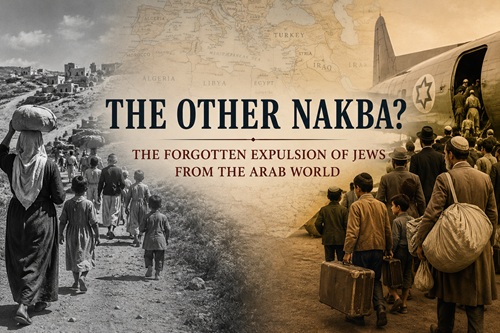 The Palestinian Nakba of 1948—the displacement of hundreds of thousands of Arabs during the war surrounding the creation of Israel—has become a central element of Arab historical memory and political identity. It is commemorated annually, taught in schools, and widely discussed in international forums. Far less known, however, is a parallel population upheaval that occurred throughout the Middle East and North Africa in the decades following Israel's creation: the exodus and expulsion of roughly 850,000 Jews from Arab and Muslim-majority countries. While the Palestinian Nakba is frequently described as one of the great refugee crises of the twentieth century, the Jewish refugee story remains largely absent from public consciousness. This raises an uncomfortable question: why is one displacement remembered worldwide while the other is often forgotten? Ancient Communities VanishBefore 1948, substantial Jewish communities existed throughout the Arab world. Many dated back centuries or even millennia before the rise of Islam. In Iraq, Jews traced their roots to the Babylonian Exile more than 2,500 years ago. In Egypt, Jewish communities had flourished since antiquity. Large populations also lived in Morocco, Yemen, Libya, Syria, and elsewhere. These communities were not always equal citizens. Under traditional Islamic rule, Jews often held "dhimmi" status, granting protection but also imposing legal and social restrictions. Nevertheless, many communities survived for centuries and developed rich religious and cultural traditions. By the mid-twentieth century, nearly a million Jews lived across the Arab world. Today, only a few thousand remain. The Shock of 1948The creation of Israel and the ensuing Arab-Israeli war transformed Jewish life throughout the region. Arab governments and populations often viewed their Jewish minorities with suspicion, seeing them as potential sympathizers with Zionism. In many countries, anti-Jewish riots erupted, businesses were confiscated, citizenship rights were curtailed, and arrests became common. The process varied from country to country. Some Jews left voluntarily out of fear and uncertainty. Others were subjected to direct expulsion, property seizures, or discriminatory legislation that made continued residence impossible. The result was a mass migration unprecedented in Middle Eastern history. Country by CountryIn Iraq, one of the oldest Jewish communities in the world collapsed almost overnight. Between 1950 and 1952, around 120,000 Iraqi Jews left under conditions that required them to renounce their citizenship and abandon much of their property. In Egypt, the nationalist regime of Gamal Abdel Nasser expelled or pressured tens of thousands of Jews to leave, particularly after the 1956 Suez Crisis. In Libya, anti-Jewish violence led to the departure of nearly the entire community. In Yemen, approximately 50,000 Jews were airlifted to Israel in the dramatic operation known as Operation Magic Carpet. In Algeria, Morocco, Tunisia, and elsewhere, independence movements, rising nationalism, and regional tensions contributed to a steady exodus. By the 1970s, most ancient Jewish communities of the Arab world had effectively disappeared. A Refugee Crisis of Comparable ScaleThe numbers are striking. Historians generally estimate that around 700,000 Palestinians became refugees during the 1948 war and its aftermath. Estimates for Jews leaving Arab countries range from approximately 800,000 to 900,000. In purely numerical terms, the two refugee crises were comparable. Yet their political trajectories diverged sharply. Most Jewish refugees were absorbed into Israel, with smaller numbers settling in Europe and North America. They eventually acquired citizenship and became integrated into their new societies, though often after enduring severe hardship and discrimination. Most Palestinian refugees, by contrast, remained stateless for generations or lived in refugee camps throughout the Middle East. Their refugee status became institutionalized and passed on to descendants. As a result, one refugee population gradually disappeared from international attention, while the other remained highly visible. Why the Jewish Exodus Is Less RememberedSeveral factors help explain the asymmetry in public memory. First, Israel absorbed the majority of Jewish refugees. Their integration, though difficult, reduced the visibility of their refugee status over time. Second, Arab governments emphasized the Palestinian experience as a symbol of injustice and national loss. The suffering of Jewish refugees did not fit this narrative and was therefore rarely acknowledged. Third, Israel itself often prioritized nation-building over refugee commemoration. Early Israeli society celebrated pioneering and renewal rather than victimhood. Finally, international institutions devoted extensive attention to Palestinian refugees but relatively little to Jews displaced from Arab countries. The consequence is a curious historical imbalance: one refugee story became globally recognized, while the other faded from view. Similarities and DifferencesComparisons between the Nakba and the Jewish exodus are often politically charged. Some argue that the two events cancel each other out, as if one displacement somehow compensates for the other. This is historically and morally problematic. Human suffering is not an accounting exercise. Others insist that the experiences are entirely unrelated. This too oversimplifies history. The reality is that both populations experienced profound trauma, loss of homes, confiscation of property, and forced migration. Yet the circumstances differed. The Palestinian displacement occurred primarily during a war in Palestine itself, whereas the Jewish exodus unfolded across multiple countries over several decades. Understanding these distinctions is essential for historical accuracy. Toward a More Complete HistoryRecognition of Jewish refugees from Arab countries does not diminish the tragedy of the Palestinian Nakba. Nor does acknowledging Palestinian suffering erase the experiences of Jews who lost homes, communities, and ancestral homelands throughout the Arab world. A mature historical perspective should be capable of holding both realities simultaneously. The twentieth century witnessed not one but two major refugee crises arising from the Arab-Israeli conflict. One became a central feature of global political discourse; the other largely disappeared from collective memory. A balanced understanding of Middle Eastern history requires acknowledging both. The descendants of Palestinian refugees and the descendants of Jewish refugees from Arab countries continue to carry the legacies of displacement. Recognizing that shared history may not resolve the conflict, but it does bring us closer to understanding its full human dimension. Appendix: What Prevented Palestinian Nation-Building?The question of Palestinian nation-building is inseparable from the historical conditions in which Palestinian political identity developed. Unlike many postcolonial cases where state formation followed a clear administrative transition, the Palestinian case evolved under prolonged external governance, repeated displacement, and fragmented territorial control. The result has been a national movement without a sovereign state, and a state-building project repeatedly interrupted by war and geopolitical constraint. 1. The Late Formation of a National FrameworkA key structural issue is chronological. Palestinian national identity, in its modern political form, crystallized relatively late compared to neighboring Arab nationalisms. During the late Ottoman period and the British Mandate era under United Kingdom administration, identity remained largely local, regional, or embedded within broader Arab or Islamic frameworks rather than focused on a distinct state project. By the time Palestinian nationalism became politically organized in the mid-20th century, the region was already undergoing rapid transformation due to Zionist settlement, British withdrawal, and escalating regional conflict. 2. The 1948 War and Fragmentation of TerritoryThe 1948 war surrounding the creation of Israel produced a decisive structural rupture. Palestinian society was geographically fragmented: large portions of the population became refugees in neighboring states, while other communities remained in the West Bank and Gaza under different political conditions. This fragmentation prevented the emergence of a unified political center. A viable state-building project typically requires territorial continuity and institutional consolidation; both were absent after 1948. 3. Governance Under External ControlAfter 1948, the West Bank came under Jordanian rule and Gaza under Egyptian administration. Palestinians in these territories did not exercise independent sovereignty. Instead, political development was subordinated to the strategic interests of surrounding Arab states. Following the 1967 war, Israel assumed military control over the West Bank and Gaza, introducing a new layer of occupation and administrative fragmentation. This dual history of external governance meant that Palestinian institutions developed under constraint rather than sovereignty. 4. The Refugee System and Political DispersalA significant portion of the Palestinian population became refugees dispersed across the region. Unlike classic nation-state formation processes, where a population consolidates within a bounded territory, Palestinians were distributed across multiple jurisdictions in Lebanon, Syria, Jordan, and beyond. This diaspora condition made centralized political organization difficult and reinforced dependence on external actors and host states. 5. Internal Political DivisionFrom the late 20th century onward, Palestinian political life became increasingly divided between competing movements, most notably Fatah and Hamas. The split between the West Bank and Gaza further entrenched institutional fragmentation after 2007. This internal division has weakened unified governance structures and complicated diplomatic negotiations with external powers. 6. Economic Constraints and Dependency StructuresNation-building requires not only political authority but also economic autonomy. Palestinian territories have remained heavily dependent on external aid, trade restrictions, and labor integration into the Israeli economy. These conditions limit fiscal sovereignty and constrain long-term institutional development. The absence of full control over borders, resources, and mobility further restricts conventional state-building capacity. 7. The Role of Conflict ContinuityUnlike postwar state formation contexts where conflict ends and reconstruction begins, the Israeli-Palestinian conflict has remained unresolved for decades. Ongoing cycles of violence, military occupation, and failed negotiations have repeatedly disrupted administrative consolidation and institutional maturation. 8. Conclusion: A Blocked but Not Absent Nation-Building ProcessIt is more precise to describe Palestinian nation-building not as absent, but as structurally obstructed. Despite fragmentation and constraint, Palestinians have developed many attributes of national identity: political representation, cultural cohesion, diplomatic recognition efforts, and institutional frameworks such as the Palestine Liberation Organization. The central issue is therefore not the absence of nationhood, but the absence of a stable sovereign framework within which nationhood can fully institutionalize into statehood.
Widget is loading comments...
|