|
TRANSLATE THIS ARTICLE
Integral World: Exploring Theories of Everything
An independent forum for a critical discussion of the integral philosophy of Ken Wilber
  Frank Visser, graduated as a psychologist of culture and religion, founded IntegralWorld in 1997. He worked as production manager for various publishing houses and as service manager for various internet companies and lives in Amsterdam. Books: Ken Wilber: Thought as Passion (SUNY, 2003), and The Corona Conspiracy: Combatting Disinformation about the Coronavirus (Kindle, 2020). Frank Visser, graduated as a psychologist of culture and religion, founded IntegralWorld in 1997. He worked as production manager for various publishing houses and as service manager for various internet companies and lives in Amsterdam. Books: Ken Wilber: Thought as Passion (SUNY, 2003), and The Corona Conspiracy: Combatting Disinformation about the Coronavirus (Kindle, 2020).
Check out my other conversations with ChatGPT Ken Wilber's Cosmic TelosThe Return of Purpose to Evolution?Frank Visser / ChatGPT
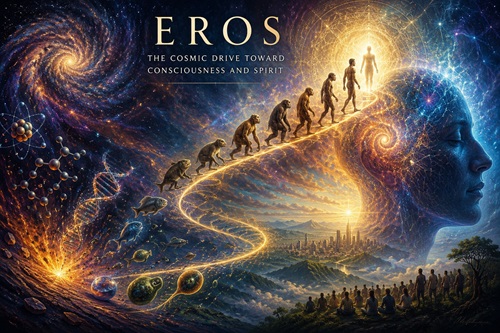 Few themes are more central to the philosophy of Ken Wilber than the idea that evolution possesses an inherent direction. Throughout his writings, from Sex, Ecology, Spirituality to later works such as A Brief History of Everything and The Religion of Tomorrow, Wilber argues that the universe is not merely a collection of accidental processes but is animated by a deep tendency toward greater complexity, consciousness, and self-awareness. This tendency is often expressed through the term Eros: a creative drive immanent within the cosmos that pushes matter toward life, life toward mind, and mind toward spirit. The concept is attractive because it offers a grand narrative that unites science, philosophy, psychology, and spirituality. Yet it is also one of the most controversial aspects of Wilber's thought. Critics have charged that his cosmic Eros rests on metaphor rather than evidence, reviving pre-scientific notions of purpose under a modern vocabulary. The debate over Wilber's Eros therefore raises a larger question: can evolution be understood as moving toward a goal, or is apparent directionality merely the result of natural processes operating without foresight? The Problem Wilber Seeks to SolveWilber begins with an observation. Over billions of years, the universe has produced increasingly complex forms: atoms, molecules, cells, organisms, brains, cultures, and reflective consciousness. He argues that this trajectory appears difficult to explain through chance alone. For Wilber, the standard neo-Darwinian account successfully explains adaptation and survival but does not fully account for the emergence of increasing complexity itself. He repeatedly asks why evolution should generate higher levels of organization at all. Why does matter organize into life? Why does life eventually generate mind? Why does consciousness become capable of self-reflection? His answer is that there exists an inherent tendency within reality toward greater depth and integration. Evolution is not random movement through possibility space; it exhibits a discernible vector. Eros as the Driving Force of EvolutionWilber borrows the Greek term Eros to describe this tendency. Unlike romantic love, Eros here refers to the universe's drive toward self-transcendence. According to Wilber, every holon—a term he uses for entities that are simultaneously wholes and parts—possesses two complementary tendencies. One is self-preservation, maintaining its integrity. The other is self-transcendence, reaching beyond its current form to participate in more complex wholes. Atoms combine into molecules. Molecules combine into cells. Cells combine into multicellular organisms. Organisms form societies. At each stage, a new level emerges that exceeds the capacities of its components. Wilber interprets this pattern as evidence that evolution contains an intrinsic upward movement. He often summarizes the process as a movement toward greater consciousness, wider perspectives, and deeper forms of awareness. Importantly, he does not usually portray Eros as an external designer intervening from outside the universe. Instead, Eros is said to be immanent within the evolutionary process itself. The universe is, in a sense, drawn toward its own realization of Spirit. Spirit-in-Action Enters the BuildingWilber's mature position identifies Eros with Spirit. In traditional religion, God often stands outside creation as its architect. Wilber instead proposes that Spirit manifests through evolutionary unfolding. The universe is not merely created by Spirit; it is Spirit gradually awakening to itself. This view draws heavily on philosophers such as Georg Wilhelm Friedrich Hegel, Alfred North Whitehead, and Pierre Teilhard de Chardin. Like Teilhard, Wilber sees evolution as a journey from matter to mind to spirit. Like Hegel, he sees history as a process of increasing self-awareness. The culmination of evolution is therefore not merely biological complexity but spiritual realization. Human beings represent a stage at which the cosmos becomes capable of consciously recognizing its own deepest nature. Wilber's Main Arguments for Cosmic ErosWilber advances several recurring arguments. The Emergence ArgumentHe points to the repeated appearance of novel levels of organization. New wholes emerge whose properties cannot be fully predicted from their parts. Because these emergent structures repeatedly move toward greater complexity, he infers an underlying developmental tendency. The Probability ArgumentWilber frequently suggests that the emergence of highly complex biological structures is extraordinarily improbable if driven solely by random mutation and natural selection. He argues that chance alone seems insufficient to account for evolutionary creativity. The Developmental ParallelAnother argument draws an analogy between individual development and cosmic evolution. Human beings reliably develop through increasingly complex cognitive stages. Wilber sees this developmental sequence as reflecting a broader evolutionary pattern operating throughout nature. The Phenomenological ArgumentWilber also appeals to spiritual experience. Mystics across cultures report encounters with an underlying unity or intelligence within reality. He interprets these experiences as evidence that evolution's apparent direction reflects a deeper spiritual ground. The Scientific CritiqueMost scientists reject Wilber's conclusions. Modern evolutionary theory does not regard increasing complexity as a universal goal. Natural selection favors reproductive success, not progress. While complexity can increase under certain conditions, many organisms remain simple because simplicity is often adaptive. Moreover, contemporary biology possesses mechanisms capable of generating complexity without invoking cosmic purpose. Cumulative selection, self-organization, developmental constraints, ecological interactions, and evolutionary innovation provide naturalistic explanations for the emergence of novel forms. Wilber often frames the issue as a choice between blind chance and Eros. Critics argue that this presents a false dichotomy. Evolutionary theory does not claim that complex organisms arise through pure randomness. Random variation is filtered by highly non-random selection processes operating over immense spans of time. As a result, many scientists see Wilber's critique of Darwinism as based on an oversimplified understanding of evolutionary mechanisms. The Philosophical CritiqueEven if evolution displays directionality, it does not necessarily follow that it has a goal. A river flows downhill in a predictable direction, yet no one assumes the river possesses intentions. Likewise, evolution may exhibit long-term trends without being guided toward a predetermined endpoint. Philosophers distinguish between teleonomy and teleology. Teleonomy refers to goal-like behavior produced by natural processes. Teleology implies genuine purpose. Critics argue that Wilber frequently moves from observations of increasing complexity to conclusions about cosmic purpose without adequately justifying the transition. This is perhaps the weakest point in his argument. Describing a pattern is not the same as explaining its cause. The Enduring Appeal of ErosDespite these criticisms, Wilber's notion of cosmic Eros continues to attract followers. One reason is existential. A purposeless universe can seem emotionally unsatisfying. Wilber offers a narrative in which human consciousness participates in a meaningful cosmic drama. Another reason is intellectual. Many people perceive long-term evolutionary history as exhibiting a remarkable trend toward increasing complexity and awareness. Wilber provides a vocabulary that integrates these observations into a coherent metaphysical vision. His account also resonates with longstanding philosophical traditions stretching from Plato to Teilhard de Chardin. The intuition that reality strives toward higher forms has deep roots in Western thought. Evaluation: Visionary Metaphysics or Spiritualized Evolution?Wilber's cosmic Eros is best understood not as a scientific theory but as a metaphysical interpretation of evolutionary history. Its strength lies in its capacity to synthesize diverse domains—cosmology, biology, psychology, culture, and spirituality—into a single grand narrative. It offers a vision of the universe that many find inspiring and meaningful. Its weakness lies in its evidential basis. The existence of increasing complexity does not by itself demonstrate the existence of Eros. The inference from evolutionary trends to cosmic purpose remains speculative. Furthermore, Wilber's criticisms of neo-Darwinism often underestimate the explanatory resources of contemporary evolutionary biology. The result is a theory that functions more effectively as philosophical mythology than as empirical explanation. Eros may serve as a powerful symbol for humanity's aspirations toward growth, integration, and self-transcendence. Whether it describes an actual force operating within nature remains unproven. In the end, Wilber's cosmic Eros stands as one of the most ambitious—and contentious—attempts to restore meaning and purpose to a universe that modern science increasingly explains without reference to either. For admirers, it reveals Spirit hidden within evolution. For critics, it projects spiritual hopes onto processes that require no such guidance. The debate persists because it touches one of humanity's oldest questions: is the universe going somewhere, or are we the ones creating the destination?
Widget is loading comments...
|