|
TRANSLATE THIS ARTICLE
Integral World: Exploring Theories of Everything
An independent forum for a critical discussion of the integral philosophy of Ken Wilber
  Frank Visser, graduated as a psychologist of culture and religion, founded IntegralWorld in 1997. He worked as production manager for various publishing houses and as service manager for various internet companies and lives in Amsterdam. Books: Ken Wilber: Thought as Passion (SUNY, 2003), and The Corona Conspiracy: Combatting Disinformation about the Coronavirus (Kindle, 2020). Frank Visser, graduated as a psychologist of culture and religion, founded IntegralWorld in 1997. He worked as production manager for various publishing houses and as service manager for various internet companies and lives in Amsterdam. Books: Ken Wilber: Thought as Passion (SUNY, 2003), and The Corona Conspiracy: Combatting Disinformation about the Coronavirus (Kindle, 2020).
Check out my other conversations with ChatGPT The Missing Volumes of Ken Wilber's Kosmos TrilogyFrank Visser / ChatGPT
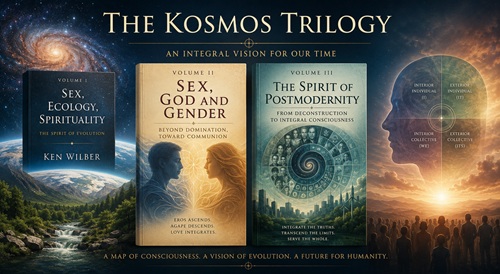 It's not impossible to imagine volumes two and three of the trilogy written by an LLM instructed to flesh out the implications of volume one. - Scott Parker[1] This is a delightful counterfactual exercise because Wilber left enough clues in his later writings to make an educated reconstruction possible. If Sex, Ecology, Spirituality (SES) was the grand synthesis of premodern, modern, and postmodern thought, the two unwritten volumes would likely have extended that synthesis into two areas that increasingly preoccupied him during the late 1990s: gender and spirituality on the one hand, and postmodern culture on the other. The irony, of course, is that much of the material probably ended up scattered across later books such as A Brief History of Everything, The Marriage of Sense and Soul, Integral Psychology, and especially Integral Spirituality. But let us imagine the trilogy completed as originally conceived. Volume II: Sex, God and GenderThe Central ThesisThe second volume would likely have addressed a problem left unresolved in SES: why do men and women appear to develop differently, spiritually, psychologically, and culturally? Wilber spent much of the 1990s wrestling with feminist critiques of developmental theories. Critics argued that hierarchical stage models were secretly male models disguised as universal truths. Drawing heavily on the work of Carol Gilligan and others, Wilber attempted to show that masculine and feminine modes of development followed different but equally valid trajectories. The central claim might have been: Spirit has no gender, but human access to Spirit is always mediated through gendered embodiment. Part One: The Great Gender WarsWilber would begin with a survey of feminist theory, distinguishing between: • Equality feminism • Difference feminism • Ecofeminism • Radical feminism • Postmodern feminism He would praise feminism for exposing patriarchal distortions while criticizing strands that reject hierarchy altogether. A recurring argument would be that developmental hierarchies are not systems of domination but systems of increasing complexity. Part Two: Eros and CommunionThis would become the heart of the book. Wilber repeatedly described masculine consciousness as tending toward agency, transcendence, autonomy, and ascent, while feminine consciousness tended toward communion, relationship, care, and inclusion. In classic Wilber fashion, he would insist that both tendencies exist in everyone. The drama of history would then be interpreted as an imbalance between: • Eros (ascending drive) • Agape (descending embrace) Civilization suffers whenever one pole overwhelms the other. Part Three: The Sacred FeminineHere Wilber would likely revisit goddess traditions, Tantric spirituality, and ecological spirituality. He would applaud their recovery of immanence while criticizing romantic attempts to replace transcendence with nature worship. A favorite Wilber refrain would reappear: The problem is not transcendence. The problem is dissociation. Part Four: Gender Beyond GenderThe culmination would be an integral account of gender identity. Wilber would argue that: • Biological sex matters. • Cultural constructions matter. • Individual experience matters. • Spiritual realization transcends all of them. This final section would attempt to reconcile traditional, modern, and postmodern views within a single AQAL framework. Critical ReceptionHad it appeared in 1998 or 1999, the book would probably have generated fierce controversy. Conservatives would accuse Wilber of relativism. Feminists would accuse him of essentialism. Postmodernists would accuse him of grand theorizing. Wilber would interpret all three criticisms as proof that he had found the integral middle path. Volume III: The Spirit of PostmodernityThe Central ThesisThe third volume would tackle what became Wilber's lifelong obsession: How can humanity preserve the truths discovered by postmodernism without succumbing to relativism? The book's guiding proposition would be: Postmodernism is both humanity's greatest achievement and its greatest danger. Part One: The Dignity of PostmodernityUnlike many conservatives, Wilber genuinely admired postmodern thinkers. He would celebrate contributions from figures such as Michel Foucault, Jacques Derrida, and Jean-Francois Lyotard. Their great achievement was exposing hidden power structures behind supposedly objective truths. Postmodernism taught humanity: • Cultural humility • Context sensitivity • Perspective taking • Recognition of marginal voices These capacities corresponded to what Wilber would later call the pluralistic or "green" stage. Part Two: The Disaster of GreenHere the knives would come out. Wilber's famous critique of "Boomeritis" would occupy center stage. The pluralistic worldview, he would argue, eventually collapses into contradictions: • All truths are relative. • Except the truth that all truths are relative. The result is what he later called "aperspectival madness." Universities, politics, and culture become trapped in endless deconstruction. Part Three: Integral ConsciousnessThis would be the true climax of the trilogy. Having synthesized: • Premodern spirituality • Modern rationality • Postmodern pluralism Wilber would introduce an emerging stage capable of integrating all three. This is the birthplace of Integral Theory as a civilizational project. The AQAL model would be expanded from a descriptive map into a prescription for global transformation. Part Four: Toward an Integral CivilizationThe final section would survey: • Integral politics • Integral education • Integral economics • Integral ecology • Integral spirituality Every social crisis would be reframed as a developmental crisis. Climate change, religious conflict, nationalism, and cultural fragmentation would all be interpreted as symptoms of humanity's difficult transition into second-tier consciousness. The Grand FinaleThe trilogy would likely conclude with an epic vision of Kosmos itself. The universe would be portrayed as an evolutionary unfolding from matter to life to mind to soul to spirit. The famous concept of Eros would return one last time: an intrinsic drive toward greater depth, complexity, consciousness, and unity. In other words, the final chapter would read very much like the closing pages of SES, only amplified to cosmic proportions. NOTES[1] Scott F. Parker, "Reading the Kosmos, A Review of Ken Wilber's Kosmos Trilogy", www.integralworld.net
Widget is loading comments...
|