|
TRANSLATE THIS ARTICLE
Integral World: Exploring Theories of Everything
An independent forum for a critical discussion of the integral philosophy of Ken Wilber
  Frank Visser, graduated as a psychologist of culture and religion, founded IntegralWorld in 1997. He worked as production manager for various publishing houses and as service manager for various internet companies and lives in Amsterdam. Books: Ken Wilber: Thought as Passion (SUNY, 2003), and The Corona Conspiracy: Combatting Disinformation about the Coronavirus (Kindle, 2020). Frank Visser, graduated as a psychologist of culture and religion, founded IntegralWorld in 1997. He worked as production manager for various publishing houses and as service manager for various internet companies and lives in Amsterdam. Books: Ken Wilber: Thought as Passion (SUNY, 2003), and The Corona Conspiracy: Combatting Disinformation about the Coronavirus (Kindle, 2020).
Check out my other conversations with ChatGPT Rupert SheldrakeThe Maverick Scientist Who Refuses to Stay in the BoxFrank Visser / ChatGPT
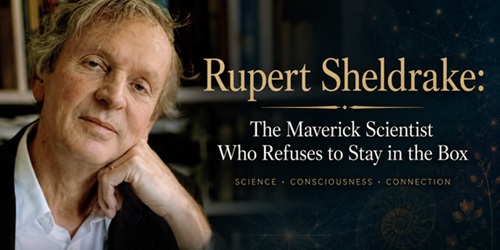 IntroductionFew contemporary thinkers have occupied a more controversial position between science and spirituality than Rupert Sheldrake. Admired by some as a courageous scientific pioneer and dismissed by others as a purveyor of pseudoscience, Sheldrake has spent decades challenging what he calls the "dogmas" of modern science. His ideas about morphic resonance, collective memory, telepathy, and the limits of materialism have generated both fascination and fierce criticism. Whether one agrees with him or not, Sheldrake remains relevant because he raises questions that many scientists and philosophers prefer to avoid: How much do we really know about consciousness? Are the laws of nature fixed? Can science investigate experiences traditionally relegated to religion or mysticism? And what happens when scientific orthodoxy becomes too rigid? The Theory of Morphic ResonanceSheldrake first gained international attention with his 1981 book A New Science of Life. There he proposed his most famous and controversial idea: morphic resonance. According to this hypothesis, organisms inherit not only genes but also collective memories from previous members of their species. Patterns of behavior, biological forms, and even habits become easier to reproduce because they have occurred before. Nature, in this view, possesses memory. A classic example concerns laboratory rats. If rats learn a new task in one part of the world, Sheldrake suggested, rats elsewhere might learn the same task more easily because of a shared morphic field. Similar ideas were applied to crystal formation, animal behavior, and human learning. Mainstream biology has largely rejected morphic resonance because it lacks a clearly defined mechanism and has not generated broadly accepted experimental confirmation. Yet the concept remains intriguing because it attempts to explain phenomena that conventional genetics and developmental biology may not fully address. Challenging Scientific MaterialismSheldrake's broader significance lies less in morphic resonance itself than in his critique of scientific materialism. He argues that modern science often operates with a set of unexamined assumptions: • Nature is fundamentally mechanical. • Consciousness is produced entirely by the brain. • The laws of nature are fixed. • Memory is stored exclusively in neural tissue. • Telepathy and related phenomena are impossible. In his book Science Set Free (published in the UK as The Science Delusion), he argued that these assumptions have hardened into dogmas. He insists that genuine science should remain open to investigating even highly unconventional possibilities. Many philosophers of science sympathize with this methodological point even while rejecting Sheldrake's conclusions. Science advances partly by questioning assumptions. The challenge is distinguishing productive speculation from unsupported conjecture. Consciousness Beyond the BrainPerhaps Sheldrake's most influential contribution concerns consciousness studies. Long before consciousness became a fashionable interdisciplinary field, he questioned the standard view that the mind is simply generated by neural activity. He proposed instead that the brain may function more like a receiver or filter than a producer of consciousness. This idea has historical precedents in thinkers such as William James, Henri Bergson, and Aldous Huxley. Although mainstream neuroscience remains firmly committed to brain-based explanations, debates about consciousness have become increasingly sophisticated. The so-called "hard problem" formulated by David Chalmers continues to challenge purely reductive accounts of subjective experience. In this respect, Sheldrake helped keep alternative possibilities alive during a period when such discussions were often dismissed outright. Animal Minds and Human-Animal ConnectionsOne of Sheldrake's most popular research areas involves animal behavior. His book Dogs That Know When Their Owners Are Coming Home examined reports of pets seemingly anticipating their owners' return. Similar studies investigated homing pigeons, telepathic experiences between humans and animals, and unusual forms of animal perception. Critics argue that these observations can often be explained by selective reporting, unconscious cues, or statistical coincidence. Nevertheless, the studies resonated with many people because they addressed experiences that pet owners frequently report but scientists rarely investigate. Here again, Sheldrake's relevance stems partly from his willingness to explore questions that conventional research often ignores. The Appeal to Spiritual SeekersSheldrake has become especially influential among audiences interested in spirituality, alternative medicine, and post-materialist philosophy. Unlike many New Age writers, however, he possesses formal scientific credentials. Educated at University of Cambridge and formerly a research fellow at Clare College, Cambridge, he speaks the language of science while questioning some of its dominant assumptions. This combination makes him attractive to readers seeking a bridge between scientific inquiry and spiritual experience. He offers a framework in which mystical experiences, telepathy, and collective consciousness might become legitimate subjects of investigation rather than automatic objects of skepticism. The CriticismsAny assessment of Sheldrake must acknowledge the substantial criticism directed toward his work. Many scientists contend that morphic resonance lacks predictive power and fails to meet standards of empirical rigor. Others argue that his experiments contain methodological weaknesses or are vulnerable to confirmation bias. The criticism is not merely ideological. Science depends on reproducible evidence, and most researchers remain unconvinced that Sheldrake's claims have met this threshold. Moreover, some philosophers argue that introducing mysterious fields or collective memories explains little unless those concepts themselves can be independently verified. The result is a peculiar situation: Sheldrake is highly visible in public discussions of science and consciousness while remaining largely marginalized within mainstream scientific institutions. Why Sheldrake Still MattersRupert Sheldrake's enduring relevance does not necessarily depend on whether morphic resonance is ultimately proven true. His importance lies in his role as a scientific dissenter. Throughout history, intellectual progress has often required individuals willing to question prevailing assumptions. Most such challenges fail, but occasionally they expose hidden limitations in accepted frameworks. Sheldrake occupies a space similar to other controversial boundary figures: not fully accepted by mainstream science, yet too persistent and influential to ignore. He continually reminds us that science is not merely a collection of facts but an evolving process of inquiry. Even his critics often engage with questions he helped popularize: the nature of consciousness, the possibility of non-local mental phenomena, the limits of reductionism, and the philosophical assumptions underlying scientific practice. ConclusionRupert Sheldrake remains one of the most provocative intellectual figures of the last half-century. His specific theories have attracted extensive criticism and have not achieved scientific acceptance. Yet his broader challenge to scientific orthodoxy continues to resonate. For supporters, he represents intellectual courage and openness to unexplored possibilities. For critics, he illustrates the dangers of speculation untethered from robust evidence. For observers, he serves as a reminder that the boundary between accepted science and forbidden questions is often more fluid than either side wishes to admit. In that sense, Sheldrake's greatest contribution may not be morphic resonance itself but his insistence that science should remain curious about mysteries it has not yet solved.
Widget is loading comments...
|