|
TRANSLATE THIS ARTICLE
Integral World: Exploring Theories of Everything
An independent forum for a critical discussion of the integral philosophy of Ken Wilber
  Frank Visser, graduated as a psychologist of culture and religion, founded IntegralWorld in 1997. He worked as production manager for various publishing houses and as service manager for various internet companies and lives in Amsterdam. Books: Ken Wilber: Thought as Passion (SUNY, 2003), and The Corona Conspiracy: Combatting Disinformation about the Coronavirus (Kindle, 2020). Frank Visser, graduated as a psychologist of culture and religion, founded IntegralWorld in 1997. He worked as production manager for various publishing houses and as service manager for various internet companies and lives in Amsterdam. Books: Ken Wilber: Thought as Passion (SUNY, 2003), and The Corona Conspiracy: Combatting Disinformation about the Coronavirus (Kindle, 2020).
Check out my other conversations with ChatGPT Truth EmergingSteve McIntosh's Evolutionary Optimism RevisitedFrank Visser / ChatGPT
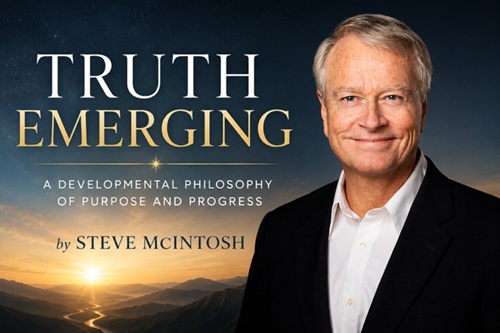 Steve McIntosh's new book, Truth Emerging: A Developmental Philosophy of Purpose and Progress, represents the latest installment in a decades-long effort to articulate an evolutionary worldview that integrates science, philosophy, culture, and spirituality. Known for earlier works such as Integral Consciousness, Evolution's Purpose, and Developmental Politics, McIntosh has consistently sought to formulate a modern philosophy capable of restoring meaning and direction to a secular age. Truth Emerging appears to be both a summary and refinement of this lifelong project. The book's central claim is straightforward yet ambitious: recent developments in science and philosophy reveal that evolution is not merely a blind process but one that discloses an underlying direction toward greater complexity, consciousness, value, and integration. Humanity's purpose, according to McIntosh, is to consciously participate in this developmental process by fostering spiritual growth, cultural advancement, and ecological maturity. This is a bold thesis. Whether readers find it inspiring or problematic will largely depend on how they view the relationship between facts and values, science and spirituality, and evolution and purpose. The Structure: Questions and Commentary
The format of the book is intriguing. Rather than presenting a continuous philosophical argument, McIntosh organizes the work around twenty key questions concerning developmental philosophy. Each receives a concise answer followed by a more extensive commentary. This structure offers several advantages. It makes complex ideas accessible to newcomers while allowing experienced readers to engage with deeper theoretical discussions. The question-and-answer format also reflects the pedagogical character of the book. McIntosh is not merely presenting a theory; he is attempting to educate readers into a particular way of seeing the world. The risk, however, is that the format may sometimes simplify issues that deserve more sustained examination. Questions about purpose, progress, truth, and evolution have occupied philosophers for centuries. Brief answers can sometimes obscure the magnitude of the controversies involved. The Appeal of Developmental PhilosophyMcIntosh belongs to a growing intellectual movement that could broadly be described as developmental or evolutionary philosophy. This movement includes influences from Pierre Teilhard de Chardin, Jean Gebser, Jürgen Habermas, Clare Graves, and, most notably, Ken Wilber. Its attraction is obvious. Modern society often oscillates between scientific reductionism and postmodern relativism. One tells us that life has no ultimate meaning; the other questions whether truth itself can be known. Developmental philosophy offers an alternative. It seeks to preserve scientific rigor while recovering notions of progress, purpose, and moral advancement. In an era marked by political polarization, environmental anxiety, and cultural pessimism, McIntosh's message is unapologetically hopeful. Humanity, he argues, is not doomed to fragmentation and decline. Evolution continues, and we can participate in it consciously. This optimism is refreshing. Unlike many contemporary intellectuals who specialize in diagnosing crises, McIntosh focuses on possibilities. The Persistent Problem of PurposeThe book's greatest strength may also be its greatest vulnerability. McIntosh has long argued that evolution reveals directionality. Complexity increases. Consciousness deepens. Human culture becomes capable of greater integration. From these observations he derives a philosophy of purpose. Yet critics will immediately raise a familiar objection: does direction imply purpose? Evolutionary biology certainly documents trends toward increasing complexity in some lineages. But complexity alone does not establish intention, goal-directedness, or cosmic meaning. The universe may produce greater complexity without aiming at it. This is where McIntosh departs from mainstream science and enters philosophical territory. He does not merely describe evolutionary patterns; he interprets them as evidence of a deeper developmental dynamic. Such interpretations are legitimate as philosophy. Problems arise only when philosophical interpretations are presented as scientific conclusions. Readers sympathetic to evolutionary spirituality will likely find McIntosh persuasive. More skeptical readers may see him moving too quickly from descriptive facts to normative conclusions. The Shadow of Integral TheoryAlthough McIntosh has developed an independent voice, Truth Emerging remains recognizably part of the Integral tradition pioneered by Ken Wilber. Like Wilber, McIntosh sees history as a developmental process. Like Wilber, he seeks to integrate science, culture, morality, and spirituality into a coherent worldview. Like Wilber, he hopes to overcome the fragmentation of modern thought through a more comprehensive perspective. Yet McIntosh often avoids some of the more speculative metaphysical claims that have generated criticism of Wilber's work. His style tends to be more grounded in political theory, developmental psychology, and cultural analysis than in mystical cosmology. In this respect, Truth Emerging may appeal to readers who appreciate the developmental insights of Integral Theory but remain cautious about grand metaphysical systems. Nevertheless, the book inherits some of Integral Theory's perennial challenges. Developmental models can easily slide into intellectual elitism, where those operating at supposedly "higher" stages are assumed to possess superior insight. The language of evolution can also blur into narratives of cultural superiority if not handled carefully. Whether McIntosh successfully avoids these pitfalls remains a question readers will need to evaluate for themselves. A Counter-Cultural Defense of ProgressOne of the most valuable aspects of the book is its defense of progress. In contemporary intellectual culture, belief in progress often attracts suspicion. Historical atrocities, environmental degradation, and technological risks have weakened confidence in grand narratives of advancement. McIntosh pushes back against this skepticism. He argues that despite setbacks and regressions, humanity has achieved genuine moral, political, and cultural progress. Democracy, human rights, scientific knowledge, and expanding circles of moral concern all provide evidence. This argument deserves serious consideration. While naïve optimism is unwarranted, excessive pessimism can become equally distorted. A balanced historical perspective recognizes both progress and tragedy. McIntosh's contribution lies in reminding readers that cynicism is not necessarily more realistic than hope. An Evolutionary Philosophy for the Twenty-First CenturyUltimately, Truth Emerging succeeds best when read as philosophy rather than science. It offers an interpretive framework for understanding human history and our place within it. It seeks to answer questions that empirical research alone cannot resolve: Why does progress matter? What should humanity strive for? How can meaning be recovered in a secular age? Whether one accepts McIntosh's answers depends largely on prior philosophical commitments. Those seeking a spiritually infused vision of evolution will find much to appreciate. Those committed to a stricter naturalism may remain unconvinced. Yet even critics should acknowledge the seriousness of the project. At a time when many intellectual traditions focus on deconstruction, McIntosh is attempting construction. He is trying to build a worldview capable of inspiring moral commitment and collective purpose. That ambition alone makes Truth Emerging worth engaging. ConclusionTruth Emerging is an accessible and thoughtful introduction to Steve McIntosh's developmental philosophy. It combines evolutionary optimism, cultural analysis, and spiritual aspiration into a coherent vision of human purpose. Its strengths lie in its clarity, accessibility, and constructive spirit. Its weaknesses stem from the enduring difficulty of grounding purpose and value in evolutionary processes without slipping into metaphysical speculation. For readers interested in developmental thought, Integral Theory, evolutionary spirituality, or the future of philosophy itself, this book will likely prove both stimulating and controversial. The central question it raises remains as provocative as ever: does the emergence of greater complexity and consciousness reveal a deeper purpose in the universe, or are we projecting meaning onto a process that is ultimately indifferent? McIntosh clearly favors the first answer. The debate, however, is far from settled.
Widget is loading comments...
|