|
TRANSLATE THIS ARTICLE
Integral World: Exploring Theories of Everything
An independent forum for a critical discussion of the integral philosophy of Ken Wilber
  Frank Visser, graduated as a psychologist of culture and religion, founded IntegralWorld in 1997. He worked as production manager for various publishing houses and as service manager for various internet companies and lives in Amsterdam. Books: Ken Wilber: Thought as Passion (SUNY, 2003), and The Corona Conspiracy: Combatting Disinformation about the Coronavirus (Kindle, 2020). Frank Visser, graduated as a psychologist of culture and religion, founded IntegralWorld in 1997. He worked as production manager for various publishing houses and as service manager for various internet companies and lives in Amsterdam. Books: Ken Wilber: Thought as Passion (SUNY, 2003), and The Corona Conspiracy: Combatting Disinformation about the Coronavirus (Kindle, 2020).
Check out my other conversations with ChatGPT David Bohm: Why He Still MattersFrank Visser / ChatGPT
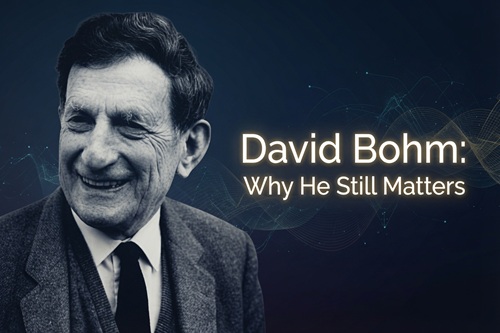
IntroductionFew twentieth-century thinkers moved as effortlessly between physics, philosophy, psychology, and spirituality as David Bohm. Although he never achieved the public fame of Albert Einstein or Stephen Hawking, Bohm remains one of the most intriguing intellectual figures of modern times. His ideas about quantum physics, consciousness, dialogue, and the nature of reality continue to inspire scientists, philosophers, educators, and spiritual seekers. Bohm's relevance lies not so much in any single scientific theory, but in his persistent attempt to overcome fragmentation—the tendency of human beings to divide reality into disconnected pieces. In an age characterized by political polarization, disciplinary specialization, and ecological crisis, his call for a more integrated understanding of reality appears remarkably contemporary. A Dissident Voice in PhysicsBohm first gained recognition as a theoretical physicist working on quantum mechanics. At a time when the dominant interpretation of quantum theory emphasized uncertainty and indeterminacy, Bohm developed an alternative framework known as the "pilot-wave theory" or the Bohmian Mechanics. His interpretation suggested that quantum particles possess definite properties and trajectories, guided by an underlying quantum field. While long regarded as a minority view, Bohmian mechanics remains an active area of research today and demonstrates that the foundations of quantum theory are not as settled as many textbooks imply. Bohm's importance here is methodological. He reminded science that even widely accepted theories should remain open to scrutiny and alternative interpretations. Scientific progress depends not only on consensus but also on the willingness to challenge prevailing assumptions. The Implicate OrderBohm's most famous philosophical contribution is the concept of the "implicate order," developed in his book Wholeness and the Implicate Order. According to Bohm, reality may possess a deeper level of organization beneath the world of separate objects we ordinarily perceive. The visible world—the "explicate order"—consists of distinct entities, events, and processes. Beneath this lies an implicate order in which everything is fundamentally interconnected. Bohm often used the analogy of a hologram. Each fragment of a holographic plate contains information about the entire image. Likewise, every aspect of reality may be enfolded within a larger whole. Whether or not one accepts this metaphysical proposal, the idea resonates with developments in systems theory, ecology, network science, and complexity studies. These fields increasingly emphasize relationships, interactions, and emergent properties rather than isolated objects. Dialogue and Collective ThoughtPerhaps Bohm's most practical contribution emerged outside physics altogether. During the later decades of his life, he became fascinated by the way human beings think together. He observed that many social conflicts arise because people identify with opinions and assumptions without recognizing how these assumptions shape perception. This led to the development of what is now known as "Bohm Dialogue." Participants engage in open-ended conversation without attempting to win arguments or defend fixed positions. The goal is not consensus but greater awareness of the thought processes operating within the group. In an era of social media outrage, ideological tribalism, and political polarization, Bohm's insights appear strikingly relevant. He argued that thought often creates divisions and then mistakes those divisions for objective reality. Genuine dialogue requires examining the assumptions underlying one's own position rather than merely criticizing opponents. Many organizations, educational institutions, and leadership programs continue to employ Bohmian dialogue techniques for precisely this reason. Consciousness and the Limits of ReductionismBohm was also concerned with the relationship between mind and matter. He rejected simplistic forms of both materialism and idealism. Instead, he proposed that consciousness and physical reality might emerge from a deeper underlying process. Mind and matter, in this view, are not separate substances but different aspects of a more fundamental reality. This perspective has influenced discussions in consciousness studies, where the limitations of strict reductionism remain hotly debated. Although Bohm's ideas do not provide a complete scientific theory of consciousness, they offer a conceptual framework that avoids both crude materialism and supernatural explanations. His work continues to attract scholars seeking alternatives to the traditional mind-body divide. Bohm and SpiritualityBohm's work has often attracted spiritual interpretations, partly because of his long friendship with Jiddu Krishnamurti. Their dialogues explored perception, conditioning, consciousness, and the possibility of psychological transformation. Unlike many New Age writers who appropriated quantum physics to justify mystical claims, Bohm remained cautious. He did not argue that quantum mechanics proved spiritual doctrines. Rather, he believed that both science and spirituality were confronting questions about wholeness, perception, and the limits of fragmented thinking. This distinction remains important. Bohm sought dialogue between scientific and contemplative traditions without collapsing one into the other. Criticisms and LimitationsBohm's ideas have not escaped criticism. Many physicists regard his philosophical speculations as too vague or insufficiently testable. The implicate order, in particular, is often seen as more metaphysical than scientific. Some critics argue that his later work moved beyond empirical science into speculative philosophy. Others note that concepts such as wholeness and interconnectedness can become so broad that they risk explaining everything and therefore nothing. These criticisms have force. Bohm's significance does not rest on providing definitive answers. Rather, it lies in opening new questions and encouraging interdisciplinary exploration. Why Bohm Matters TodayDavid Bohm anticipated several themes that have become increasingly prominent in contemporary thought: • The importance of systems and networks over isolated entities. • The recognition that observer and observed are often interconnected. • The need for dialogue in polarized societies. • The limits of reductionist explanations. • The search for integrative frameworks that bridge science, philosophy, and human experience. At a time when knowledge is becoming ever more specialized, Bohm reminds us that understanding requires synthesis as well as analysis. He challenged both scientists and philosophers to look beyond fragmented categories and consider the larger patterns that connect seemingly separate domains. ConclusionDavid Bohm remains relevant because he addressed a problem that has only intensified since his death: fragmentation. Whether in science, politics, culture, or personal consciousness, modern life often divides reality into disconnected compartments. Bohm's enduring message was that these divisions may be useful for practical purposes, but they should not be mistaken for the structure of reality itself. His vision of wholeness may never become a fully established scientific theory, yet it continues to inspire inquiry across disciplines. In that sense, Bohm's greatest contribution was not a particular doctrine but a way of thinking: the conviction that beneath the fragments lies a deeper order waiting to be understood.
Widget is loading comments...
|