|
TRANSLATE THIS ARTICLE
Integral World: Exploring Theories of Everything
An independent forum for a critical discussion of the integral philosophy of Ken Wilber
  Frank Visser, graduated as a psychologist of culture and religion, founded IntegralWorld in 1997. He worked as production manager for various publishing houses and as service manager for various internet companies and lives in Amsterdam. Books: Ken Wilber: Thought as Passion (SUNY, 2003), and The Corona Conspiracy: Combatting Disinformation about the Coronavirus (Kindle, 2020). Frank Visser, graduated as a psychologist of culture and religion, founded IntegralWorld in 1997. He worked as production manager for various publishing houses and as service manager for various internet companies and lives in Amsterdam. Books: Ken Wilber: Thought as Passion (SUNY, 2003), and The Corona Conspiracy: Combatting Disinformation about the Coronavirus (Kindle, 2020).
Check out my other conversations with ChatGPT Synthesis and CritiqueCorey DeVos, Daniel Ofman, and the Anatomy of the Wilber-Visser ConflictFrank Visser / ChatGPT
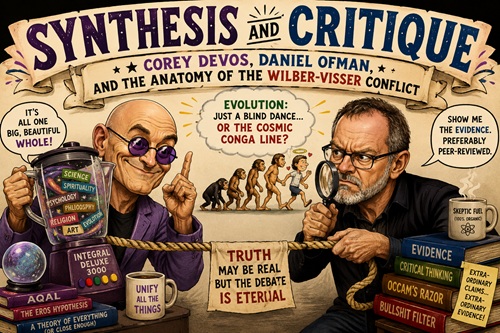 The comparison between Corey DeVos' Polarity Analysis and the Core Qualities model of Dutch management consultant Daniel Ofman is illuminating because both frameworks attempt to move beyond simplistic judgments of people and ideas. Both suggest that what appears problematic often contains a hidden strength, and that development requires integration rather than suppression. Yet they emerge from very different traditions and serve different purposes. At first glance, the similarities are striking. Both models reject black-and-white thinking. Both encourage people to see virtues and pathologies as interconnected. Both seek to transform conflict into understanding. And both offer a structured way to analyze human behavior. However, the deeper one looks, the more significant the differences become. Ofman's Core Qualities ModelOfman's model begins with a person's innate strengths or "core qualities." A quality such as decisiveness, empathy, discipline, enthusiasm, or creativity is fundamentally positive. Yet every strength can become excessive when overextended. For example:
According to Ofman, each pitfall has a corresponding challenge. The decisive person may need more patience. The flexible person may need greater determination. Finally, what irritates us in others often points to an "allergy"—a quality we lack or suppress. Someone who values order may be irritated by spontaneity; someone highly spontaneous may be irritated by structure. The genius of Ofman's model is that it turns interpersonal conflict into self-reflection. The enemy becomes a mirror.
DeVos' Polarity AnalysisCorey DeVos' polarity framework at Integral Life operates at a broader level. It is less concerned with individual personality traits and more concerned with worldviews, values, ideologies, and developmental perspectives. The basic idea is that opposing positions often contain partial truths. Instead of asking which side is right, polarity analysis asks: "What truth is each side protecting?" For example: • Individual freedom versus collective responsibility • Science versus spirituality • Stability versus change • Agency versus communion • Rationality versus intuition The goal is not compromise but integration. One seeks a higher-order perspective capable of appreciating both poles simultaneously. This approach draws heavily from the influence of Ken Wilber and Integral Theory's emphasis on transcend-and-include thinking. The Structural SimilarityBoth models share a common architecture. Ofman: Quality → Pitfall → Challenge → Allergy DeVos: Pole A → Excess of Pole A → Pole B → Excess of Pole B In both systems, pathology emerges not because a value is wrong but because it becomes exaggerated. For Ofman, decisiveness becomes domination. For polarity analysis, individual freedom can become selfish libertarianism. Likewise, collective responsibility can degenerate into authoritarian control. The underlying message is remarkably similar: virtue carried to excess becomes vice. The Difference Between Psychology and MetatheoryThe most important difference lies in scale. Ofman focuses on individual psychology. His framework helps managers, coaches, couples, and teams understand recurring interpersonal tensions. DeVos applies a metatheoretical lens. His concern is not primarily why two colleagues clash, but why entire worldviews, political camps, or developmental stages misunderstand one another. Ofman's model is diagnostic. DeVos' model is integrative. One helps people understand themselves. The other attempts to help people understand complex social and cultural conflicts. A Critical Difference: SymmetryHere the comparison becomes especially interesting. Ofman's model assumes genuine symmetry. Every quality has an associated shadow. Nobody occupies a position that is simply superior to all others. Every strength requires balancing. DeVos' polarity analysis often claims similar symmetry but is embedded within Integral Theory's developmental hierarchy. In practice, one side of a conflict is frequently interpreted as operating from a less developed perspective than the other. This creates a tension. The language of polarity suggests equality between poles. The language of developmental stages suggests hierarchy between perspectives. Critics of Integral Theory have long noted this ambiguity. Are opposing viewpoints equally valid poles requiring integration, or are some viewpoints manifestations of lower developmental stages that must be transcended? Ofman's model largely avoids this problem because it remains psychologically horizontal rather than developmentally vertical. The Risk of DepoliticizationA second criticism concerns power and real-world conflict. Ofman's model works best in situations where both parties genuinely contribute to a misunderstanding. But some conflicts involve objective asymmetries: • Oppressor and oppressed • Truth and falsehood • Science and pseudoscience • Aggressor and victim Similarly, polarity analysis can sometimes transform substantive disagreements into questions of perspective balancing. Critics may object that not every conflict is best understood as two partial truths seeking integration. Sometimes one side is simply more factually accurate than the other. This critique has particular relevance within Integral circles, where appeals to "both-and" thinking have occasionally been used to soften sharp empirical or ethical disputes. What Ofman Might Contribute to Integral TheoryIronically, Ofman's framework may offer something Integral Theory itself sometimes lacks: humility. Ofman's central insight is that your greatest strength can become your greatest weakness. Applied to Integral Theory, one might say: • Integral inclusiveness can become intellectual overreach. • Systems thinking can become system-building grandiosity. • Spiritual openness can become metaphysical speculation. • Developmental sophistication can become developmental elitism. In Ofman's language, every integral quality contains a potential pitfall. That observation could serve as a valuable corrective to any framework that aspires to explain everything. ConclusionCorey DeVos' Polarity Analysis and Daniel Ofman's Core Qualities model belong to different intellectual worlds, yet they share a common intuition: conflict often arises when a legitimate strength becomes exaggerated and loses balance. Ofman applies this insight to individual character and relationships. DeVos applies it to cultures, ideologies, and developmental worldviews. Where Ofman excels is psychological realism and self-reflection. Where DeVos excels is mapping large-scale tensions within complex social systems. Yet Ofman's model may ultimately possess one advantage: it subjects itself to the very principle it teaches. Every quality has a shadow, including the quality of integration itself. If Integral Theory embraced that lesson more fully, it might become not only more comprehensive, but also more self-critical.
Appendix: Applying Both Models to the Wilber-Visser Conflict over EvolutionThe longstanding disagreement between Ken Wilber and Frank Visser over evolution provides an interesting case study for both Ofman's Core Qualities model and DeVos' Polarity Analysis. It reveals both the strengths and limitations of these frameworks when applied to intellectual disputes. Using Ofman's Core Qualities ModelOfman's approach would begin by identifying the core quality each participant brings to the discussion. Wilber's core quality might be described as synthesis. Throughout his career he has sought to integrate science, spirituality, psychology, philosophy, and religion into a single overarching framework. His instinct is always to connect domains that modern culture keeps separate. The pitfall of synthesis is over-integration. A desire to unify disparate fields can lead to speculative connections that outrun the available evidence. Critics have often argued that Wilber's appeals to Eros, Spirit-in-action, or evolutionary directionality cross precisely this line. Visser's core quality might be described as critical realism. He consistently asks whether claims are supported by empirical evidence and whether metaphysical assumptions have been smuggled into scientific discussions. The pitfall of critical realism is reductionism. A strong emphasis on empirical verification can sometimes appear dismissive of broader existential, philosophical, or spiritual questions that science alone may not settle. Ofman's model would then identify the challenge for each side. Wilber's challenge would be greater empirical discipline and restraint regarding claims about evolution. Visser's challenge would be greater openness to questions of meaning, value, and subjective experience that lie beyond straightforward scientific explanation. The "allergies" are equally revealing. Wilber often appears irritated by what he calls flatland thinking, reductionism, or scientism. Visser appears irritated by what he sees as spiritualized speculation, metaphysical inflation, and the tendency to invoke cosmic purpose without sufficient evidence. Ofman's model would suggest that each is reacting to an exaggerated version of something he himself needs in moderated form. Using DeVos' Polarity AnalysisA polarity analysis would frame the dispute differently. Pole A: Scientific naturalism This pole emphasizes empirical evidence, methodological rigor, evolutionary biology, and explanatory sufficiency through natural mechanisms such as mutation, selection, drift, and emergence. Pole B: Spiritual meaning This pole emphasizes purpose, depth, interiority, consciousness, value, and the intuition that evolution may express something more than blind physical processes. The polarity analyst would argue that both poles protect important truths. Scientific naturalism protects rigor and accountability to evidence. Spiritual meaning protects existential significance and the reality of lived experience. The pathology of Pole A is scientism—the claim that science exhausts all forms of knowledge. The pathology of Pole B is metaphysical dogmatism—the claim that spiritual intuitions can substitute for scientific evidence. An ideal integral synthesis would seek to preserve both without collapsing one into the other. The Problem Revealed by the ConflictThe Wilber-Visser dispute also exposes a weakness in polarity approaches. The disagreement is not merely about balancing two values. It is also about factual claims. Visser's central objection has never been that spirituality lacks value. Rather, he has argued that Wilber repeatedly presents speculative metaphysical ideas as if they were supported by evolutionary science. This transforms the issue from a polarity between science and spirituality into a dispute about evidentiary standards. To use an analogy, the conflict is not between two equally valid poles such as freedom and order. It is closer to a disagreement over whether a particular bridge design actually works. In such cases, empirical questions cannot be resolved through perspective-taking alone. The Meta-IronyPerhaps the most ironic application of Ofman's model concerns Integral Theory itself. The core quality of Integral Theory is inclusiveness. Its pitfall can become inclusiveness without discrimination—the tendency to include explanatory frameworks whose evidential status differs dramatically. Conversely, the core quality of Visser's critique is discrimination and evidence-based analysis. Its pitfall can become an excessive focus on error detection at the expense of appreciating the broader existential motivations that make integral visions attractive in the first place. Viewed this way, the conflict is not simply between a visionary and a skeptic. It is a clash between two legitimate intellectual virtues: synthesis and criticism. The unresolved question is whether those virtues can genuinely complement one another. After more than two decades of debate, the historical record suggests that each side sees the other less as a necessary challenge and more as a recurring pitfall. That conclusion itself may be the most Ofman-like insight of all. The qualities that make Wilber and Visser valuable contributors to the discussion are inseparable from the characteristics that make their disagreement so persistent.
Widget is loading comments...
|