|
TRANSLATE THIS ARTICLE
Integral World: Exploring Theories of Everything
An independent forum for a critical discussion of the integral philosophy of Ken Wilber
  Frank Visser, graduated as a psychologist of culture and religion, founded IntegralWorld in 1997. He worked as production manager for various publishing houses and as service manager for various internet companies and lives in Amsterdam. Books: Ken Wilber: Thought as Passion (SUNY, 2003), and The Corona Conspiracy: Combatting Disinformation about the Coronavirus (Kindle, 2020). Frank Visser, graduated as a psychologist of culture and religion, founded IntegralWorld in 1997. He worked as production manager for various publishing houses and as service manager for various internet companies and lives in Amsterdam. Books: Ken Wilber: Thought as Passion (SUNY, 2003), and The Corona Conspiracy: Combatting Disinformation about the Coronavirus (Kindle, 2020).
Check out my other conversations with ChatGPT
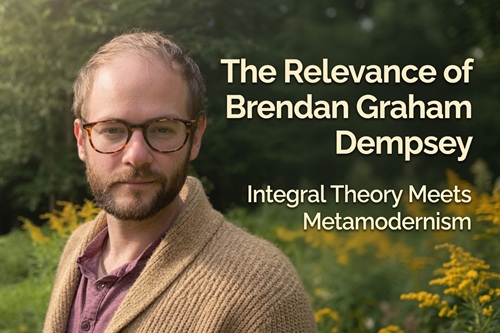 The Relevance of Brendan Graham DempseyIntegral Theory Meets MetamodernismFrank Visser / ChatGPTA New Voice in the Post-Wilber LandscapeBrendan Graham Dempsey occupies a distinctive position in the intellectual landscape that emerged after the formative period of Integral Theory. Unlike the first generation of integral thinkers, whose primary task was constructing comprehensive frameworks, Dempsey belongs to a newer generation concerned with refinement, reinterpretation, and dialogue across disciplines. His significance lies not in proposing an entirely new system but in helping Integral Theory adapt to contemporary philosophical and cultural developments. In particular, he has become one of the most visible bridge figures between Integral Theory and Metamodernism, two movements that share important concerns yet often differ in style, emphasis, and epistemology. From System-Building to System-RefinementThe early integral movement, especially under the influence of Ken Wilber, was characterized by ambitious synthesis. Integral Theory sought to bring together psychology, spirituality, science, culture, and philosophy into a coherent explanatory framework. Dempsey's work reflects a different intellectual moment. Rather than endlessly expanding the scope of the system, he focuses on examining its assumptions, clarifying its claims, and identifying where its strengths and limitations lie. This shift from construction to refinement is characteristic of a mature intellectual tradition. Once the grand architecture has been erected, the challenge becomes determining which parts remain structurally sound. In this respect, Dempsey serves as both steward and critic of the integral project. The Metamodern TurnDempsey's growing influence owes much to his engagement with Metamodernism. While Integral Theory emerged largely as a response to the fragmentation of postmodern thought, Metamodernism attempts to move beyond the modern-postmodern divide altogether. Metamodern thinkers emphasize oscillation rather than certainty, sincerity rather than cynicism, and constructive engagement rather than deconstruction. They seek meaning while remaining aware of the limitations of every meaning system. Dempsey has become an important interpreter of this sensibility. Rather than viewing Integral Theory and Metamodernism as rivals, he treats them as complementary responses to similar cultural challenges. His work explores how integral developmental frameworks can coexist with the epistemic humility and reflexivity characteristic of metamodern thought. This makes him one of the few thinkers capable of speaking fluently in both intellectual languages. A Post-Metaphysical IntegralismA recurring theme in Dempsey's work is the effort to preserve what is valuable in integral thinking while reducing its tendency toward metaphysical excess. Classical Integral Theory often blurred the distinction between developmental psychology and cosmology. Descriptions of consciousness development sometimes expanded into claims about the ultimate structure and purpose of reality itself. Critics have long argued that such moves exceed the available evidence. Dempsey's approach is generally more cautious. While remaining sympathetic to spiritual perspectives, he tends to frame large metaphysical narratives as interpretive possibilities rather than established facts. This orientation aligns closely with the metamodern preference for meaningful narratives that remain aware of their provisional status. The result is a version of integral thought that is less triumphalist and more self-reflective. Clarifying What Integral Theory Can and Cannot ClaimOne of Dempsey's most valuable contributions is his role in clarifying the proper scope of integral explanation. Integral Theory excels as a framework for understanding multiple perspectives, developmental patterns, and complex systems. Difficulties arise when these descriptive tools are transformed into comprehensive ontological claims about cosmic evolution, divine purpose, or the ultimate architecture of existence. Dempsey repeatedly returns to questions of justification and evidence. What exactly does a developmental model demonstrate? What follows from it, and what does not? Where does interpretation end and speculation begin? Such questions are crucial if Integral Theory is to maintain credibility beyond its own intellectual community. From Integration to OscillationOne of the most interesting developments in Dempsey's work is the subtle shift from the integral ideal of synthesis toward the metamodern ideal of productive tension. Classical integral thinking often assumes that conflicting viewpoints can eventually be integrated into a more comprehensive whole. Metamodernism is less confident that final synthesis is possible. It emphasizes the ongoing movement between perspectives, recognizing that many tensions cannot be permanently resolved. Dempsey increasingly operates within this space. Rather than forcing every contradiction into a higher-order synthesis, he often treats tensions as enduring features of human inquiry. Science and spirituality, objectivity and subjectivity, realism and idealism may remain in creative dialogue without ever achieving complete reconciliation. This represents an important evolution in the integral conversation. Philosophical AccountabilityAnother reason for Dempsey's relevance is his commitment to engaging broader intellectual currents. Rather than treating Integral Theory as a self-contained worldview, he places it in conversation with contemporary philosophy, systems theory, religious studies, and cultural criticism. This willingness to expose integral ideas to external scrutiny is healthy for the movement. Intellectual traditions become stronger when they engage criticism rather than insulating themselves from it. Dempsey's work therefore functions as a form of philosophical quality control. He asks whether integral concepts genuinely explain phenomena or merely redescribe them in more elaborate language. He seeks rigor without abandoning the larger quest for meaning that originally attracted many people to integral thought. Why His Work Matters NowThe relevance of Brendan Graham Dempsey reflects a broader cultural transition. The age of grand ideological certainty appears to be fading, yet purely skeptical or relativistic approaches have proven unsatisfying. Many people continue to seek comprehensive narratives capable of integrating science, culture, ethics, and spirituality. The challenge is how to pursue such narratives without repeating the excesses of earlier systems. Dempsey's work offers one possible answer. By combining the integrative ambitions of Integral Theory with the humility and reflexivity of Metamodernism, he points toward a more mature form of meaning-making—one that seeks coherence without demanding certainty. Conclusion: A Bridge Between Two Intellectual WorldsBrendan Graham Dempsey's importance lies less in founding a new movement than in mediating between existing ones. He stands at the crossroads of Integral Theory and Metamodernism, helping each learn from the strengths and limitations of the other. In doing so, he embodies a broader shift in contemporary thought: away from closed systems and toward frameworks that remain open, self-critical, and adaptive. Whether one ultimately embraces Integral Theory, Metamodernism, both, or neither, Dempsey's work illuminates an important question for our time: how can we construct meaningful narratives about human development and culture while remaining aware of their inevitable incompleteness? That question may prove more enduring than any particular theory that attempts to answer it.
Widget is loading comments...
|