|
TRANSLATE THIS ARTICLE
Integral World: Exploring Theories of Everything
An independent forum for a critical discussion of the integral philosophy of Ken Wilber
  Frank Visser, graduated as a psychologist of culture and religion, founded IntegralWorld in 1997. He worked as production manager for various publishing houses and as service manager for various internet companies and lives in Amsterdam. Books: Ken Wilber: Thought as Passion (SUNY, 2003), and The Corona Conspiracy: Combatting Disinformation about the Coronavirus (Kindle, 2020). Frank Visser, graduated as a psychologist of culture and religion, founded IntegralWorld in 1997. He worked as production manager for various publishing houses and as service manager for various internet companies and lives in Amsterdam. Books: Ken Wilber: Thought as Passion (SUNY, 2003), and The Corona Conspiracy: Combatting Disinformation about the Coronavirus (Kindle, 2020).
Check out my other conversations with ChatGPT
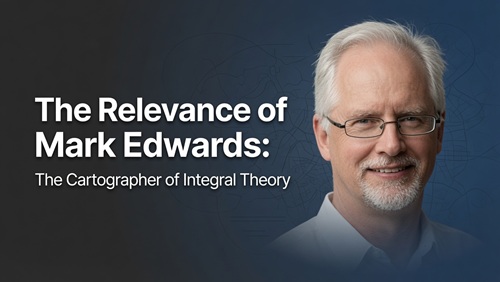 The Relevance of Mark EdwardsThe Cartographer of Integral TheoryFrank Visser / ChatGPTAmong the many thinkers associated with Integral Theory, few have worked as diligently behind the scenes as Mark Edwards. While Ken Wilber developed the overarching vision of Integral Theory, Edwards devoted much of his academic career to refining, clarifying, and critically examining its conceptual architecture. His contribution lies less in grand metaphysical claims and more in the painstaking work of mapping, organizing, and testing the framework itself. In an intellectual movement often criticized for sweeping generalizations, Edwards stands out as a scholar committed to methodological rigor. From Vision to MethodOne recurring challenge facing Integral Theory is the gap between its ambitious philosophical scope and its practical application. Wilber's AQAL model ("All Quadrants, All Levels") attempts to integrate subjective experience, culture, behavior, and systems into a single framework. Yet critics have often asked whether AQAL functions as a scientific model, a philosophical worldview, or merely a classificatory scheme. Edwards addressed precisely this issue. Rather than endlessly expanding the theory's scope, he focused on questions of structure and method. How should integral maps be constructed? How can different frameworks be compared? What standards should be applied when evaluating integral claims? His work helped move Integral Theory from visionary synthesis toward a more disciplined form of meta-theory. The Meta-Theoretical TurnEdwards belongs to a tradition that treats theories themselves as objects of study. Instead of asking whether a particular theory is true, meta-theorists ask how theories are organized, what assumptions they contain, and how they relate to one another. In this respect, Edwards broadened Integral Theory beyond Wilber's original formulations. He explored how multiple systems of thought could coexist without being reduced to a single hierarchy. This represented a subtle but important shift away from the tendency within some integral circles to view AQAL as the ultimate map encompassing all others. Edwards often emphasized the distinction between reality and the maps used to describe reality. No matter how sophisticated a framework becomes, it remains a representation rather than the territory itself. This cautionary note has become increasingly relevant as integral thinkers encounter growing criticism from philosophers, scientists, and systems theorists. Mapping the MapsOne of Edwards' most significant contributions is his analysis of "integral maps." He examined how conceptual frameworks function as tools for orientation rather than mirrors of reality. This perspective resonates strongly with developments in systems thinking, complexity science, and contemporary philosophy of science. Scientific models are now widely understood as useful approximations rather than literal depictions of reality. By stressing the provisional nature of all maps, Edwards introduced a degree of intellectual humility that is sometimes lacking in grand unifying theories. His work suggests that the value of Integral Theory lies not in possessing the final truth but in providing a flexible framework for dialogue among competing perspectives. A Corrective to Integral ExcessIntegral Theory has often been accused of what might be called "altitude intoxication"—the belief that occupying a higher conceptual vantage point automatically confers deeper understanding. Critics have argued that this tendency can encourage sweeping judgments about science, religion, politics, and culture. Edwards frequently acted as a corrective to such excesses. Rather than celebrating ever more encompassing syntheses, he highlighted the importance of boundaries, distinctions, and methodological precision. He showed that integration requires careful analysis before synthesis can occur. In this sense, Edwards represents a more academic and restrained face of the integral movement. His work reminds us that meta-theory should illuminate complexity, not merely claim to transcend it. Beyond WilberAlthough deeply influenced by Wilber, Edwards should not be viewed merely as a disciple. His writings contain a quiet but persistent effort to expand Integral Theory beyond its founder's formulations. He engaged with systems theory, organizational studies, developmental psychology, and social science methodology in ways that sometimes challenged assumptions within the broader integral community. While remaining broadly sympathetic to integral aims, he avoided treating any single framework as sacrosanct. This independent stance has allowed his work to age relatively well compared to some of the more speculative aspects of Integral Theory. Why Mark Edwards Matters TodayThe relevance of Mark Edwards lies in an intellectual climate increasingly skeptical of grand narratives while still searching for integrative approaches. Contemporary scholars face the challenge of navigating enormous amounts of information across disciplines without collapsing into either fragmentation or dogmatism. Edwards offers a middle path. His work demonstrates that integration requires methodological discipline, conceptual clarity, and a willingness to examine the assumptions built into our own frameworks. Rather than constructing ever larger theories, he encourages us to become better mapmakers. For those interested in Integral Theory, his contribution serves as a reminder that the strength of a meta-theory depends not on the grandeur of its claims but on the quality of its tools. ConclusionMark Edwards may never achieve the visibility of Ken Wilber, but his influence within Integral Theory is profound. If Wilber supplied the vision, Edwards supplied much of the cartography. He transformed Integral Theory from a sweeping synthesis into a subject of methodological reflection, asking how integrative frameworks themselves should be evaluated. In a movement often attracted to metaphysical heights, Edwards has consistently directed attention back to the mapmaker's craft. That contribution remains valuable not only for integral thinkers but for anyone attempting to understand how knowledge from many domains can be brought together without losing intellectual rigor along the way. Widget is loading comments...
|