|
TRANSLATE THIS ARTICLE
Integral World: Exploring Theories of Everything
An independent forum for a critical discussion of the integral philosophy of Ken Wilber
  Frank Visser, graduated as a psychologist of culture and religion, founded IntegralWorld in 1997. He worked as production manager for various publishing houses and as service manager for various internet companies and lives in Amsterdam. Books: Ken Wilber: Thought as Passion (SUNY, 2003), and The Corona Conspiracy: Combatting Disinformation about the Coronavirus (Kindle, 2020). Frank Visser, graduated as a psychologist of culture and religion, founded IntegralWorld in 1997. He worked as production manager for various publishing houses and as service manager for various internet companies and lives in Amsterdam. Books: Ken Wilber: Thought as Passion (SUNY, 2003), and The Corona Conspiracy: Combatting Disinformation about the Coronavirus (Kindle, 2020).
Check out my other conversations with ChatGPT
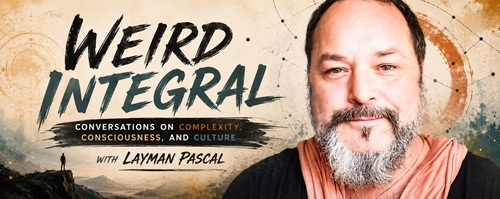 The Relevance of Layman PascalA Post-Systemic Experiment in Thinking Out LoudFrank Visser / ChatGPTThere is a recognizable pattern in contemporary Integral-adjacent culture: systems are built, refined, defended, and eventually outgrown by the very people who were supposed to inhabit them. What begins as synthesis tends to become architecture; what begins as openness tends to harden into doctrine. The term “Integral” itself has gone through several of these phases. Within this shifting landscape, Layman Pascal occupies a peculiar position. He does not present himself as a system-builder in the strict sense, nor as a critic standing entirely outside the game. He operates more like someone speaking from inside the collapse of system-building, while still retaining enough structure to keep the conversation intelligible. “Weird Integral” is as good a label as any for that stance. Not because it defines a school of thought, but because it signals a departure from the expectation that Integral thinking must eventually resolve into a coherent doctrine. After the Integral Promise of TotalityClassical Integral Theory, associated most prominently with Ken Wilber, carried an implicit promise: that fragmentation could be overcome through synthesis, that competing domains of knowledge could be integrated into a single developmental map, and that consciousness itself could be charted in a structured hierarchy of unfolding complexity. That ambition was intellectually compelling and culturally influential. It also created a tension that has never fully been resolved: the more comprehensive the system becomes, the more it risks becoming another enclosed worldview. What follows is predictable. A generation of thinkers absorbs the model, internalizes its vocabulary, and then begins to notice its pressure points. The critique does not necessarily reject integration itself, but rather the expectation that integration must culminate in finality. Pascal's relevance begins precisely at this inflection point. Weirdness as Method, Not AccidentThe “weird” in Weird Integral is not aesthetic decoration. It reflects a methodological shift: away from system completion and toward sustained exposure to unresolved complexity. Pascal's work is not organized around defending a single theoretical structure. Instead, it moves through interviews, conversations, and exploratory essays that treat meaning as something negotiated in real time. The emphasis is less on doctrinal coherence than on cognitive behavior under conditions of uncertainty. This is where his distance from traditional Integral orthodoxy becomes visible. Rather than reinforcing a unified map of reality, he tends to examine how different maps interact, interfere, and partially translate each other without ever fully aligning. The result is not system failure. It is system suspension. Meta-Rationality Without GuaranteesMuch of Pascal's work aligns loosely with what is sometimes called meta-rational thinking: an attempt to move beyond both rigid rationalism and unbounded relativism without reverting to a new absolute framework. In practice, this means tolerating multiple epistemic modes simultaneously—analytic, intuitive, developmental, phenomenological—without insisting that they converge into a final synthesis. This is also where the tension becomes visible. Meta-rational discourse often risks drifting into abstraction, where the language of “complexity,” “perspective,” and “integration of perspectives” can become so flexible that it loses contact with constraint. Pascal's version of this tendency is moderated by his conversational style. He tends to keep ideas embedded in dialogue rather than detached system-building. Still, the underlying question remains unresolved: what exactly anchors meta-rational thinking when it refuses both foundational certainty and structural closure? “Weird Integral” is, in part, what it looks like to live inside that question without prematurely exiting it. The Collapse of Final ExplanationsThere is a broader cultural context that makes this stance intelligible. Across philosophy, cognitive science, and cultural theory, confidence in final explanatory frameworks has been steadily eroding. Grand unifying narratives—whether scientific, spiritual, or ideological—still exist, but they increasingly coexist with awareness of their own limitations. The result is not intellectual silence, but a proliferation of partial systems that overlap without fully reconciling. Pascal operates in this environment as a kind of conversational cartographer. The aim is not to produce the final map, but to trace how mapping itself behaves under stress. In this sense, Weird Integral is not a rejection of integration. It is an observation that integration no longer arrives as completion. It arrives as ongoing negotiation. Dialogue as a Cognitive InstrumentOne of the most consistent features of Pascal's work is its reliance on dialogue as a primary epistemic tool. Rather than presenting arguments as finished structures, he tends to explore them through sustained conversational exchange. This matters more than it might initially appear. Dialogue, in this context, is not merely communicative. It functions as a method for revealing hidden assumptions, testing conceptual elasticity, and observing how ideas transform when exposed to alternative frames. It also introduces instability. Conversations do not converge in the same way essays do. They loop, revise, contradict, and reframe. For some observers, this feels inconclusive. For others, it is precisely where thinking becomes visible. “Weird Integral” names this preference for process over closure. The Tension That Never ResolvesThe central limitation of this mode of thinking is also its defining feature. If no framework is final, then critique becomes continuous. If all perspectives are partial, then judgment becomes provisional. If synthesis is always incomplete, then coherence is always deferred. This produces a recognizable intellectual atmosphere: high sensitivity to nuance, high tolerance for ambiguity, and persistent resistance to premature closure. It also produces fatigue in some readers, who may reasonably ask whether anything ever stabilizes long enough to be acted upon. Pascal does not resolve this tension. He inhabits it. That is both his strength and his constraint. Conclusion: Integral After Integration“Weird Integral” is not a school, and Layman Pascal is not its architect. The phrase works better as a description of a transitional condition in contemporary thought: post-systemic, dialogical, and structurally undecided. Within that condition, Pascal's relevance is straightforward. He exemplifies a mode of thinking that no longer assumes integration will culminate in final synthesis, but also refuses to abandon integration as an aspiration altogether. What remains is not a completed framework, but an ongoing attempt to think coherently in the absence of closure. Whether that is intellectually sustainable in the long run is an open question. For now, it is simply where a certain strand of Integral thinking has ended up: not outside the system, not inside it, but moving through its unresolved remainder. Widget is loading comments...
|