|
TRANSLATE THIS ARTICLE
Integral World: Exploring Theories of Everything
An independent forum for a critical discussion of the integral philosophy of Ken Wilber
  Frank Visser, graduated as a psychologist of culture and religion, founded IntegralWorld in 1997. He worked as production manager for various publishing houses and as service manager for various internet companies and lives in Amsterdam. Books: Ken Wilber: Thought as Passion (SUNY, 2003), and The Corona Conspiracy: Combatting Disinformation about the Coronavirus (Kindle, 2020). Frank Visser, graduated as a psychologist of culture and religion, founded IntegralWorld in 1997. He worked as production manager for various publishing houses and as service manager for various internet companies and lives in Amsterdam. Books: Ken Wilber: Thought as Passion (SUNY, 2003), and The Corona Conspiracy: Combatting Disinformation about the Coronavirus (Kindle, 2020).
Check out my other conversations with ChatGPT
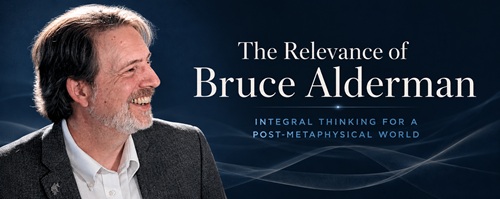 The Relevance of Bruce AldermanIntegral Thinking for a Post-Metaphysical WorldFrank Visser / ChatGPTBruce Alderman occupies an unusual and increasingly important position in the contemporary integral landscape. Neither a conventional academic nor a traditional spiritual teacher, he represents a newer generation of integral thinkers attempting to preserve the depth ambitions of Ken Wilber's project while critically revising its metaphysical excesses. In this sense, Alderman is relevant not because he merely repeats Integral Theory, but because he participates in its transformation under post-metaphysical conditions. His work stands at the intersection of philosophy, spirituality, developmental psychology, media ecology, and cultural criticism. Unlike many second-generation integral writers who became either loyalist interpreters or vague spiritual generalists, Alderman has tried to keep integral discourse intellectually alive by exposing it to contemporary critiques—particularly those emerging from postmodernism, enactivism, complexity theory, phenomenology, and systems thinking. This makes him representative of a broader transition: the movement of Integral Theory away from grand metaphysical certainty toward a more reflexive, dialogical, and epistemically cautious framework. From Integral System to Integral ProcessOne of the distinguishing features of Alderman's work is his tendency to treat integral thinking less as a finished system and more as an evolving inquiry. This contrasts with the more canonical presentation of Integral Theory associated with Wilber's middle period, where AQAL (“all quadrants, all levels”) was often presented as a near-universal explanatory architecture. Alderman tends to soften this system-building impulse. He emphasizes process over closure, interpretation over dogma, and participatory meaning-making over metaphysical declaration. This shift mirrors broader intellectual developments across many fields. Twentieth-century grand theories increasingly ran into problems of overreach. Structuralism, Marxism, psychoanalysis, and even evolutionary psychology all faced criticism when they attempted total explanation. Integral Theory has faced similar concerns. Critics have argued that Wilber's framework sometimes functions less as an open heuristic and more as a universal template into which all phenomena are forcibly fitted. Alderman's relevance lies partly in his sensitivity to this problem. He appears aware that contemporary intellectual culture is deeply suspicious of totalizing systems. As a result, his style is more exploratory and less doctrinaire than earlier integral discourse. The Post-Metaphysical ChallengePerhaps the central challenge facing Integral Theory today is the post-metaphysical critique. Can one retain developmental spirituality without invoking unverifiable cosmic hierarchies, subtle planes, Eros-in-the-cosmos, or teleological evolution? Alderman's work can be read as an attempt to answer “yes.” He belongs to a cluster of thinkers influenced by post-metaphysical philosophy, especially the work of Jürgen Habermas and later reinterpretations of Wilber himself. In this approach, spiritual insight is treated less as access to ontological absolutes and more as transformative human experience embedded within language, culture, embodiment, and history. This is a crucial transition. Classic Integral Theory often blurred phenomenology and metaphysics. Mystical experience was frequently interpreted as evidence for objective cosmic structures. Developmental stages became woven into narratives about the universe itself evolving toward Spirit. Alderman appears more cautious. He often emphasizes perspectival humility and participatory engagement rather than metaphysical certainty. This makes his work more compatible with contemporary philosophy of mind, cognitive science, and critical theory. In effect, he helps translate integral discourse into a form more intelligible to intellectually secular audiences. Dialogue Rather Than DeclarationAnother reason for Alderman's relevance is stylistic and methodological. Much integral writing historically suffered from a tendency toward vertical authority: the enlightened theorist explaining reality from a higher developmental altitude. This produced admiration among followers but skepticism among outsiders. Alderman's approach is more conversational and dialogical. He engages thinkers across traditions rather than simply subsuming them into an integral hierarchy. This may sound like a minor stylistic difference, but it reflects a deeper philosophical shift. The older integral model often operated with hidden asymmetries: Integral Theory interpreted everyone else. Few external frameworks were allowed to genuinely interrogate Integral Theory itself. Alderman seems more open to reciprocal critique. This matters because intellectual systems survive only when they can absorb criticism without collapsing into defensive orthodoxy. In that sense, his work represents an attempt to normalize integral discourse within broader intellectual culture instead of preserving it as a semi-esoteric subculture. Spirituality Without Anti-IntellectualismA persistent problem in contemporary spirituality is the collapse into anti-intellectualism. As traditional religion declines, many seekers drift toward vague mysticism, conspiracy thinking, pseudoscience, or inflated metaphysical speculation. Integral Theory originally presented itself as an antidote to this fragmentation by integrating science, psychology, spirituality, and culture. Yet parts of the integral movement eventually reproduced some of the same problems they sought to transcend—particularly in relation to evolutionary spirituality, paranormal claims, and speculative metaphysics. Alderman's work is relevant because he attempts to preserve spiritual seriousness while maintaining intellectual accountability. He does not appear interested in flat reductionism. He recognizes the depth of contemplative practice, symbolic meaning, and transformative experience. But neither does he fully retreat into metaphysical absolutism. Instead, he occupies a middle territory where spirituality becomes interpretive, developmental, and existential rather than cosmologically dogmatic. This balancing act is increasingly important in contemporary culture, where many educated individuals seek forms of spirituality compatible with critical thought. The Media Ecology DimensionAlderman has also shown interest in media, consciousness, and technological culture. This is significant because the contemporary human condition is increasingly shaped not merely by ideology or religion but by information systems. Social media, algorithmic attention structures, AI systems, digital fragmentation, and hyper-mediated identity now influence cognition at a civilizational scale. Any contemporary philosophy that ignores this transformation risks irrelevance. Integral Theory historically focused heavily on developmental interiors—states, stages, values, consciousness structures. Alderman expands the conversation toward the technological environments shaping those interiors. This aligns integral thought with media theorists such as Marshall McLuhan, Douglas Rushkoff, and contemporary digital philosophers. It also grounds spirituality in material cultural conditions instead of treating consciousness as an isolated inner ascent. The Limits of Integral RevisionismAt the same time, Alderman's project faces difficulties. One problem confronting all post-metaphysical integral thinkers is whether enough remains once the metaphysical scaffolding is removed. If one abandons cosmic teleology, Spirit-in-action, involution/evolution narratives, and hierarchical certainty, what distinguishes Integral Theory from sophisticated pluralism? This is not merely a hostile critique; it is a structural question. Much of the emotional appeal of classic Integral Theory came from its grand synthesis: • evolution had direction, • consciousness had cosmic significance, • spirituality mapped reality itself, • developmental hierarchy reflected universal order. Post-metaphysical reinterpretations often gain intellectual credibility precisely by surrendering these stronger claims. But doing so can dilute the visionary power that originally attracted followers. Alderman therefore inhabits a difficult middle position: too critical for orthodox integral enthusiasts, still too spiritually expansive for strict secular academics. Yet this intermediate territory may ultimately prove the most productive. Integral Theory's Survival Depends on Thinkers Like AldermanThe future relevance of Integral Theory may depend less on preserving Wilber's original formulations and more on whether newer thinkers can critically reconstruct the project for a post-grand-theory age. Bruce Alderman represents one such reconstruction. He embodies an integral sensibility that is: • less triumphalist, • less metaphysically inflated, • more interdisciplinary, • more self-critical, • more culturally situated, • and more philosophically modest. Whether Integral Theory survives as a serious intellectual movement may depend on precisely these qualities. The age of sweeping metaphysical synthesis has largely passed. Contemporary intellectual culture demands reflexivity, epistemic humility, and openness to critique. Alderman's importance lies in recognizing this shift while still defending the possibility that human development, contemplative practice, and integrative thinking remain meaningful pursuits. In that sense, Bruce Alderman is relevant because he represents not the triumph of Integral Theory, but its adaptation to a more skeptical and pluralistic world. Comment Form is loading comments...
|