|
TRANSLATE THIS ARTICLE
Integral World: Exploring Theories of Everything
An independent forum for a critical discussion of the integral philosophy of Ken Wilber
  Frank Visser, graduated as a psychologist of culture and religion, founded IntegralWorld in 1997. He worked as production manager for various publishing houses and as service manager for various internet companies and lives in Amsterdam. Books: Ken Wilber: Thought as Passion (SUNY, 2003), and The Corona Conspiracy: Combatting Disinformation about the Coronavirus (Kindle, 2020). Frank Visser, graduated as a psychologist of culture and religion, founded IntegralWorld in 1997. He worked as production manager for various publishing houses and as service manager for various internet companies and lives in Amsterdam. Books: Ken Wilber: Thought as Passion (SUNY, 2003), and The Corona Conspiracy: Combatting Disinformation about the Coronavirus (Kindle, 2020).
Check out my other conversations with ChatGPT
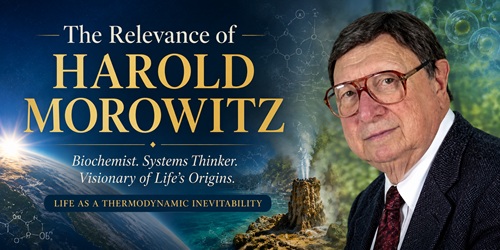 Harold Morowitz and the Logic of LifeWhy This Forgotten Biochemist Still MattersFrank Visser / ChatGPTAmong twentieth-century scientific thinkers, Harold J. Morowitz occupies a peculiar place. He was neither a celebrity scientist nor the founder of a fashionable movement. Yet his work quietly anticipated many contemporary discussions about complexity, emergence, systems theory, thermodynamics, evolution, and the origin of life. Long before “complexity science” became intellectually fashionable, Morowitz was asking a deceptively simple question: why does matter organize itself into life at all? His answer was strikingly naturalistic. Life, he argued, is not a miraculous interruption of physics but an expected outcome of energetic processes operating under suitable planetary conditions. In a culture still divided between mechanistic reductionism on the one hand and spiritualized vitalism on the other, Morowitz tried to chart a third way: life as a thermodynamic inevitability. That insight remains deeply relevant. Life Against EquilibriumMorowitz's central intuition can be summarized in one sentence: life exists because the universe is not in equilibrium. Traditional thermodynamics often emphasized entropy, decay, and disorder. Popular culture absorbed this as the gloomy notion that everything ultimately runs down. But Morowitz focused on a complementary reality: whenever energy flows through matter, local pockets of increasing organization can emerge spontaneously. The Earth is not a closed system. It receives a constant influx of solar energy. Under such conditions, organized structures naturally arise: hurricanes, convection cells, crystal growth, ecosystems, and eventually living cells. This does not abolish entropy; it exploits it. Morowitz helped articulate the idea that biological order is not an exception to physical law but a consequence of it. Organisms maintain and reproduce structure precisely because they dissipate energy gradients. Life is therefore deeply tied to nonequilibrium thermodynamics. This perspective anticipated later work by thinkers such as Ilya Prigogine, Stuart Kauffman, and contemporary complexity theorists. But Morowitz expressed these ideas with unusual philosophical clarity. He saw metabolism not as an accidental feature of life but as its very foundation. Metabolism FirstOne of Morowitz's most influential contributions concerned the origin of life. Many origin-of-life theories focus on replication: how did the first self-copying molecules arise? Morowitz argued that this framing may be backwards. Before genes, there had to be organized energy flow. Before information storage, there had to be metabolism. He therefore became associated with “metabolism-first” theories of abiogenesis. In this view, life did not begin with a magical self-replicating molecule suddenly appearing in a primordial soup. Instead, progressively self-organizing chemical cycles emerged in environments rich in energy gradients, such as hydrothermal vents. This was a profound conceptual shift. It relocated the mystery of life from improbable accidents toward lawful self-organization. Today, many origin-of-life researchers investigate autocatalytic networks, geochemical cycles, and vent chemistry in ways remarkably consonant with Morowitz's vision. The modern interest in alkaline hydrothermal vents, championed by researchers like Mike Russell and Nick Lane, strongly echoes Morowitzian themes: energy flow first, informational complexity later. Against Reductionism Without MysticismMorowitz is especially relevant because he avoided two opposite intellectual temptations. First, he resisted crude reductionism. He did not believe biology could be understood merely by cataloging molecules. Organisms are systems. Their properties emerge from dynamic organization across multiple levels. Second, he resisted mystical inflation. He did not invoke cosmic consciousness, hidden teleology, or spiritual forces to explain complexity. Organization arises because matter under energetic constraint naturally develops stable patterns. This balance is rare. In contemporary debates, critics of reductionism often leap prematurely into metaphysical speculation: panpsychism, cosmic purpose, informational mysticism, or neo-vitalism. Meanwhile, hardline materialists sometimes reduce life to meaningless molecular machinery. Morowitz offered a more disciplined alternative. Complexity is real. Emergence is real. But neither requires supernatural supplementation. This makes him particularly important in discussions where spirituality attempts to appropriate systems theory or complexity science as evidence for cosmic intentionality. The Sacred Without SupernaturalismMorowitz nevertheless retained a sense of wonder. He was not a dry mechanist. He often wrote about science with philosophical and even spiritual sensitivity. But unlike many “science-and-spirituality” writers, he did not smuggle transcendence into explanatory gaps. For Morowitz, the astonishing fact was already here in nature itself: the universe generates increasing complexity through lawful processes. That alone was sufficient to inspire awe. This attitude resembles a form of naturalistic reverence. The cosmos does not need supernatural engineering to be meaningful or astonishing. Matter itself possesses extraordinary generative potential under the right energetic conditions. Such a perspective may offer a healthier bridge between science and existential meaning than metaphysical grandiosity. The Importance of EnergyAnother reason Morowitz remains relevant is his insistence on energy as the organizing principle of biology. Modern biology often emphasizes information: DNA, codes, signaling, computation. Morowitz reminded us that information without energy is inert abstraction. Living systems are fundamentally energetic systems. Cells are not merely information processors; they are thermodynamic engines. This emphasis has become increasingly important in contemporary research on metabolism, bioenergetics, ecology, and Earth-system science. It also corrects exaggerated analogies between biology and computation that became fashionable in late twentieth-century thought. Life is not software floating free from physics. It is materially embodied energy transformation. A Systems Thinker Before Systems Thinking Became FashionableMorowitz also helped legitimize systems thinking during a period dominated by reductionist molecular biology. Today, interdisciplinary systems science is everywhere: ecology, climate science, network theory, complex adaptive systems, and Earth-system analysis. But decades ago, such approaches were often marginalized. Morowitz argued that wholes possess organizational properties irreducible to isolated parts. Yet he did so without abandoning scientific rigor. In this respect, he belongs to a lineage including Ludwig von Bertalanffy, Gregory Bateson, and Howard T. Odum. His work helped prepare the conceptual terrain for later complexity science. Why He Was OverlookedMorowitz never became a major public intellectual partly because he occupied an awkward middle ground. He was too philosophical for narrow laboratory specialists, yet too scientifically rigorous for popular spiritual culture. He did not offer easy slogans. Nor did he cultivate ideological tribes. Additionally, modern scientific culture often rewards specialization over synthesis. Morowitz was fundamentally synthetic. He wanted to understand life as an integrated planetary phenomenon. Such thinkers are frequently appreciated only retrospectively. The Continuing Relevance of MorowitzToday humanity faces intertwined crises involving ecology, climate, energy, and technological civilization. These are fundamentally systems problems. Morowitz's worldview is therefore increasingly timely. He reminds us that: • life is inseparable from planetary energy flows, • complexity emerges naturally under nonequilibrium conditions, • reductionism alone cannot explain organized wholes, • emergence does not imply supernatural teleology, • and biology must ultimately be understood systemically. Perhaps most importantly, Morowitz demonstrated that scientific naturalism need not be spiritually barren. One can reject mystical metaphysics while still experiencing profound intellectual wonder at the self-organizing creativity of nature. That may be his deepest legacy. In an age oscillating between sterile mechanism and inflated cosmic spirituality, Harold Morowitz still points toward a more grounded understanding of life: neither miraculous nor meaningless, but thermodynamically alive. Appendix: Morowitz and the Influence of Teilhard de ChardinAny assessment of Harold Morowitz's intellectual legacy would be incomplete without acknowledging the profound influence of the French Jesuit paleontologist and theologian Pierre Teilhard de Chardin. Although Morowitz remained firmly committed to scientific naturalism, he shared Teilhard's fascination with the emergence of increasing complexity throughout cosmic history. Teilhard famously envisioned evolution as a grand narrative stretching from matter to life, mind, and ultimately spiritual unification in what he called the Omega Point. For him, evolution was not merely a biological process but a cosmic drama infused with direction and meaning. Morowitz found much to admire in this vision, particularly its emphasis on the continuity between physical, biological, and mental evolution. Like Teilhard, he rejected the notion that life is an accidental anomaly in an otherwise lifeless universe. Both thinkers sought a unified account of cosmic development, one that connected the formation of stars, the emergence of cells, and the appearance of consciousness. Yet important differences remained. Where Teilhard interpreted evolutionary complexity through a theological lens, Morowitz sought to ground it in thermodynamics and systems theory. He replaced Teilhard's divine attractor with energy flow. Increasing complexity did not require a transcendent Omega Point; it could emerge naturally from the dynamics of matter far from equilibrium. In this respect, Morowitz can be seen as translating some of Teilhard's intuitions into the language of modern science. He retained the sense of an unfolding cosmos while dispensing with overt supernatural assumptions. The result was a vision that preserved wonder without requiring theological commitments. This balancing act partly explains Morowitz's appeal to readers interested in both science and spirituality. He demonstrated that one could appreciate Teilhard's grand evolutionary imagination while remaining within the boundaries of empirical inquiry. The influence is perhaps most visible in Morowitz's lifelong search for lawful principles underlying the rise of complexity. Like Teilhard, he viewed evolution as a coherent process rather than a collection of isolated accidents. Unlike Teilhard, however, he resisted interpreting that coherence as evidence of cosmic purpose. For critics of spiritualized evolution—including those skeptical of later thinkers such as Ken Wilber—Morowitz represents an intriguing middle position. He accepted much of the evolutionary grandeur that inspired Teilhard while declining to infer hidden spiritual forces, Eros, or transcendent directionality. Complexity, in his view, emerges because of the way energy and matter interact under the laws of nature. One might therefore describe Morowitz as a naturalized Teilhardian: a thinker who preserved the cosmic sweep of evolutionary emergence while replacing metaphysical aspiration with thermodynamic necessity. That synthesis remains one of his most distinctive and enduring contributions. Widget is loading comments...
|