|
TRANSLATE THIS ARTICLE
Integral World: Exploring Theories of Everything
An independent forum for a critical discussion of the integral philosophy of Ken Wilber
  Frank Visser, graduated as a psychologist of culture and religion, founded IntegralWorld in 1997. He worked as production manager for various publishing houses and as service manager for various internet companies and lives in Amsterdam. Books: Ken Wilber: Thought as Passion (SUNY, 2003), and The Corona Conspiracy: Combatting Disinformation about the Coronavirus (Kindle, 2020). Frank Visser, graduated as a psychologist of culture and religion, founded IntegralWorld in 1997. He worked as production manager for various publishing houses and as service manager for various internet companies and lives in Amsterdam. Books: Ken Wilber: Thought as Passion (SUNY, 2003), and The Corona Conspiracy: Combatting Disinformation about the Coronavirus (Kindle, 2020).
Check out my other conversations with ChatGPT
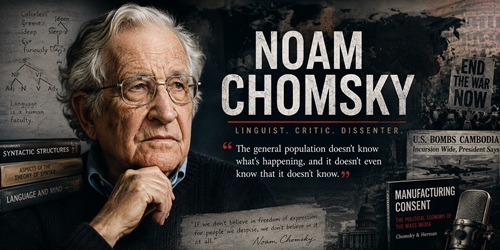 Noam Chomsky: The Relentless DissenterFrank Visser / ChatGPTLinguist, Political Critic, Public IntellectualFew contemporary thinkers have had an influence as broad, controversial, and enduring as Noam Chomsky. To some, he is the most important intellectual critic of American power since the Vietnam era. To others, he is an ideologically rigid polemicist whose anti-imperial commitments blind him to the crimes of America's adversaries. Yet even his critics usually concede one point: Chomsky fundamentally altered the landscape of both linguistics and political dissent. His relevance today lies not merely in the content of his arguments, but in the unusual combination of scientific prestige and radical political critique he brought into public life. Chomsky was not a journalist who drifted into activism. He was already one of the most influential linguists in the world when he became a central voice of anti-war criticism during the 1960s. That dual identity gave his political interventions unusual authority. He represented a model of the intellectual as dissenter: rigorous, uncompromising, and largely indifferent to popularity. Revolutionizing LinguisticsChomsky first rose to prominence through his critique of behaviorism in linguistics and psychology. In works such as Syntactic Structures, he challenged the dominant idea that language could be explained merely through conditioning and stimulus-response mechanisms. Instead, he proposed that humans possess an innate biological capacity for language: a universal grammatical structure underlying all human languages. This became known as “generative grammar.” The implications reached far beyond linguistics. Chomsky helped revive interest in the mind as an active, structured system rather than a passive recording device. His work contributed significantly to the rise of cognitive science and weakened the dominance of strict behaviorism associated with figures like B. F. Skinner. Although aspects of Chomsky's linguistic theories have been challenged or revised over the decades, his historical importance remains immense. He transformed linguistics from a largely descriptive discipline into a formal and theoretical science concerned with the deep structures of cognition. Manufacturing ConsentFor the wider public, however, Chomsky is primarily known for political critique. His 1988 book Manufacturing Consent, co-authored with Edward S. Herman, became one of the most influential critiques of mass media ever written. The core argument was not that journalists consciously lie, but that structural pressures shape what becomes acceptable discourse. Ownership, advertising, elite sourcing, ideological assumptions, and geopolitical interests create a filtering process that systematically privileges some narratives while marginalizing others. The “propaganda model” remains relevant because it anticipated dynamics now intensified by digital media: • concentration of ownership, • dependence on official narratives, • selective outrage, • and the fusion of entertainment with political messaging. Critics argue that Chomsky underestimated journalistic pluralism and overstated elite coordination. Yet the persistence of media echo chambers, narrative synchronization during wars, and the close relationship between corporate and state power continue to give his analysis explanatory force. Ironically, the rise of social media both vindicated and complicated his model. While digital platforms weakened traditional gatekeepers, they also created new systems of algorithmic amplification, outrage economies, and informational fragmentation. The Permanent Critic of EmpireChomsky's political relevance stems largely from his role as a relentless critic of American foreign policy. During the Vietnam War he emerged as one of the most prominent intellectual opponents of U.S. interventionism. He later extended this critique to Latin America, the Middle East, and the broader architecture of American global power. Unlike many liberal critics, Chomsky rejected the idea that American interventions are primarily motivated by humanitarian concerns. He interpreted them instead through the lens of strategic and economic interests, often emphasizing continuity across Republican and Democratic administrations. This is why he famously argued that many modern U.S. presidents could plausibly be judged as war criminals under the standards established at the Nuremberg Trials. For supporters, this consistency is precisely what makes him valuable. He applies moral standards universally rather than selectively. For detractors, it produces a distorted picture in which America becomes the primary source of global disorder while authoritarian rivals receive comparatively less scrutiny. Yet even critics often acknowledge Chomsky's documentary rigor. His political writings are saturated with official records, declassified documents, and mainstream sources. He cultivated a style of argument that relied less on rhetorical flourish than on accumulation of evidence. The Ethics of Intellectual ResponsibilityOne of Chomsky's most enduring contributions is his conception of intellectual responsibility. In his essay “The Responsibility of Intellectuals” (1967), he argued that intellectuals have a duty to expose government deception and challenge systems of power rather than rationalize them. This idea emerged during the Cold War, when many academics and experts became integrated into state and military institutions. Chomsky saw this fusion of expertise and power as morally dangerous. He believed intellectuals should resist becoming technocratic servants of empire. That ideal retains relevance in an age when experts are increasingly entangled with media systems, think tanks, corporate funding, and political polarization. At the same time, Chomsky's model of dissent belongs to an older intellectual culture: deeply textual, historically grounded, and resistant to celebrity branding. He rarely personalized debates and generally avoided the confessional style common in contemporary discourse. Chomsky's Blind SpotsChomsky's critics are not without substantial arguments. He has often been accused of minimizing or relativizing atrocities committed by anti-Western regimes. His comments on Cambodia during the Khmer Rouge period remain particularly controversial. Others argue that his analytical framework can become overly reductionistic. By focusing so heavily on American power, he sometimes appears to treat other actors as reactive rather than autonomous. Nationalism, religion, ideology, and local historical dynamics can recede behind a largely structural critique of imperial systems. There is also a paradox in Chomsky's worldview. While he is often associated with radical skepticism toward official narratives, he remains strongly committed to Enlightenment rationality, secularism, and empirical analysis. In this sense, he is less a postmodern critic than a fiercely rationalist dissenter. The Last Great Public Intellectual?Chomsky may represent one of the last examples of the twentieth-century “public intellectual” in the classical sense: a scholar who intervenes across disciplines and addresses moral questions on a civilizational scale. Today intellectual culture is more fragmented. Expertise is specialized, attention spans are shorter, and public discourse is increasingly shaped by algorithms, influencers, and ideological tribes. Chomsky emerged from a slower intellectual world dominated by books, lectures, and long-form argumentation. Yet his continued relevance suggests a persistent hunger for systematic critique. Even those who reject his conclusions often engage with the questions he forced into public consciousness: • How independent are the media? • How should power be held accountable? • Are international laws applied universally? • What responsibilities do intellectuals have toward truth and dissent? These questions have not disappeared. If anything, they have become more urgent in an era of permanent information warfare, geopolitical fragmentation, and institutional distrust. ConclusionNoam Chomsky's significance cannot be reduced to agreement or disagreement with his politics. His relevance lies in the model of intellectual life he embodies: skeptical toward power, committed to evidence, resistant to conformity, and willing to endure marginalization for unpopular positions. In linguistics, he transformed the study of language and cognition. In politics, he became one of the most persistent critics of American global dominance. In public culture, he defended the ideal that intellectuals should challenge power rather than serve it. Whether viewed as prophet, polemicist, or provocateur, Chomsky remains impossible to ignore. That alone is rare in an age saturated with disposable opinion. Appendix: Chomsky's Contrarian Stance on the Ukraine WarNo discussion of Noam Chomsky's contemporary relevance would be complete without addressing his highly controversial position on the Ukraine war. For many admirers, the conflict exposed both the strengths and limitations of his intellectual framework. For critics, it revealed a tendency to interpret global events through an overly America-centric lens. From the outset of Russia's full-scale invasion in 2022, Chomsky unequivocally condemned the attack as a serious war crime and a blatant violation of international law. He repeatedly stated that Russia bore responsibility for launching the war and described the invasion as criminal. Yet Chomsky simultaneously argued that understanding a war is not the same as justifying it. Consistent with his long-standing approach to international relations, he insisted that analysts must examine the broader geopolitical context that preceded the invasion. NATO Expansion and the Security DilemmaCentral to Chomsky's argument was the claim that NATO's eastward expansion after the Cold War created a foreseeable security dilemma for Russia. Like economists and foreign-policy realists such as Jeffrey Sachs and John Mearsheimer, Chomsky argued that successive American administrations ignored repeated warnings from diplomats and strategic thinkers that continued NATO expansion would eventually provoke a severe Russian reaction. According to this view, the key question is not whether Russia had a right to invade—it did not—but whether Western policymakers pursued a strategy that made such a conflict more likely. Chomsky often pointed out that the United States would never tolerate a hostile military alliance expanding into countries directly bordering America. He frequently invoked the example of the 1962 Cuban Missile Crisis, arguing that great powers routinely react aggressively when they perceive threats near their borders. The Criticism: A Failure to Recognize Ukrainian Agency?Critics contend that this analysis grants excessive weight to Russian security concerns while minimizing Ukrainian self-determination. From this perspective, countries such as Poland, Estonia, Latvia, and Lithuania sought NATO membership precisely because they feared future Russian aggression. NATO expansion was therefore not simply an American project but an expression of the sovereign choices of nations with painful historical memories of Russian domination. Many Ukrainians found Chomsky's emphasis on NATO deeply frustrating. They argued that it risked treating Ukraine as a pawn in a contest between great powers rather than as an independent nation entitled to determine its own future. The counterargument can be summarized succinctly: even if NATO expansion was strategically unwise, Russia still chose to invade. Negotiation Versus VictoryChomsky also diverged sharply from mainstream Western opinion by consistently advocating negotiated settlement over military escalation. He warned that the conflict carried risks extending far beyond Ukraine itself, including direct confrontation between nuclear powers. For Chomsky, preventing escalation and minimizing human suffering took precedence over maximalist political objectives. This position drew criticism from those who believed negotiations under conditions of military occupation would reward aggression and encourage future invasions. Opponents argued that peace without justice could amount to capitulation. Supporters countered that every war eventually ends through negotiation and that prolonging conflict indefinitely may impose costs greater than the concessions required to end it. The Chomsky PatternThe Ukraine debate illustrates a recurring pattern in Chomsky's political thought. His instinct is almost always to ask what role American power played in producing a crisis. He does not begin with the intentions of adversaries but with the policies of his own government. This reflects his belief that citizens bear the greatest responsibility for the actions carried out in their name and with their tax dollars. That perspective has often produced important insights. It helped expose American crimes in Vietnam, Central America, and Iraq. But critics argue that the same framework can sometimes become reductive, causing local histories, national aspirations, and ideological motivations to fade into the background. ConclusionChomsky's position on Ukraine neither fits neatly into pro-Russian apologetics nor into mainstream Western narratives. He condemned Russia's invasion while also criticizing decades of Western policy that, in his view, helped create the conditions for the conflict. Whether one finds this analysis persuasive largely depends on how one balances two principles: the right of sovereign nations to choose their alliances, and the reality that great powers often react forcefully to perceived threats in their immediate sphere of influence. The controversy itself is revealing. Even in his nineties, Chomsky remained what he had been throughout his career: a dissenter unwilling to align comfortably with prevailing orthodoxies. His Ukraine stance may ultimately be remembered less for the specific conclusions it reached than for the enduring question it posed: Can a durable international order be built on freedom of choice alone, or must it also account for the security fears of rival powers? Widget is loading comments...
|