|
TRANSLATE THIS ARTICLE
Integral World: Exploring Theories of Everything
An independent forum for a critical discussion of the integral philosophy of Ken Wilber
  Frank Visser, graduated as a psychologist of culture and religion, founded IntegralWorld in 1997. He worked as production manager for various publishing houses and as service manager for various internet companies and lives in Amsterdam. Books: Ken Wilber: Thought as Passion (SUNY, 2003), and The Corona Conspiracy: Combatting Disinformation about the Coronavirus (Kindle, 2020). Frank Visser, graduated as a psychologist of culture and religion, founded IntegralWorld in 1997. He worked as production manager for various publishing houses and as service manager for various internet companies and lives in Amsterdam. Books: Ken Wilber: Thought as Passion (SUNY, 2003), and The Corona Conspiracy: Combatting Disinformation about the Coronavirus (Kindle, 2020).
Check out my other conversations with ChatGPT
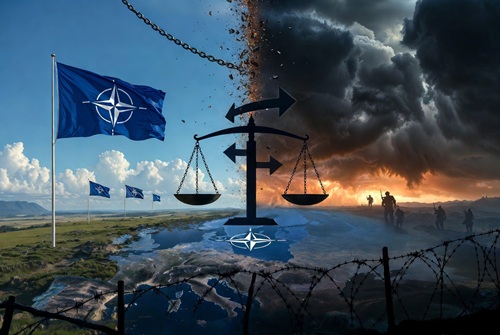 The Security Dilemma That Became a WarNATO Expansion Between Freedom and FearFrank Visser / ChatGPTJeffrey Sachs has become one of the most prominent advocates of the view that the Ukraine war is fundamentally a security dilemma created by NATO expansion. According to this perspective, the conflict is not primarily about Russian imperialism or Ukrainian nationalism, but about the collision between two legitimate principles: the freedom of nations to choose their alliances and the security concerns of great powers. The controversy revolves around a deceptively simple question: was NATO expansion a broken promise to Russia, or was it the rightful expression of freedom by newly independent states? NATO Expansion: The Freedom NarrativeFrom the Western perspective, NATO enlargement after the collapse of the Soviet Union was an exercise in self-determination. Countries such as Poland, Czech Republic, and Hungary sought NATO membership not because they were forced to do so by Washington, but because of their own historical experiences with Russian domination. For these countries, NATO represented security, democracy, and integration into the Western political order. After decades of Soviet control, joining NATO was seen as an affirmation of sovereignty. The principle was straightforward: every nation should be free to determine its own foreign policy and security arrangements. Under this view, Russia possesses no veto over the decisions of its neighbors. To deny Ukraine or other Eastern European states the right to join NATO would effectively acknowledge a Russian sphere of influence and reduce smaller nations to pawns in great-power politics. Supporters of this position often ask: if NATO expansion was aggressive, why did so many countries voluntarily seek membership? The answer, they argue, lies in fear of Russia rather than fear of the West. The Broken Promise NarrativeJeffrey Sachs and many realist scholars see the situation differently. They argue that Western leaders created expectations during the negotiations over German reunification in 1990 that NATO would not move eastward. The controversy centers on conversations between Soviet leader Mikhail Gorbachev and Western officials. Several Western diplomats reportedly suggested that NATO would move "not one inch eastward" if Moscow accepted a unified Germany within NATO. Critics of NATO expansion argue that while no formal treaty prohibited enlargement, Russia reasonably understood these assurances as a broader political commitment. They see subsequent expansion as a violation of the spirit, if not the letter, of those understandings. From this perspective, Russia watched NATO move steadily toward its borders over three decades. Former members of the Soviet sphere joined one after another. Discussions eventually extended to Georgia and Ukraine, crossing what many Russian leaders regarded as a fundamental red line. The realist argument does not necessarily defend Russian actions. Rather, it claims that great powers predictably react to perceived encirclement. Just as the United States would object to a hostile military alliance incorporating Mexico or Canada, Russia objected to NATO's approach toward Ukraine. Was There Actually a Promise?The historical record is more ambiguous than either side often admits. There was never a signed agreement prohibiting NATO enlargement. No treaty language committed the alliance to remain confined to its Cold War boundaries. However, declassified documents show that various Western officials discussed limitations on NATO's future expansion during negotiations with Soviet leaders. The debate is not over whether such statements occurred—they did—but whether they applied only to East Germany or implied a broader commitment regarding Eastern Europe. Historians remain divided. Some conclude that Russia later constructed a myth of betrayal. Others argue that Western leaders made political assurances they never intended to codify legally. In practice, both sides can claim partial truth. There was no binding promise, yet there were certainly expectations and understandings that contributed to later Russian resentment. The Security DilemmaThe deeper issue may be what international relations scholars call the security dilemma. A security dilemma occurs when actions taken by one side to increase its security unintentionally decrease the security of another side. Neither side necessarily intends aggression, yet both become less secure. NATO expansion can be viewed through this lens. Eastern European states joined NATO because they feared Russia. Russia then interpreted NATO's growth as evidence that it was being strategically encircled. Russian responses reinforced Eastern European fears, encouraging further support for NATO. The result was a self-reinforcing cycle. What appeared defensive from Warsaw looked offensive from Moscow. What appeared protective from Brussels looked threatening from the Kremlin. Ukraine as the Collision PointUkraine became the focal point because it embodies both principles simultaneously. From the freedom perspective, Ukrainians should decide their own future. If they wish to move toward Europe and potentially join NATO, that is their sovereign right. From the security-dilemma perspective, Ukraine occupies a uniquely sensitive position in Russian strategic thinking. Russian leaders have long viewed Ukraine not merely as another neighboring country but as central to their security architecture and historical identity. These two principles collide directly. Ukrainian sovereignty implies freedom of choice. Russian security concerns imply limits on that choice. No diplomatic formula has successfully reconciled both claims. The Tragedy of Competing TruthsOne reason the Ukraine debate remains so polarized is that both narratives contain important truths. The freedom narrative correctly emphasizes the rights of smaller nations. It rejects the idea that powerful countries should determine the destinies of weaker neighbors. The security narrative correctly emphasizes that great powers react strongly to perceived threats near their borders. Ignoring such concerns may be morally satisfying but strategically dangerous. The tragedy is that these truths are not easily compatible. A world based solely on spheres of influence undermines national sovereignty. A world based solely on sovereign choice can generate intense security fears among neighboring powers. ConclusionThe question of NATO expansion cannot be reduced to either a broken promise or an expression of freedom. It was, in important respects, both a geopolitical challenge and a democratic aspiration. Jeffrey Sachs highlights a reality often neglected in Western discourse: great powers have security concerns that cannot simply be ignored. His critics highlight an equally important reality: smaller nations possess rights that cannot simply be subordinated to those concerns. The Ukraine war emerged at the intersection of these competing principles. The central lesson may be that international politics rarely presents a choice between good and evil. More often, it presents a collision between legitimate but incompatible interests, where every solution carries costs and every failure carries consequences. Widget is loading comments...
|