|
TRANSLATE THIS ARTICLE
Integral World: Exploring Theories of Everything
An independent forum for a critical discussion of the integral philosophy of Ken Wilber
  Frank Visser, graduated as a psychologist of culture and religion, founded IntegralWorld in 1997. He worked as production manager for various publishing houses and as service manager for various internet companies and lives in Amsterdam. Books: Ken Wilber: Thought as Passion (SUNY, 2003), and The Corona Conspiracy: Combatting Disinformation about the Coronavirus (Kindle, 2020). Frank Visser, graduated as a psychologist of culture and religion, founded IntegralWorld in 1997. He worked as production manager for various publishing houses and as service manager for various internet companies and lives in Amsterdam. Books: Ken Wilber: Thought as Passion (SUNY, 2003), and The Corona Conspiracy: Combatting Disinformation about the Coronavirus (Kindle, 2020).
Check out my other conversations with ChatGPT
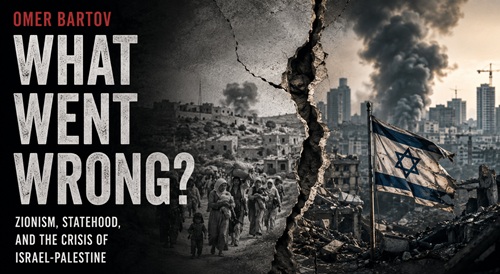 Omer Bartov's What Went Wrong?Structural Failure and the Crisis of the Israeli StateFrank Visser / ChatGPTIntroduction: A Question That Is Already an ArgumentOmer Bartov's Israel: What Went Wrong? is framed as a question, but its structure is closer to a diagnosis. The “what went wrong” is not posed as an open-ended puzzle; it is a retrospective interrogation of a political formation whose contradictions, in Bartov's view, were embedded from the start. The book argues that the present crisis in Israel-Palestine is not an accidental deviation from an otherwise stable democratic project, but the logical unfolding of foundational tensions within Zionism's translation into statehood. Foundational Contradiction: Democracy and Ethno-NationalismThe first core claim is that Israel's institutional architecture was built on an unresolved contradiction between liberal-democratic aspiration and ethno-national exclusivity. Bartov places particular emphasis on the absence of a formal constitution guaranteeing equal rights to all citizens, Jewish and Arab alike. This absence, he argues, was not incidental but formative: it allowed a flexible legal order in which equality remained contingent, and in which Jewish national identity could gradually become structurally privileged. From this perspective, the “democratic” character of the state is not denied outright, but qualified as structurally unstable—always vulnerable to redefinition through shifting legal instruments and parliamentary majorities rather than entrenched constitutional guarantees. The Nakba as Structure, Not EventA second major thesis extends the historical frame beyond 1948. Bartov treats the Nakba not as a concluded episode of wartime displacement, but as the origin point of an ongoing regime of spatial, legal, and political control over Palestinians. Here he draws implicitly on settler-colonial analysis: the idea that certain political formations do not resolve indigenous presence through integration, but through continuous management, fragmentation, and containment. On this reading, later developments—the 1967 occupation, the expansion of settlements in the West Bank, and the prolonged blockade of Gaza—are not anomalous departures from the original state project, but intensifications of its underlying logic. The significance of this move is historiographical as much as political: it redefines Israeli history as continuity rather than rupture. From Occupation to Systemic Crisis: Gaza and the PresentThe book's contemporary focus is the escalating violence in Gaza and the broader militarization of Israeli society. Bartov interprets these developments as the cumulative outcome of earlier structural choices rather than sudden moral collapse. He argues that the increasing normalization of extreme military force, combined with the erosion of liberal checks and balances, has produced a political environment in which mass violence against Palestinians becomes not only possible but institutionally rationalized. In its most controversial claim, the book suggests that current Israeli actions in Gaza meet the threshold of genocide—framed not as an exceptional breakdown but as the endpoint of a long historical trajectory. This is where the book moves from historical diagnosis to moral indictment. Core Thesis: A Failed Political ReconciliationAcross these layers, Bartov's central argument can be distilled into a single proposition: Israel failed to construct a stable political order that reconciles Jewish self-determination with universal civic equality. “Wrong,” in this sense, does not refer to a single policy error or a recent political turn. It refers to a structural incapacity embedded at the moment of state formation. The result is a progressive narrowing of political possibilities, culminating in a system increasingly defined by ethno-national consolidation, securitization, and asymmetric violence. Reception I: Liberal and Academic ValidationThe reception of the book in liberal and academic circles has largely been one of serious engagement and qualified endorsement. Many reviewers treat Bartov's intervention as a late but significant reckoning from a scholar with established authority in Holocaust and genocide studies. In this reading, the book's value lies in its refusal to isolate contemporary events from their historical conditions. It is seen as reinforcing a growing historiographical shift toward structural explanations of the Israeli-Palestinian conflict, particularly those that emphasize legal asymmetry, occupation, and long-term dispossession. At the same time, even sympathetic readers sometimes note the book's tension between critique and implied reformability: it exposes deep structural contradictions while still speaking in the language of potential correction rather than systemic rupture. Reception II: Structural Critique and Settler-Colonial DisagreementA more critical reception emerges from scholars and commentators who question the book's framing question itself. For these readers, “What Went Wrong?” presupposes that there was a viable, morally coherent version of Zionism that simply failed in execution. From a settler-colonial perspective, this is the central weakness of the argument. The critique is that Bartov may overemphasize constitutional and institutional failures while underplaying the deeper ideological and material dynamics of land, sovereignty, and displacement that predate and exceed state constitutional design. In this view, the problem is not that Israel deviated from a workable liberal model, but that the liberal framing obscures the underlying structure of colonization and demographic contestation. Reception III: Political Indeterminacy and the Problem of SolutionsA third strand of reception focuses on the gap between diagnosis and prescription. Bartov's analysis points toward solutions that are broadly binational or confederal in spirit, but the book does not fully articulate a concrete political pathway. Supporters interpret this openness as intellectual honesty in the face of intractable conditions. Critics interpret it as a limitation: a thorough structural critique that stops short of specifying how such a transformation could be achieved within existing geopolitical realities. This tension reflects a broader problem in political theory: the difficulty of translating structural diagnosis into actionable reform without either oversimplifying or abstracting away from power relations. Meta-Reception: Authority, Biography, and Moral WeightFinally, the reception is shaped by Bartov's own intellectual and biographical positioning. As a Holocaust scholar and former Israeli soldier, his authority carries particular weight in debates over genocide, state violence, and historical responsibility. For some readers, this background amplifies the book's moral force, suggesting an internal critique emerging from within the historical and institutional fabric of the Israeli state. For others, it raises questions about the limits of internal critique—whether it remains partially bound to the conceptual horizons it seeks to transcend. Conclusion: The Limits of the Question ItselfThe deepest point of contention around What Went Wrong? is not its empirical claims, but its framing. The question presupposes that the trajectory of Israel-Palestine can be understood as deviation from an implied norm of political “rightness.” Critics who reject this framing argue that the more fundamental issue is whether the original configuration was ever capable of producing a stable, egalitarian order in the first place. In that sense, the debate over Bartov's book becomes less about historical interpretation than about the limits of liberal historical diagnosis when confronted with enduring structural conflict. Comment Form is loading comments...
|