|
TRANSLATE THIS ARTICLE
Integral World: Exploring Theories of Everything
An independent forum for a critical discussion of the integral philosophy of Ken Wilber
  Frank Visser, graduated as a psychologist of culture and religion, founded IntegralWorld in 1997. He worked as production manager for various publishing houses and as service manager for various internet companies and lives in Amsterdam. Books: Ken Wilber: Thought as Passion (SUNY, 2003), and The Corona Conspiracy: Combatting Disinformation about the Coronavirus (Kindle, 2020). Frank Visser, graduated as a psychologist of culture and religion, founded IntegralWorld in 1997. He worked as production manager for various publishing houses and as service manager for various internet companies and lives in Amsterdam. Books: Ken Wilber: Thought as Passion (SUNY, 2003), and The Corona Conspiracy: Combatting Disinformation about the Coronavirus (Kindle, 2020).
Check out my other conversations with ChatGPT
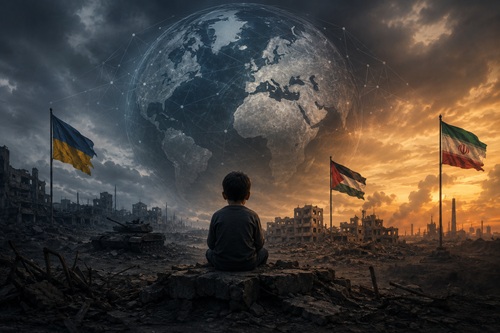 Three Stalemates, One World DisorderUkraine, Gaza, and Iran in a Fragmenting International SystemFrank Visser / ChatGPTAt first glance, the wars in Ukraine, Gaza, and Iran appear fundamentally different. Ukraine is a territorial war between states. Gaza is a conflict rooted in nationalism, occupation, and identity. Iran represents a broader regional struggle involving nuclear ambitions, deterrence, regime survival, and great-power rivalry. Yet all three conflicts have increasingly settled into a similar pattern: prolonged violence without decisive victory, intermittent diplomacy without lasting resolution, and repeated cycles of escalation followed by fragile pauses. They are not frozen conflicts in the traditional sense, but neither are they moving toward clear political settlements. They occupy an unstable middle ground between war and peace. This raises a larger question. What if these conflicts are not separate crises at all, but symptoms of a deeper transformation in the international order? The End of Decisive OutcomesOne striking feature shared by all three conflicts is the inability of military power to achieve political objectives. In Ukraine, Russia has failed to subjugate the country, while Ukraine has been unable to fully expel Russian forces. Despite enormous casualties and unprecedented military aid, neither side can impose its preferred outcome. The result is strategic exhaustion and mounting pressure for some form of negotiated settlement. In Gaza, Israel has demonstrated overwhelming military superiority, yet military operations alone have not resolved the underlying Palestinian question. Hamas has been severely damaged but not politically erased. Meanwhile, international legitimacy costs continue to rise. In Iran, recent military confrontations have likewise produced a stalemate. The United States and Israel have shown their capacity to inflict damage, but not to impose a durable settlement. Iran, for its part, has demonstrated an ability to absorb punishment while maintaining enough leverage to disrupt regional stability and global energy flows. In all three cases, military action has proven more effective at preventing defeat than achieving victory. The Return of Geopolitical MultipolarityA second common factor is the decline of unchallenged Western dominance. The post-Cold War era created expectations that a liberal international order, backed by overwhelming American power, could shape global outcomes. That assumption is now under strain. Russia remains capable of resisting Western pressure. Iran has survived decades of sanctions and isolation. China increasingly acts as a balancing force in global diplomacy and trade. Regional powers such as Turkey, Saudi Arabia, India, and the Gulf states pursue their own interests rather than automatically aligning with Washington. The result is a fragmented geopolitical landscape in which no single actor possesses sufficient leverage to dictate outcomes. This is not necessarily a return to Cold War bipolarity. Rather, it resembles a more fluid and unpredictable multipolar system in which competing powers can obstruct one another more easily than they can construct stable alternatives. Information Warfare and Permanent PolarizationAnother common feature is the collapse of shared narratives. Every conflict now unfolds simultaneously on the battlefield and in the information sphere. Governments, activists, intelligence agencies, media outlets, and online communities compete to define reality itself. Ukraine is presented alternately as a struggle for democracy, a proxy war, an anti-colonial resistance, or a geopolitical chess match. Gaza is framed as self-defense, resistance, occupation, genocide, counterterrorism, or decolonization, depending on one's political position. Iran is portrayed either as a destabilizing authoritarian regime or as a target of Western and Israeli aggression. These competing narratives often become immune to evidence because they function as identity markers rather than analytical frameworks. The result is not merely disagreement but epistemic fragmentation: different populations increasingly inhabit different realities. Security Dilemmas EverywherePolitical scientists have long described the "security dilemma": actions taken by one side to increase security are perceived as threats by the other side, producing escalating cycles of mistrust. This dynamic is visible in all three conflicts. Russia views NATO expansion as a threat; Eastern European states view NATO as protection against Russia. Israel views military dominance as necessary for survival; Palestinians and neighboring actors experience that dominance as oppression. Iran sees missile programs and regional proxies as deterrence; its adversaries see them as aggressive expansionism. Each side can tell a coherent story about why its actions are defensive. Each side can also point to evidence supporting its fears. The tragedy is that these fears reinforce one another. The Economics of ConflictWar today is increasingly integrated into global economic systems. Energy prices, sanctions, arms production, supply chains, and strategic minerals have become central components of modern conflict. The overlap between the Ukraine and Iran conflicts illustrates this clearly. Rising oil prices strengthen Russia's revenues. Western military resources are divided between multiple theaters. Weapons technologies migrate from one battlefield to another. Strategic calculations in Europe affect decisions in the Middle East and vice versa. Conflict is no longer local. Every major war has become part of a larger network of economic and geopolitical interdependence. Why Peace Processes FailMany observers assume that peace emerges once the costs of war become sufficiently high. History suggests otherwise. Conflicts often continue because leaders fear the political consequences of compromise more than the costs of continued fighting. A ceasefire may be rational from a humanitarian perspective while appearing politically suicidal to leaders whose legitimacy depends on projecting strength. Maximalist goals also create problems. If one side demands total victory, regime change, complete territorial restoration, or unconditional surrender, negotiations become almost impossible. Analysts of the Iran conflict have repeatedly noted that unclear or maximalist war aims make diplomatic closure far more difficult. Peace requires not only incentives to stop fighting but also political narratives that allow leaders to justify compromise. Those narratives are currently scarce. Toward a Different ApproachThe uncomfortable reality is that none of these conflicts are likely to end through decisive military victory. The more plausible path is a gradual shift from victory-oriented thinking toward conflict management and mutual security arrangements. This does not mean moral equivalence between all parties. Nor does it require abandoning principles. It means recognizing that sustainable peace generally emerges when adversaries conclude that coexistence is less costly than permanent confrontation. Several principles could support such a shift: Security Must Be ReciprocalNo durable settlement can rest entirely on the insecurity of one side. Ukraine will require security guarantees. Israel will require security guarantees. Palestinians will require political rights and security guarantees. Iran will require assurances regarding regime survival and regional inclusion. Whether one sympathizes with these actors or not, stable peace requires addressing the security concerns of all major parties. Regional Frameworks MatterMany conflicts persist because they are treated as isolated crises rather than components of broader regional systems. The future of Gaza cannot be separated from wider Middle Eastern politics. The future of Iran cannot be separated from Gulf security arrangements. The future of Ukraine cannot be separated from European security architecture. Peace processes that ignore regional realities tend to fail. Great Powers Need LimitsMajor powers frequently prolong conflicts by viewing them through the lens of strategic competition. When wars become proxies for broader rivalries, local populations pay the price. A more stable order would require major powers to accept limits on their ambitions and spheres of influence. That may sound idealistic. Yet endless escalation is proving increasingly costly for everyone involved. Beyond the Age of VictoryPerhaps the deepest lesson of Ukraine, Gaza, and Iran is that we are living through the decline of the victory paradigm itself. Modern military power remains extraordinarily destructive. What it increasingly fails to do is produce legitimate and stable political outcomes. The twenty-first century's most persistent conflicts reveal a paradox. States can destroy more effectively than ever, but they struggle to build lasting political settlements. If that diagnosis is correct, then the central challenge is not how to win wars but how to construct institutions, narratives, and security arrangements capable of making peace politically possible. Until that happens, Ukraine, Gaza, and Iran may remain what they increasingly resemble already: not separate crises, but interconnected expressions of a world searching for a new equilibrium. Widget is loading comments...
|