|
TRANSLATE THIS ARTICLE
Integral World: Exploring Theories of Everything
An independent forum for a critical discussion of the integral philosophy of Ken Wilber
  Frank Visser, graduated as a psychologist of culture and religion, founded IntegralWorld in 1997. He worked as production manager for various publishing houses and as service manager for various internet companies and lives in Amsterdam. Books: Ken Wilber: Thought as Passion (SUNY, 2003), and The Corona Conspiracy: Combatting Disinformation about the Coronavirus (Kindle, 2020). Frank Visser, graduated as a psychologist of culture and religion, founded IntegralWorld in 1997. He worked as production manager for various publishing houses and as service manager for various internet companies and lives in Amsterdam. Books: Ken Wilber: Thought as Passion (SUNY, 2003), and The Corona Conspiracy: Combatting Disinformation about the Coronavirus (Kindle, 2020).
Check out my other conversations with ChatGPT The Seduction of Pure IsnessA Critique of Bentinho Massaro's Metaphysical IdealismFrank Visser / ChatGPT
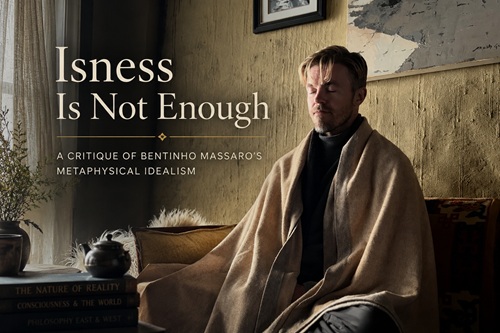 Bentinho Massaro's statement is a polished expression of a very old philosophical and mystical doctrine: the distinction between ultimate reality and the world of appearances.[1] Versions of it can be found in Advaita Vedanta, certain strands of Buddhism, Neoplatonism, and Western idealism. Its appeal is obvious. It promises an escape from the confusion, suffering, and impermanence of ordinary life by locating one's true identity in a timeless, unchanging realm of pure being. The problem is not that the doctrine lacks poetic power. The problem is that it collapses under philosophical scrutiny. The Curious Denial of the World's ExistenceMassaro writes: "The world cannot be said to have Isness. The world can only be said to appear." This raises an immediate question: appear to whom? An appearance is never free-floating. An appearance is always an appearance of something and to someone. If the world appears, then something exists that is appearing. To say that the world appears but does not exist is rather like saying a rainbow is visible but nothing is visible. The statement undermines itself. Even illusions exist as phenomena. A mirage may not be what it seems to be, but the mirage itself is real as an event. A dream may misrepresent reality, but the dream itself is a real occurrence within a dreaming brain. The distinction between "appearing" and "being" is therefore not nearly as absolute as Massaro suggests. Appearances are themselves part of reality. The Category Error at the Heart of MysticismMystics often report experiences of pure awareness devoid of objects, concepts, or distinctions. Such experiences are psychologically fascinating and potentially transformative. But from the fact that one can experience pure awareness, it does not follow that only awareness exists. This is a classic category mistake. Imagine a scientist looking through a microscope and discovering a previously unknown cellular structure. It would be absurd to conclude that only that structure exists and that everything else is illusion. Likewise, discovering a dimension of consciousness does not prove that consciousness is the sole reality. Mystical experience can reveal something important about the mind without revealing the metaphysical structure of the universe. "You Are Without Appearing"Massaro claims: "You are, without appearing." But every human being appears. We occupy space. We interact with objects. We have bodies. We cast shadows. We age. We can be photographed. One could argue that our deepest nature is not reducible to these appearances. That is a respectable philosophical position. But to say that we do not appear at all is simply false. The statement can only be maintained by redefining "you" to mean some hidden metaphysical essence and excluding everything observable from the definition. This is not an argument. It is a linguistic maneuver. The Privileging of Inner ExperienceLike many nondual teachings, this passage privileges subjective experience over everything else. The sense of "Isness" is treated as self-authenticating and more real than the external world. Yet subjective certainty has a poor track record as a guide to metaphysical truth. People have felt absolutely certain that they were communicating with angels, recalling past lives, leaving their bodies, or receiving messages from God. The intensity of an experience tells us something about the experience itself, not necessarily about the structure of reality. Modern neuroscience repeatedly demonstrates that feelings of unity, timelessness, self-transcendence, and boundless being correlate with particular brain states. This does not invalidate such experiences. It merely shows that they occur within nature rather than standing outside it. The False ChoicePerhaps the most revealing sentence is the final one: "The choice to be real or appear lost is thenceforth forevermore consciously yours." This presents a stark binary. Either: Be identified with pure Isness and live in reality. But this is a false dilemma. Human beings can recognize both dimensions simultaneously. We can acknowledge the reality of subjective consciousness while also acknowledging the reality of an external world. We need not choose between matter and mind, appearance and existence, science and spirituality. The world is not a dream simply because consciousness exists. The Problem of Self-RefutationThere is an irony running through the entire statement. Massaro uses language, concepts, distinctions, and communication—all features of the supposedly unreal world—to persuade others of the unreality of the world. His words appear on screens. They are transmitted through physical networks. They are read by embodied minds. If the world truly lacks Isness, why should any statement made within it possess validity? The doctrine depends upon the reality of the very realm it dismisses. The View from NaturalismA more parsimonious explanation is available. Human beings possess a capacity for self-awareness. Under certain conditions—meditation, contemplation, psychedelics, or spontaneous insight—the ordinary distinction between self and world may temporarily dissolve. This can generate a profound sense of pure being or "Isness." Such experiences are real. What does not follow is the conclusion that the entire physical universe is unreal. The simplest interpretation is that mystical consciousness reveals one aspect of reality, not the whole of it. Conclusion: Isness Is Not EnoughMassaro's statement derives its power from a genuine human experience: the discovery of a dimension of awareness deeper than ordinary thought. That discovery can be meaningful and transformative. The error occurs when a psychological insight is inflated into a universal metaphysical doctrine. The world is not merely appearance. Appearance is one way reality manifests itself. The sense of pure being is not proof that matter, history, evolution, biology, and the cosmos are illusions. It is simply one feature of an extraordinarily complex universe capable of reflecting upon itself. The mystic discovers depth. The metaphysician then overreaches by declaring that depth is all there is. That leap—from experience to ontology—is where the argument fails. NOTES[1] Post on Facebook by Bentinho Massaro (850.000 followers), March 20, 2026: A recent expression from Bentinho Massaro during his indefinite stay in the Himalayas: Only that which is has actual Isness. The world cannot be said to have Isness. The world can only be said to appear. Shift your attention to the sense of Isness. That is existence. That is your Self. That alone is. The world appears, without Isness. You are, without appearing. If you wish to be with Reality, be with your Self—which is, without ever appearing. If you wish to forget Reality and be lost in a dream, be with the world—which appears without ever being. Once you discover this primordial distinction between existence and appearance, the choice to be real or appear lost is thenceforth forevermore consciously yours.
Widget is loading comments...
|