|
TRANSLATE THIS ARTICLE
Integral World: Exploring Theories of Everything
An independent forum for a critical discussion of the integral philosophy of Ken Wilber
  Frank Visser, graduated as a psychologist of culture and religion, founded IntegralWorld in 1997. He worked as production manager for various publishing houses and as service manager for various internet companies and lives in Amsterdam. Books: Ken Wilber: Thought as Passion (SUNY, 2003), and The Corona Conspiracy: Combatting Disinformation about the Coronavirus (Kindle, 2020). Frank Visser, graduated as a psychologist of culture and religion, founded IntegralWorld in 1997. He worked as production manager for various publishing houses and as service manager for various internet companies and lives in Amsterdam. Books: Ken Wilber: Thought as Passion (SUNY, 2003), and The Corona Conspiracy: Combatting Disinformation about the Coronavirus (Kindle, 2020).
Check out my other conversations with ChatGPT Edgar Morin and the Challenge of ComplexityFrank Visser / ChatGPT
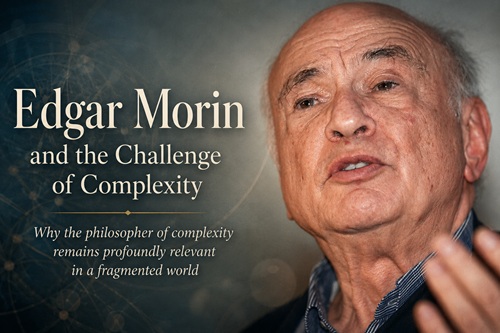 The death of Edgar Morin at the age of 104 marks the passing of one of the last great public intellectuals of the twentieth century. Throughout a life that spanned the Second World War, the Cold War, globalization, and the digital age, Morin remained remarkably active, publishing, lecturing, and commenting on world affairs almost until the end of his life. His death closes an intellectual chapter, but his central message may be more relevant today than ever: reality is complex, and our ways of thinking are often too simple to understand it. The Thinker of ComplexityMorin is best known for developing the concept of "complex thought" (pensée complexe), a lifelong effort to overcome the fragmentation of knowledge. He argued that modern academic disciplines had become isolated from one another, producing specialists who knew more and more about less and less. The result was a fragmented understanding of reality. His monumental six-volume work, La Méthode, attempted to reconnect the sciences, humanities, philosophy, history, and ecology into a broader framework. Instead of reducing phenomena to simple causes, Morin emphasized interdependence, feedback loops, emergence, uncertainty, and contradiction. Long before "systems thinking" became fashionable, Morin argued that the most important problems facing humanity could not be solved from within a single discipline. Why Complexity Matters TodayMorin's relevance has only increased because the world itself has become more interconnected. Climate change, pandemics, migration, artificial intelligence, economic instability, and geopolitical tensions do not exist as separate problems. They interact and amplify one another. A pandemic affects economics; economics affects politics; politics affects social trust; social trust affects public health responses. Morin often argued that modern civilization suffers from what he called a crisis of understanding. We possess enormous amounts of information, yet struggle to grasp the larger patterns connecting events. His criticism of reductionism applies equally to political ideologies, economic theories, and scientific specializations that seek single-factor explanations for multifaceted realities. The term "polycrisis," now widely used to describe interconnected global crises, reflects a mode of thinking that Morin championed decades before it became fashionable. A Humanist Without IllusionsUnlike many intellectuals who became prisoners of their own ideological systems, Morin's life was marked by self-criticism. He joined the French Resistance during World War II and initially embraced communism. Later, however, he became a critic of Stalinism and reflected extensively on his own political mistakes. This willingness to question himself became central to his philosophy. Knowledge, he argued, must always include awareness of its own limitations. Morin distrusted dogmatism of every kind. He saw certainty as one of the greatest dangers in both politics and intellectual life. Human beings need convictions, he believed, but they also need doubt. This attitude gave his work a distinctive tone. He was neither a pessimist nor an optimist. Rather, he combined skepticism about humanity's failures with hope for its possibilities. Even in his final interviews, he defended a humanism rooted in uncertainty rather than certainty. Morin and Integral ThinkingMorin's work has particular relevance for readers interested in integrative and holistic approaches to knowledge. Like many systems theorists and interdisciplinary thinkers, he criticized the compartmentalization of knowledge and sought broader syntheses. In this respect, his work overlaps with themes found in integral philosophy, complexity science, systems theory, and ecological thinking. Yet Morin differed from many grand synthesizers in one important respect: he insisted that integration must preserve uncertainty and contradiction. The goal was not to construct a final worldview that explained everything. It was to develop a way of thinking capable of navigating complexity without prematurely simplifying it. This distinction is important. Whereas some integral approaches seek an overarching meta-framework, Morin emphasized the permanent incompleteness of knowledge. Complexity, for him, was not a puzzle waiting to be solved but a condition of reality itself. Education for an Uncertain WorldOne of Morin's most enduring contributions may lie in education. In works such as The Seven Complex Lessons in Education for the Future, he argued that schools and universities should teach students not merely facts but the nature of knowledge itself. Students should learn how errors arise, how disciplines interact, how uncertainty operates, and how global problems transcend traditional academic boundaries. This message has become increasingly relevant in the age of artificial intelligence and information overload. The challenge is no longer access to information. It is learning how to organize, evaluate, and connect information meaningfully. Morin anticipated this problem long before the internet transformed society. The Legacy of a CenturyFew intellectuals witnessed as much history as Edgar Morin. Born in 1921, he lived through fascism, world war, decolonization, nuclear confrontation, globalization, and the rise of artificial intelligence. Throughout these transformations, he maintained a commitment to intellectual openness and human solidarity. His legacy does not consist of a single theory or doctrine. Rather, it lies in a habit of mind: resisting oversimplification, embracing uncertainty, and recognizing the interconnectedness of phenomena. In an era increasingly polarized between rigid ideologies and fragmented expertise, Morin's central insight remains remarkably fresh. The world is not simple. Human beings are not simple. Society is not simple. The task of thought is not to eliminate that complexity, but to learn how to live with it intelligently. That may be Edgar Morin's most enduring lesson.
Appendix: Edgar Morin and Ken Wilber—Two Visions of IntegrationAt first glance, Edgar Morin and Ken Wilber appear to be intellectual allies. Both reacted against the fragmentation of modern knowledge. Both sought to reconnect disciplines that had become isolated from one another. Both criticized reductionism and argued that reality cannot be understood through narrowly specialized perspectives alone. Yet beneath these similarities lie profound differences. Shared Opposition to ReductionismMorin and Wilber agree that reality is multidimensional. Both reject the idea that human beings can be adequately understood through biology alone, psychology alone, sociology alone, or spirituality alone. Both advocate broader frameworks that can accommodate multiple perspectives and levels of analysis. In this respect, both can be seen as participants in a twentieth-century movement toward systems thinking, holism, and interdisciplinarity. Both also emphasize context. A phenomenon gains meaning from its relationships to larger wholes. Neither thinker is satisfied with simplistic, linear explanations. Different Attitudes Toward SynthesisThe deepest difference concerns the nature of integration itself. Wilber's project aims at a comprehensive meta-theory. His AQAL framework ("all quadrants, all levels") seeks to provide a universal map capable of organizing knowledge across disciplines. The ambition is encyclopedic: science, psychology, spirituality, culture, and social systems are all placed within a single overarching architecture. Morin's project is almost the opposite. He sought integration without closure. Complexity thinking does not culminate in a final map of reality. Instead, it emphasizes the permanent incompleteness of knowledge. Every model reveals some aspects of reality while obscuring others. For Morin, the quest for a final synthesis risks becoming another form of reductionism. Uncertainty Versus HierarchyWilber's work is strongly hierarchical. Reality unfolds through developmental stages, from matter to life to mind to soul to spirit. Higher stages are generally seen as more inclusive and more adequate than lower stages. Human development follows a directional trajectory toward increasing complexity and consciousness. Morin was much more cautious. Although he acknowledged evolution and emergence, he resisted grand developmental narratives. History does not move smoothly upward. Progress and regression coexist. Greater complexity can create new problems as well as new possibilities. Morin distrusted theories that claimed to reveal the overall direction of history or evolution. This skepticism places him closer to contemporary complexity science than to developmental philosophies influenced by thinkers such as Georg Wilhelm Friedrich Hegel or Pierre Teilhard de Chardin. Science and SpiritualityAnother major contrast concerns spirituality. Wilber places mystical experience at the center of his worldview. Nondual consciousness functions as the ultimate reference point for his philosophical system. Spiritual realization is often presented as revealing truths about the nature of reality itself. Morin remained largely within a secular humanist framework. He was fascinated by religion, myth, meaning, and culture, but he did not build his philosophy around claims of transcendent spiritual knowledge. Complexity emerges from nature, culture, and human experience rather than from a cosmic spiritual drive. For readers of Integral World, this distinction is especially important. Much of the criticism directed at Wilber has focused on his tendency to move from spiritual experience to metaphysical conclusions. Morin rarely makes that move. Complexity Without MetaphysicsMorin's complexity theory is strikingly modest compared to Wilber's metaphysical vision. Wilber often proposes explanations involving Eros, Spirit-in-action, or evolutionary self-transcendence. These concepts function as underlying principles guiding cosmic development. Morin generally avoids such metaphysical commitments. Complexity does not require a hidden spiritual force. It arises from interactions among systems, feedback loops, chance events, and emergent properties. The universe becomes more complex not because it is pursuing a predetermined goal, but because complexity can emerge under certain conditions. This difference parallels the broader contrast between teleological and non-teleological views of evolution. Which Approach Has Aged Better?An interesting question is which thinker has proven more compatible with developments in contemporary science. Many of Morin's themes—networks, emergence, self-organization, uncertainty, ecological interdependence, and nonlinear causality—have become mainstream topics within complexity science. Wilber's broader framework remains influential among integral practitioners, but many of its stronger metaphysical claims have found little support within the natural sciences. His evolutionary spirituality continues to attract admirers, yet it remains largely outside scientific discourse. As a result, Morin's work often appears more at home in contemporary academic discussions of complexity than Wilber's. Two Kinds of HolismUltimately, Morin and Wilber represent two different forms of holism. Wilber seeks a grand synthesis: a unified framework capable of situating all forms of knowledge within a comprehensive developmental cosmology. Morin seeks a disciplined openness: a way of thinking that connects domains without pretending to master them completely. Wilber asks, "How can everything fit together within a larger pattern?" Morin asks, "How can we think about interconnected realities without oversimplifying them?" Both questions remain valuable. But in an age increasingly aware of uncertainty, unpredictability, and the limits of knowledge, Morin's caution about final syntheses may prove to be his most enduring contribution.
Comment Form is loading comments...
|