|
TRANSLATE THIS ARTICLE
Integral World: Exploring Theories of Everything
An independent forum for a critical discussion of the integral philosophy of Ken Wilber
  Frank Visser, graduated as a psychologist of culture and religion, founded IntegralWorld in 1997. He worked as production manager for various publishing houses and as service manager for various internet companies and lives in Amsterdam. Books: Ken Wilber: Thought as Passion (SUNY, 2003), and The Corona Conspiracy: Combatting Disinformation about the Coronavirus (Kindle, 2020). Frank Visser, graduated as a psychologist of culture and religion, founded IntegralWorld in 1997. He worked as production manager for various publishing houses and as service manager for various internet companies and lives in Amsterdam. Books: Ken Wilber: Thought as Passion (SUNY, 2003), and The Corona Conspiracy: Combatting Disinformation about the Coronavirus (Kindle, 2020).
Check out my other conversations with ChatGPT The Origin of SARS-CoV-2Natural Recombination or Laboratory Manipulation?Frank Visser / ChatGPT
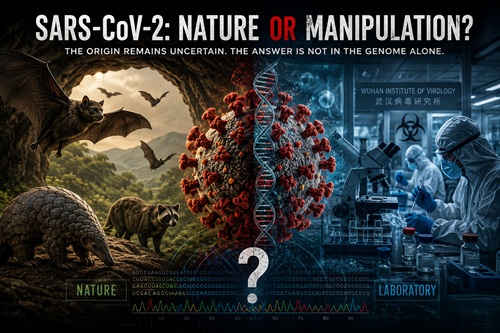 Few scientific controversies in recent memory have generated as much confusion, politicization, and epistemological uncertainty as the origin of SARS-CoV-2, the virus responsible for the COVID-19 pandemic. More than six years after the outbreak in Wuhan, China, the central question remains unresolved: did the virus emerge naturally through recombination and zoonotic spillover, or was it somehow connected to laboratory research? What is striking is not merely that the debate persists, but that the viral genome itself did not settle the matter decisively. In the early months of 2020, many expected genomic analysis to function like a forensic fingerprint: if the virus had been engineered, surely the sequence would reveal telltale signs of manipulation. Yet the genome turned out to be far more ambiguous than anticipated. Why? The answer lies in the evolving sophistication of biotechnology, the complexity of viral evolution, and the mistaken assumption that engineering must leave obvious molecular scars. The Early Expectation: The Genome as Smoking GunWhen the SARS-CoV-2 genome was first sequenced in January 2020, virologists immediately began comparing it to known coronaviruses. The expectation was straightforward. If researchers had assembled the virus using standard genetic engineering techniques, the genome might contain recognizable features: • restriction enzyme sites, • vector sequences, • unusual codon usage, • stitched-together segments, • or signs of known laboratory backbones. In older generations of genetic engineering, these clues often remained visible. Molecular biologists could detect where genes had been inserted or edited. Early recombinant organisms frequently carried “scars” of manipulation. But SARS-CoV-2 did not contain obvious signatures of this kind. This led many scientists to conclude that the virus was probably natural in origin. A highly influential 2020 paper in Nature Medicine, “The Proximal Origin of SARS-CoV-2,” argued that the virus showed no evidence of deliberate engineering. This paper became foundational in shaping public perception. However, an important nuance was often lost in public discussion: absence of evidence for known engineering methods is not evidence of absence of manipulation altogether. Why Modern Manipulation May Leave No Clear TraceThe key issue is that biotechnology has advanced enormously. Modern viral engineering can be remarkably subtle. Researchers working with coronaviruses routinely use techniques such as: • seamless cloning, • reverse genetics systems, • serial passage, • directed evolution, • synthetic assembly, • and site-directed mutagenesis. These methods can alter viruses without leaving obvious artificial signatures. In particular, serial passage experiments are highly relevant. In such experiments, viruses are repeatedly grown in cells or animals to select for adaptive mutations. The resulting genome may appear entirely natural because the evolutionary process itself generates the changes. A virus adapted this way does not necessarily carry the equivalent of molecular fingerprints. This is crucial. The simplistic dichotomy between “natural virus” and “engineered virus” obscures a large gray zone: • naturally occurring viruses collected from wildlife, • modified viruses, • adapted viruses, • recombined viruses, • or viruses unintentionally selected under laboratory conditions. A lab-associated origin does not necessarily imply a deliberately designed bioweapon. It could involve ordinary research practices in virology. The Furin Cleavage Site ControversyThe most debated genomic feature of SARS-CoV-2 has been its furin cleavage site. This short insertion in the spike protein enhances the virus's ability to infect human cells. Importantly, SARS-related coronaviruses previously known to science lacked such a feature. To some researchers, this appeared suspicious. Furin cleavage sites are not unnatural in viruses generally; many pathogens possess them. The question was narrower: why did this specific SARS-like coronavirus possess one when its closest known relatives did not? Critics of the natural-origin hypothesis argued that scientists had previously discussed inserting furin cleavage sites into coronaviruses experimentally. Documents later revealed proposals for such work, although there is no direct evidence that the exact SARS-CoV-2 sequence was created this way. Defenders of the zoonotic hypothesis responded that furin cleavage sites can evolve naturally and that undiscovered intermediary viruses may exist in wildlife reservoirs. The genome alone could not adjudicate between these interpretations. Recombination in NatureCoronaviruses are unusually prone to recombination. When two related viruses infect the same host cell, they can exchange genetic material, producing hybrid offspring. Nature effectively runs massive evolutionary experiments continuously across bat populations and intermediary hosts. Southern China and Southeast Asia harbor enormous coronavirus diversity. Bats, civets, raccoon dogs, and other mammals create ecological networks where viral mixing is common. This means that highly unusual genomic combinations can arise naturally. Indeed, the closest known relatives of SARS-CoV-2 are bat coronaviruses, particularly strains like RaTG13 and BANAL viruses discovered later in Laos. These relatives strongly support a bat ancestry for the virus lineage. However, none is close enough to constitute a direct ancestor. The evolutionary gap remains significant. Thus, while natural recombination is biologically plausible, the precise evolutionary pathway remains undocumented. The Missing Intermediate HostOne major weakness of the natural spillover hypothesis is the continued absence of a confirmed intermediate host. For the original SARS outbreak in 2002-2003, civets were quickly implicated. For MERS, camels were identified. But despite extensive searching, no definitive animal source for SARS-CoV-2 has been found. This absence does not disprove zoonosis. Wildlife surveillance is incomplete, and many viruses likely circulate undetected. But it does weaken confidence in a straightforward market-spillover narrative. The Huanan seafood market in Wuhan appears to have functioned as an amplification site early in the outbreak, but whether it was the original source remains uncertain. The Laboratory ContextThe lab-origin debate gained credibility partly because of geography and research context. Wuhan houses the Wuhan Institute of Virology, China's leading coronavirus research center. Scientists there conducted extensive bat coronavirus sampling and research, including gain-of-function-related work and reverse genetics studies. This coincidence is difficult to ignore. Yet coincidence alone is not proof. Major virology institutes are often located near outbreak zones precisely because they study local pathogens. Still, the possibility of a research-related accident cannot be dismissed merely because no genomic “smoking gun” exists. Laboratory accidents are historically common in microbiology. SARS itself escaped laboratories multiple times after 2003 in Singapore, Taiwan, and Beijing. The debate therefore shifted from “Was the virus engineered?” to the broader question: “Could a naturally occurring virus under laboratory study have escaped accidentally?” That distinction matters enormously. Why the Genome Could Not Resolve the DebateThe central reason the genome failed to provide a definitive answer is epistemological. Genomes reveal ancestry and evolutionary relationships, but they do not reliably reveal context. A viral sequence does not come with metadata explaining where it evolved. Several possibilities can produce nearly identical genomic outcomes: • natural recombination in wildlife, • laboratory collection of a naturally occurring virus, • serial passage adaptation in cell cultures or animals, • recombinant assembly using seamless techniques, • or combinations of these. Modern biotechnology increasingly blurs the line between natural and artificial evolution. This is analogous to selective breeding in agriculture. A domesticated dog genome may not contain obvious “engineering marks,” yet human intervention profoundly shaped its evolution. Similarly, viruses manipulated through evolutionary selection rather than crude insertion methods may appear entirely natural at the sequence level. Politics and PolarizationUnfortunately, the origin debate became entangled with geopolitics almost immediately. Some early dismissals of the lab-origin hypothesis were motivated partly by concern over anti-Chinese sentiment and conspiracy theories. Conversely, some proponents of lab-origin theories embraced speculative or sensational claims unsupported by evidence. This polarization damaged scientific discourse. What should have remained a probabilistic forensic investigation became a symbolic ideological battlefield: • trust in science versus skepticism, • globalization versus nationalism, • institutional authority versus populist distrust. As a result, nuanced positions became difficult to maintain publicly. Yet the most intellectually responsible conclusion today may simply be this: • the virus was almost certainly not an intentionally designed bioweapon; • natural bat ancestry is highly likely; • but a laboratory-associated pathway remains plausible and unexcluded. The Larger LessonThe SARS-CoV-2 origin debate exposes a deeper philosophical issue about modern science itself. We often imagine science as capable of producing definitive certainty from data alone. But forensic biology rarely operates this way. Evidence can narrow probabilities without yielding absolute conclusions. The viral genome provided important clues: • strong evidence of bat ancestry, • no obvious evidence of crude engineering, • and several unusual features open to multiple interpretations. But genomes are not historical documentaries. They do not directly record whether evolution occurred in caves, animal markets, laboratories, or cell cultures. In the end, the uncertainty surrounding SARS-CoV-2 may reflect not scientific failure but the intrinsic difficulty of reconstructing singular historical events from incomplete evidence. The irony is profound. Humanity now possesses the ability to read viral genomes letter by letter, yet we still struggle to reconstruct the exact pathway by which one microscopic organism altered the course of global history.
No, the coronavirus still was NOT made in a lab
Appendix: Did Dan Wilson Already Nail the Case for Natural Origin?The short answer is: partly yes, but not completely. Dan Wilson's YouTube channel “Debunk the Funk” became influential during the pandemic because he did something many scientists failed to do effectively in public: he translated molecular virology into accessible language while directly confronting sensationalist claims. His strongest contribution was not proving a natural origin beyond doubt, but dismantling a series of weak or fraudulent arguments for deliberate engineering. That distinction matters. Wilson correctly pointed out several things that remain valid today. First, SARS-CoV-2 does not resemble a crudely assembled synthetic construct. Early “bioweapon” narratives often depended on misunderstandings of genome analysis, especially claims that the virus contained HIV inserts, impossible restriction sites, or obvious cloning signatures. Wilson showed these arguments collapsed under basic comparative genomics. Second, he emphasized an important evolutionary principle: if researchers had engineered SARS-CoV-2 using known viral backbones, one might expect clearer genomic continuity with those backbones. Instead, the virus differs extensively from all previously published coronavirus strains across the genome, not just in one suspicious location. That pattern is more consistent with long natural evolution than with simplistic cut-and-paste engineering. Third, Wilson stressed that coronaviruses naturally recombine at extraordinary rates. To lay audiences, the furin cleavage site looked like a smoking gun. But virologists already knew that insertions, recombination events, and cleavage-site evolution occur naturally in many viral families. The mere existence of an unusual feature does not prove manipulation. In that sense, Wilson successfully debunked many low-grade conspiracy theories. However, the debate evolved. The stronger modern lab-origin arguments are no longer primarily about a deliberately engineered bioweapon. They concern the possibility of: • collection of wild viruses, • laboratory adaptation, • serial passage, • unpublished viral databases, • biosafety lapses, • or accidental release during ordinary coronavirus research. And here Wilson's earlier arguments become less decisive. Why? Because modern laboratory manipulation may leave no obvious genomic fingerprints. A virus adapted through serial passage in animals or cell culture could still appear evolutionarily natural. Even several scientists who favor zoonosis acknowledge this theoretical possibility. This is where many public discussions became confused. People often assumed there were only two possibilities: purely natural spillover, or overt genetic engineering. But the real landscape is broader and blurrier. A naturally occurring bat coronavirus studied in a laboratory and accidentally released would still look largely natural genomically. The genome alone might never distinguish between: cave evolution, • wildlife-trade amplification, • or laboratory adaptation. Wilson's critics therefore argue that he effectively disproved only the weakest version of the lab-origin theory: intentional crude engineering. They maintain that he did not eliminate more subtle laboratory scenarios. At the same time, many lab-origin advocates overstate their case. Some claim the genome positively proves engineering, but the evidence remains circumstantial and probabilistic rather than definitive. Even today, no published sequence identical or near-identical to SARS-CoV-2 has been shown to exist in laboratory records before the outbreak. So where does that leave Wilson? His core scientific point still stands: • SARS-CoV-2 does not look like a simplistic synthetic construct. • Many alleged “smoking guns” were based on poor molecular biology. • Natural coronavirus evolution is more versatile than many non-specialists realized. But his conclusions become less airtight if the question shifts from: “Was this deliberately engineered?” to: “Could laboratory research involving natural coronaviruses have played some role?” That latter question remains unresolved. Ironically, both sides often overclaim certainty. Some natural-origin defenders speak as if zoonosis has been conclusively demonstrated. Some lab-origin advocates speak as if laboratory involvement has been conclusively proven. Neither is true. The current state of evidence still points toward a bat-derived virus with natural evolutionary ancestry. But whether the final jump to humans occurred entirely in nature or somewhere along the interface between field collection, laboratory study, and human exposure remains unknown. In retrospect, Dan Wilson was highly effective at puncturing sensationalism and pseudo-genetics. What he did not—and probably could not—do was close the deeper forensic uncertainty surrounding the exact pathway by which SARS-CoV-2 entered the human population. Wilson's strongest point, in my opinion, was the large number of mutations, throughout the genome.Yes—that is probably the strongest mainstream scientific argument for a natural origin, and it is much stronger than the often-repeated “it doesn't look engineered” slogan. What Dan Wilson emphasizes well is that SARS-CoV-2 differs from its nearest known relatives by a very large number of distributed mutations across the genome. The pattern matters as much as the quantity. If one were engineering a virus from a known backbone, one would normally expect: • recognizable scaffold usage, • localized insertions, • suspiciously optimized sequences, • traces of known reverse-genetics systems, • or unusual clustering of adaptive mutations. Instead, SARS-CoV-2 appeared as a globally coherent but substantially divergent virus. Its differences from viruses like RaTG13 were spread throughout the genome in a way consistent with long unsampled evolutionary history. That creates a major problem for simplistic “lab construction” scenarios. The virus does not resemble a lightly modified known coronavirus. To produce such a genome artificially, researchers would effectively have needed either: an unknown precursor virus much closer to SARS-CoV-2 than anything published, or extensive serial evolution over long periods. And once one invokes long serial evolution in animals or cell cultures, the distinction between “natural” and “lab-associated evolution” becomes much blurrier. This is why the debate gradually shifted from: “Was this genetically engineered?” to: “Could a naturally evolving virus have been collected and accidentally released from a lab?” Those are very different hypotheses. The genomic evidence strongly weakens the classic deliberate-engineering claim. There are no obvious fingerprints of manipulation, no clear modular assembly signatures, and no known precursor close enough to make direct engineering plausible. Critics of natural origin therefore focused increasingly on circumstantial rather than genomic arguments: • Wuhan's coronavirus research, • biosafety concerns, • unpublished viral databases, • gain-of-function experiments, • geographic coincidence, • lack of identified intermediate host, • and early institutional opacity. But genomically, the virus behaves much more like an evolved lineage than a designed construct. This is also why the furin cleavage site became such a fixation point. It was one of the few genomic features that looked initially unusual enough to sustain suspicions. Yet over time, the broader comparative coronavirus literature weakened the claim that such insertions are uniquely artificial. Similar cleavage-site dynamics occur naturally in multiple viral families. Wilson's broader point, then, is methodological: the genome is not merely a sequence of interesting anomalies; it is an evolutionary document. And the overall statistical texture of SARS-CoV-2 looks more like messy evolutionary accumulation than rational engineering. That does not definitively prove zoonosis. Absence of engineering fingerprints is not proof of a wildlife spillover event. But it substantially narrows the plausible space of lab-origin scenarios toward accidental release of a naturally evolved or experimentally passaged virus, rather than deliberate genomic construction.
Widget is loading comments...
|