|
TRANSLATE THIS ARTICLE
Integral World: Exploring Theories of Everything
An independent forum for a critical discussion of the integral philosophy of Ken Wilber
  Frank Visser, graduated as a psychologist of culture and religion, founded IntegralWorld in 1997. He worked as production manager for various publishing houses and as service manager for various internet companies and lives in Amsterdam. Books: Ken Wilber: Thought as Passion (SUNY, 2003), and The Corona Conspiracy: Combatting Disinformation about the Coronavirus (Kindle, 2020). Frank Visser, graduated as a psychologist of culture and religion, founded IntegralWorld in 1997. He worked as production manager for various publishing houses and as service manager for various internet companies and lives in Amsterdam. Books: Ken Wilber: Thought as Passion (SUNY, 2003), and The Corona Conspiracy: Combatting Disinformation about the Coronavirus (Kindle, 2020).
Check out my other conversations with ChatGPT Altitude SicknessWhen Metatheory Loses Contact with the GroundFrank Visser / ChatGPT
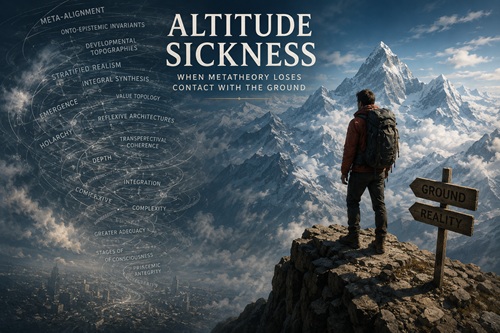 The Seduction of SynthesisThere is a recurring pathology in contemporary intellectual culture that appears most vividly in Integral Theory, metamodernism, systems philosophy, consciousness studies, and grand civilizational theorizing. It begins with a legitimate dissatisfaction toward reductionism and fragmentation, but gradually evolves into something else: an intoxication with abstraction itself. The result is what might be called Altitude Sickness. At high conceptual altitude, everything appears connected. Psychology merges with cosmology, ethics with evolution, complexity with spirituality, epistemology with politics, AI with metaphysics. Vast explanatory panoramas emerge in which all domains of knowledge become expressions of deeper developmental dynamics. This initially feels exhilarating. Narrow disciplinary silos dissolve. Hidden patterns seem visible everywhere. History acquires direction. Complexity acquires meaning. Contradictions become reconcilable from “higher” perspectives. But as with literal altitude sickness, elevation brings cognitive distortions. The farther one ascends into abstraction, the easier it becomes to mistake distance for depth.[1] The Legitimate Origins of MetatheoryThe original impulse behind these metatheoretical systems is often reasonable. Modern intellectual life is fragmented. Academic specialization frequently produces narrow expertise without broader orientation. Scientific reductionism can flatten lived experience into mechanism. Postmodern relativism can dissolve normative confidence into irony and paralysis. Grand synthesis emerges as a response to this exhaustion. The metatheorist attempts to reconnect the shattered fragments of knowledge into a coherent whole. And for a while, this integrative effort can produce real insight. Cross-disciplinary thinking matters. Human beings do inhabit nested systems. Developmental processes are real. Cultural evolution exists. Complexity matters. The trouble begins when synthesis gradually mutates into inflation. When Description Becomes Metaphysics Description becomes metaphysics. Complexity becomes teleology. Hierarchy becomes morality. And developmental models become hidden cosmologies. This transition is rarely announced openly. It happens through subtle conceptual slippage. A framework that initially describes increasing organizational complexity quietly begins implying increasing existential significance. “More complex” becomes “more evolved.” “More evolved” becomes “more adequate.” “More adequate” becomes “closer to reality.” At that point, the map ceases merely to organize phenomena and begins ranking existence itself. One sees this repeatedly in integral and metamodern discourse. The language varies: • depth, • altitude, • developmental stages, • integrative capacity, • perspectival complexity, • meta-systemic cognition, • onto-epistemic adequacy. But the underlying structure remains remarkably stable. Reality is interpreted as a developmental ascent toward greater integration, complexity, reflexivity, and inclusiveness. The Return of TeleologyThis gives metatheory an almost gravitational pull toward spiritualization. Even when explicitly secular, these systems often preserve the emotional architecture of older metaphysical worldviews. Evolution is no longer driven by divine providence or Spirit, but by emergence, complexity, self-organization, or developmental attractors. The vocabulary modernizes while the narrative structure remains intact. History still appears to be going somewhere. This is why so many post-religious intellectuals find such systems emotionally satisfying. They restore orientation without requiring traditional theology. They offer transcendence without supernaturalism. They transform fragmentation into coherence. Yet coherence itself can become addictive. The Problem of Explanatory OmnivorousnessAt sufficient altitude, almost any phenomenon can be integrated into the framework. Economic crises become developmental turbulence. Political conflict becomes stage transition. Scientific disagreement becomes perspectival partiality. Moral disputes become clashes between levels of consciousness. The framework grows increasingly universal—and increasingly difficult to falsify. This is a crucial symptom of altitude sickness: explanatory omnivorousness. Every objection gets absorbed into the system at a “higher” level of interpretation. Contradictions cease functioning as threats because the framework specializes in reframing contradiction itself as evidence of insufficient integration. In this way, metatheory acquires immunological defenses. Abstraction DriftAnother symptom is abstraction drift. Concrete realities gradually disappear beneath conceptual architecture. The theorist speaks fluently about civilization, consciousness, emergence, and planetary evolution while becoming strangely detached from empirical specificity. The prose becomes saturated with elevated terminology: • meta-alignment, • stratified ontologies, • integral enactments, • developmental topographies, • recursive reflexivity, • trans-perspectival coherence. Each term gestures toward profundity. Together they generate an atmosphere of immense significance. Yet when translated into ordinary language, the claims are often surprisingly simple—or surprisingly vague. The Hierarchy ProblemAltitude sickness also produces epistemic hierarchy. Once developmental metaphors dominate thought, disagreement is easily reinterpreted as developmental limitation. Critics are not merely mistaken; they are operating from lower complexity, narrower cognition, flatter ontology, or reduced depth sensitivity. This creates a subtle but powerful elitism disguised as inclusiveness. “All perspectives contain partial truths,” the metatheorist says. But some perspectives, naturally, are more integrative than others. And the metatheoretical framework itself almost always occupies the highest integrative position available. This self-positioning is rarely accidental. The danger here is not merely intellectual arrogance. It is the replacement of argument with altitude. Instead of defending claims through evidence and reasoning, the framework implies that disagreement reflects insufficient developmental capacity to perceive the larger synthesis. At that point, the theory becomes less an analytical instrument than a worldview management system. The Need for Conceptual OxygenNone of this means metatheory is useless. Human knowledge genuinely requires synthesis. Reductionism genuinely fails in important ways. Interdisciplinary thinking matters enormously. Some forms of cognition really are more reflective, flexible, and comprehensive than others. But synthesis has limits. A healthy metatheory remains tethered to empirical resistance. It treats its abstractions as heuristic tools rather than revelations about the hidden direction of reality itself. It recognizes complexity without automatically moralizing it. It avoids converting developmental models into cosmic hierarchies. Most importantly, it retains contact with the ground. Because at extreme conceptual altitude, one can begin mistaking intellectual vertigo for enlightenment. NOTES[1] The term "altitude sickness" in the context of integral theory was introduced by Mark Edwards, see for example: Mark Edwards, "Altitude Lens Sickness", IFIS, March 31, 2010.
Widget is loading comments...
|