|
TRANSLATE THIS ARTICLE
Integral World: Exploring Theories of Everything
An independent forum for a critical discussion of the integral philosophy of Ken Wilber
  Frank Visser, graduated as a psychologist of culture and religion, founded IntegralWorld in 1997. He worked as production manager for various publishing houses and as service manager for various internet companies and lives in Amsterdam. Books: Ken Wilber: Thought as Passion (SUNY, 2003), and The Corona Conspiracy: Combatting Disinformation about the Coronavirus (Kindle, 2020). Frank Visser, graduated as a psychologist of culture and religion, founded IntegralWorld in 1997. He worked as production manager for various publishing houses and as service manager for various internet companies and lives in Amsterdam. Books: Ken Wilber: Thought as Passion (SUNY, 2003), and The Corona Conspiracy: Combatting Disinformation about the Coronavirus (Kindle, 2020).
Check out my other conversations with ChatGPT Togetherness and the New Biology of CooperationA Critical Review of Rowan Hooper's TogethernessFrank Visser / ChatGPT
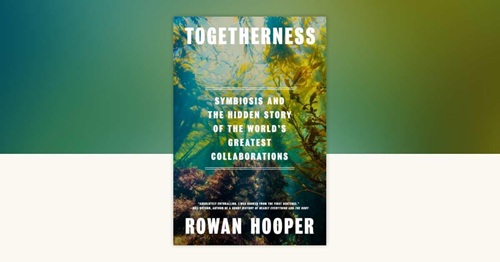 Togetherness by Rowan Hooper belongs to a growing genre of popular science books arguing that evolution has been misunderstood for too long as a story of ruthless competition. Hooper proposes instead that cooperation, symbiosis, and interdependence are the deeper logic of life itself. At first glance, this sounds like a refreshing corrective. Modern biology increasingly recognizes that organisms are not isolated individuals but complex ecological partnerships. Yet the book also raises an important question: does correcting one distortion risk creating another? The Case for CooperationHooper's central argument rests on solid scientific ground. Biology over the past decades has revealed how deeply life depends on collaboration. Corals survive through partnerships with algae. Plants co-evolved with pollinators. Mammals rely on immense microbial ecosystems in their guts. Even the emergence of complex cells may have resulted from ancient symbiotic mergers between primitive organisms. These discoveries genuinely changed biological thinking. The old image of evolution as purely “red in tooth and claw” no longer captures the complexity of life. Organisms are embedded in networks of dependency, exchange, and co-evolution. Hooper deserves credit for bringing these developments to a wider audience. With his background in evolutionary biology and science journalism through New Scientist, he is well equipped to translate sophisticated science into accessible narrative. The likely strength of Togetherness lies in this storytelling ability. Rather than drowning readers in technical jargon, Hooper appears to guide them through vivid biological examples showing how cooperation operates throughout nature. The Problem of OvercorrectionYet the book's promotional framing already hints at a potential weakness. The repeated claim that “we got evolution wrong” oversimplifies both Darwin and modern evolutionary biology. Darwin himself discussed cooperation extensively, especially regarding social instincts and eusocial insects. Later theorists developed powerful explanations for altruism and cooperation through kin selection, reciprocal altruism, multilevel selection, and evolutionary game theory. The field was never as one-dimensional as the book's rhetoric suggests. This creates the impression that Hooper may be fighting a somewhat outdated caricature of Darwinism—one more associated with popular social Darwinism than with contemporary evolutionary science itself. In that sense, Togetherness risks becoming less a scientific revolution than a cultural mood shift. When Biology Becomes Moral PhilosophyA more serious issue emerges when biological cooperation is translated into social or political ideals. The book reportedly contrasts symbiosis not only with competitive evolution, but also with modern capitalism and individualism. That move is rhetorically appealing, especially in an age of polarization and ecological anxiety. But it introduces philosophical complications. Nature is not morally cooperative. Symbiosis itself often contains exploitation, manipulation, or instability. Parasites are symbiotic too. Cooperation evolves because it offers selective advantages under certain conditions—not because evolution possesses ethical intentions. This distinction matters enormously. Describing cooperation in nature does not automatically justify specific human social arrangements. Biology explains what exists; it does not directly prescribe what ought to exist. Books like this sometimes drift toward what could be called ecological sentimentalism: the tendency to project human longings for harmony onto natural systems. Competition Never Went AwayThe greatest weakness of the “cooperation revolution” narrative is that it can unintentionally replace one oversimplification with another. Twentieth-century popular culture exaggerated competition. Twenty-first-century popular science sometimes romanticizes cooperation. But evolution depends on both. Predator-prey dynamics, sexual competition, territorial conflict, extinction pressures, and ecological rivalry remain central evolutionary forces. Cooperation itself usually evolves within competitive environments. The deeper truth is not that cooperation replaces competition, but that life constantly generates both simultaneously. Multicellular organisms are cooperative cellular alliances, yet cancer represents competition within that alliance. Ecosystems depend on mutual interdependence, yet species compete for niches and resources. Human societies likewise combine solidarity and rivalry in unstable mixtures. Nature is neither a battlefield nor a utopia. It is both. The Intellectual Lineage Behind the BookHooper's work belongs to a broader intellectual tradition emphasizing cooperation as an evolutionary force. • Lynn Margulis stressed symbiosis as central to evolution through her endosymbiotic theory. • David Sloan Wilson promoted multilevel selection and group dynamics. • Peter Kropotkin argued more than a century ago in Mutual Aid that cooperation was as natural as competition. Hooper appears to stand within this lineage, updating it for an era shaped by microbiome science, systems thinking, and ecological crisis. Final AssessmentTogetherness is likely most persuasive when it remains close to biology and least persuasive when it expands into cultural diagnosis. Its central insight—that life is profoundly relational—is undoubtedly important. Modern biology increasingly supports this perspective. Hooper performs a valuable service by challenging simplistic “survival of the fittest” clichés that still dominate public imagination. But the book becomes more questionable when cooperation is elevated into a quasi-spiritual or moral principle supposedly revealing the true meaning of evolution. Evolution has no single meaning. Life unfolds through a permanent tension between alliance and conflict, integration and competition, symbiosis and struggle. Cooperation is indispensable, but so is rivalry. Neither abolishes the other. The most mature evolutionary worldview may therefore be neither the old competitive Darwinism nor the newer cooperative idealism, but a recognition that life advances through the unstable interplay of both. Appendix: Ken Wilber and the Evolutionary Cooperation NarrativeKen Wilber's relationship to the “cooperation versus competition” debate is indirect but important, because he reframes the entire issue within a metaphysical-developmental schema rather than a strictly biological one. Where authors like Rowan Hooper stay within evolutionary biology and emphasize empirical shifts toward symbiosis and ecological interdependence, Wilber shifts the discussion to what he calls “Kosmic evolution” structured by nested developmental stages (matter → life → mind → spirit). In that sense, cooperation is not just a biological pattern for him but a manifestation of increasing interior depth in reality. Cooperation as Developmental UnfoldingIn Wilber's framework, evolution is driven by what he often describes as “Eros” or an intrinsic self-organizing tendency toward greater complexity and consciousness. Within that picture, cooperation tends to appear as a higher-order achievement: more integrated holons, more inclusive identities, and more expansive forms of mutual recognition. So biological symbiosis, social coordination, and ethical concern are interpreted as expressions of a deeper ontological drive toward integration. Cooperation is not merely adaptive; it is spiritually meaningful. This places Wilber close, at least rhetorically, to the same intuition found in cooperation-focused biology: life is not just competitive fragmentation but also progressive integration. However, the explanatory register is radically different. Where Wilber Diverges from Evolutionary BiologyFrom the standpoint of mainstream evolutionary theory, Wilber's move is a category shift rather than a scientific extension. He imports teleology into evolution: development is not just contingent adaptation under selection pressures but also an expression of an inherent directionality. This is precisely where critics have raised concerns. It risks conflating descriptive biology with metaphysical interpretation. The biological record shows increasing complexity in some lineages and simplicity or stasis in others; it does not clearly support a universal vector of increasing integration or consciousness. Hooper-style narratives of cooperation remain empirically grounded because they explain symbiosis, mutualism, and ecological interdependence as outcomes of selection processes. Wilber, by contrast, tends to treat those same phenomena as outward signs of an inward evolutionary intention. Where Wilber Overlaps with the Cooperation TraditionDespite these differences, Wilber does resonate with certain themes also found in Margulis, Kropotkin, and systems biology: • Reality is relational rather than atomistic • Organisms are nested within larger systems • Stability often depends on interdependence rather than isolation • Higher complexity tends to involve coordination of parts into wholes In this sense, Wilber can be read as a philosophical amplification of a genuine shift in scientific sensibility: away from isolated individuals and toward networks, holarchies, and systems. But he extends this shift beyond empirical constraint into a metaphysical architecture of consciousness evolution. The Key Difference: Description versus DirectionThe decisive contrast is therefore not whether cooperation exists in nature—both Hooper and Wilber affirm that it does—but what it means. In Hooper and modern biology: cooperation is an evolved strategy under specific ecological constraints, always coexisting with competition. The first is contingent and pluralistic. The second is directional and hierarchical. Critical AssessmentWilber's attraction in this context is clear: he offers a unifying narrative in which biological cooperation, psychological development, and spiritual aspiration all align. This is intellectually elegant and psychologically compelling. But the cost of that elegance is explanatory inflation. The risk is that empirical patterns (like symbiosis or social cooperation) are reinterpreted as evidence for a pre-given cosmic telos. From a strict evolutionary standpoint, that move is not warranted. Cooperation in nature does not require a metaphysical engine of “Eros,” and competition is not eliminated by higher integration—it is reorganized. Wilber's model therefore sits adjacent to the cooperation tradition rather than inside it. It shares its vocabulary of integration and relationality, but not its methodological restraint. ConclusionWilber can be seen as taking the intuition behind modern cooperative biology and universalizing it into a grand metaphysical system. In doing so, he transforms a set of contingent evolutionary findings into a directional philosophy of existence. Whether that transformation is seen as insight or overreach depends on one's tolerance for metaphysical extension beyond empirical biology.
Comment Form is loading comments...
|