|
TRANSLATE THIS ARTICLE
Integral World: Exploring Theories of Everything
An independent forum for a critical discussion of the integral philosophy of Ken Wilber
  Frank Visser, graduated as a psychologist of culture and religion, founded IntegralWorld in 1997. He worked as production manager for various publishing houses and as service manager for various internet companies and lives in Amsterdam. Books: Ken Wilber: Thought as Passion (SUNY, 2003), and The Corona Conspiracy: Combatting Disinformation about the Coronavirus (Kindle, 2020). Frank Visser, graduated as a psychologist of culture and religion, founded IntegralWorld in 1997. He worked as production manager for various publishing houses and as service manager for various internet companies and lives in Amsterdam. Books: Ken Wilber: Thought as Passion (SUNY, 2003), and The Corona Conspiracy: Combatting Disinformation about the Coronavirus (Kindle, 2020).
Check out my other conversations with ChatGPT Replaying the Tape of LifeGould's Contingency Thesis and Its CriticsFrank Visser / ChatGPT
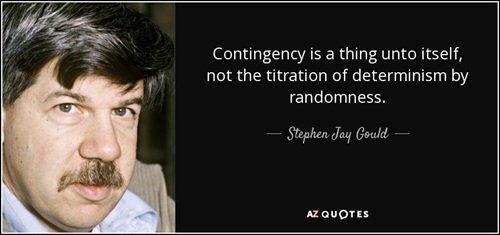 Gould's “Tape of Life” Thought ExperimentStephen Jay Gould's famous thought experiment, introduced in Wonderful Life (1989), asks us to imagine rewinding Earth's evolutionary history to a deep past moment—often the Cambrian explosion—and letting it run again under the same initial conditions. His central claim is that we would not expect to see humans reappear, or even anything closely resembling them. The point is not just unpredictability in a practical sense, but a stronger thesis about historical contingency. Evolution, on Gould's view, is shaped by a dense web of accidents: mass extinctions, rare mutations, environmental shocks, and path-dependent branching events. These factors lock in certain trajectories while foreclosing others. Natural selection operates locally and opportunistically, but it does not steer life toward intelligence, complexity, or humanity. The Burgess Shale fossils are crucial to his argument. They reveal a Cambrian world with a much broader range of body plans than what survived into later eras. From Gould's perspective, the modern biosphere is not the expression of an underlying evolutionary trend but the result of a severe pruning process in which contingency played a decisive role. Contingency Versus Direction in EvolutionGould's broader philosophical claim is that evolution lacks foresight or directionality. The appearance of progress—toward complexity, cognition, or adaptability—is retrospective, not intrinsic to the process itself. If we replayed evolutionary history, the outcome would likely diverge radically, producing a biosphere with entirely different dominant forms and possibly no species capable of human-like intelligence. This makes the “tape of life” a powerful anti-anthropocentric intuition pump. It undermines the idea that humans are an expected or even likely outcome of evolution and instead reframes us as a historical accident embedded in a long chain of low-probability events. Convergent Evolution (Simon Conway Morris' Counterpoint)A major challenge to Gould's contingency thesis comes from the work of Simon Conway Morris, a paleobiologist best known for his extensive research on convergent evolution. Convergence refers to the repeated emergence of similar biological solutions in unrelated evolutionary lineages facing comparable environmental or functional constraints. Examples are widespread: camera-type eyes have evolved independently in vertebrates and cephalopods; echolocation appears in bats and dolphins; streamlined body shapes recur in fast-swimming predators across unrelated groups; and complex social organization arises in both insects and mammals. Conway Morris argues that such patterns are not accidental but deeply informative. His central claim is that evolution is strongly constrained by physical and biochemical realities. Given certain environmental pressures, there are only so many viable solutions. This implies that the “space of possible life forms” is far more structured than Gould allows. On this view, intelligence-like capacities, sensory sophistication, and even human-like cognitive features may be recurring attractors in evolutionary dynamics rather than rare flukes. While Conway Morris does not claim that humans are inevitable in their exact form, he suggests that something functionally similar to us may be a highly probable outcome under broadly Earth-like conditions. Evaluating the Strength of Gould's ArgumentThe strength of Gould's thought experiment lies in its emphasis on path dependence and historical fragility. Evolutionary systems exhibit nonlinear dynamics: small changes early in the chain can produce radically different outcomes later. Mass extinctions, in particular, demonstrate how much of evolutionary history depends on stochastic disruptions rather than gradual optimization. However, the argument is not strictly empirical. We cannot replay the tape of life, so the claim remains a counterfactual inference rather than a testable prediction. Its plausibility depends on how we weigh contingency against constraint in evolutionary processes. Critiques and Alternative ViewsBeyond Conway Morris, other evolutionary thinkers have offered more qualified critiques. Richard Dawkins, for instance, largely agrees that evolution is not goal-directed and that humans are not the endpoint of a progressive process. However, he is more open to the idea that natural selection can repeatedly generate complex adaptations under similar selective pressures. This leaves room for partial convergence without implying inevitability. More broadly, critics argue that Gould sometimes overstates contingency by underplaying the repeated structure of evolutionary solutions. If similar ecological problems consistently produce similar biological answers, then the “replay” of evolution might not diverge as radically as Gould suggests. A further philosophical critique targets the coherence of the thought experiment itself. Replaying the tape assumes that initial conditions can be meaningfully held constant across deep time in a chaotic system. Yet evolutionary processes amplify microscopic differences, making exact counterfactual replication conceptually unstable. Conclusion: Accident or Constraint?Gould's “tape of life” remains one of the most influential arguments against evolutionary teleology. Its enduring value lies less in its literal predictive content and more in its corrective force: it disrupts the intuition that human existence is somehow built into the structure of evolution. Yet the counterpoint from convergent evolution—especially as developed by Simon Conway Morris—shows that evolutionary space may not be as open-ended as Gould suggests. Instead, life may be shaped by a tension between contingency and constraint: historical accidents determining which paths are taken, and deep structural regularities shaping where those paths can plausibly lead. Whether humans are a cosmic fluke or an emergent inevitability ultimately depends on how that tension is resolved—and on how much structure we believe is hidden in the space of biological possibility itself.
Widget is loading comments...
|