|
TRANSLATE THIS ARTICLE
Integral World: Exploring Theories of Everything
An independent forum for a critical discussion of the integral philosophy of Ken Wilber
  Frank Visser, graduated as a psychologist of culture and religion, founded IntegralWorld in 1997. He worked as production manager for various publishing houses and as service manager for various internet companies and lives in Amsterdam. Books: Ken Wilber: Thought as Passion (SUNY, 2003), and The Corona Conspiracy: Combatting Disinformation about the Coronavirus (Kindle, 2020). Frank Visser, graduated as a psychologist of culture and religion, founded IntegralWorld in 1997. He worked as production manager for various publishing houses and as service manager for various internet companies and lives in Amsterdam. Books: Ken Wilber: Thought as Passion (SUNY, 2003), and The Corona Conspiracy: Combatting Disinformation about the Coronavirus (Kindle, 2020).
Check out my other conversations with ChatGPT Why Did Evolution Take So Long?The Erratic Trajectory of Nature and the Problem of Spiritual DirectionFrank Visser / ChatGPT
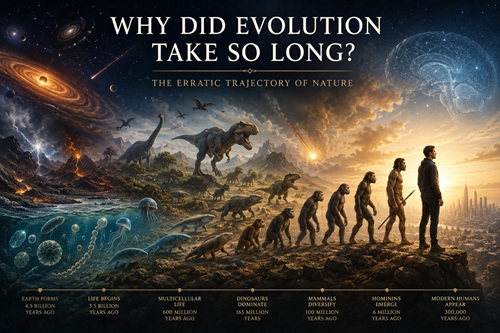 The idea that evolution is guided by a spiritual force or cosmic drive has fascinated philosophers, mystics, and religious thinkers for centuries. From Aristotle's “final causes” to Teilhard de Chardin's Omega Point and Ken Wilber's concept of Eros-in-the-Kosmos, many have argued that life evolves toward greater complexity, consciousness, and spiritual realization. Humanity, in this view, is not an accident but the intended flowering of cosmic development. Yet the actual history of evolution presents a far messier picture. If evolution is indeed spiritually directed, why did it take nearly four billion years for humans to appear? Why such extraordinary waste, delay, extinction, and contingency? Why did nature proceed through such chaotic and inefficient pathways? The fossil record does not resemble a smooth ascent toward enlightenment. It looks more like a zigzagging experiment conducted without foresight. The Vastness of Evolutionary TimeLife on Earth began approximately 3.5 to 4 billion years ago. For most of that time, the planet was inhabited only by single-celled organisms. Multicellular life emerged relatively late, around 600 million years ago. Mammals existed for over 100 million years before humans appeared. Anatomically modern humans have only existed for about 300,000 years—a tiny sliver of evolutionary history. If the emergence of consciousness or spirituality was evolution's intended goal, the timeline raises uncomfortable questions. Why spend billions of years producing bacteria? Why endure repeated evolutionary dead ends? Why permit mass extinctions that wiped out most existing species multiple times? The spiritualized interpretation of evolution often emphasizes directionality while ignoring duration and inefficiency. Nature's Erratic PathEvolution does not move in straight lines. It proceeds through mutation, environmental pressure, accident, isolation, and extinction. Entire branches of life flourish and disappear without leading anywhere recognizable as “higher.” The dinosaurs dominated Earth for roughly 165 million years. They were enormously successful. Yet they vanished because of an asteroid impact unrelated to spiritual development. Mammals only rose to dominance because ecological space suddenly became available after catastrophe. This is difficult to reconcile with the idea of a carefully guided evolutionary ascent. If humans were the intended outcome, the process seems strangely indirect. Nature repeatedly starts over, improvises, collapses, and adapts opportunistically. Evolution resembles tinkering more than engineering. Contingency Versus DestinyModern evolutionary biology places enormous emphasis on contingency. Small accidents can radically alter future outcomes. A different climate shift, a different asteroid trajectory, or a different mutation could have changed everything. The paleontologist Stephen Jay Gould famously argued that if we could “rewind the tape of life” and let evolution run again, humans probably would not reappear. Intelligence like ours is not seen as inevitable but contingent. This stands in sharp contrast to spiritual evolutionary theories that treat humanity as evolution's destined culmination. The tension here is profound. Either evolution is fundamentally open-ended and shaped by historical accidents, or it is secretly guided toward predetermined outcomes. The scientific evidence overwhelmingly favors the former interpretation. The Wastefulness of NatureNature is extraordinarily wasteful. More than 99% of all species that ever lived are extinct. Evolution generates immense suffering, predation, disease, and reproductive failure. Entire ecosystems vanish. Countless organisms die before reproducing. A spiritual interpretation of evolution must somehow explain this colossal inefficiency. Why would a divine or cosmic intelligence require hundreds of millions of years of extinction and brutality to produce reflective consciousness? Why use such a circuitous route? Some spiritual thinkers answer that struggle is necessary for growth. But this often sounds suspiciously retrospective: whatever happened becomes justified because it happened. The danger is that the theory becomes unfalsifiable. Complexity Is Not a Straight LineAnother problem is that evolution does not consistently move toward greater complexity. Many organisms simplify over time if simplicity improves survival. Parasites often lose organs and capabilities. Bacteria remain among the most successful life forms on Earth precisely because they are simple and adaptable. Human beings tend to interpret complexity as progress because we identify with intelligence and culture. But evolution itself has no known preference for brains over bacterial resilience. The assumption that evolution “wanted” consciousness may reflect human narcissism more than biological reality. The Seduction of Retrospective MeaningOnce humans emerged, it became tempting to reinterpret all prior evolution as leading inevitably toward us. This is a classic hindsight illusion. Because we exist, we reconstruct history as though our emergence was always the point. But this is like claiming every raindrop in a storm was aiming for a particular puddle. Spiritual narratives often impose coherence onto a process that, scientifically speaking, appears radically decentralized and undirected. This does not necessarily eliminate spirituality from human life. But it weakens the claim that evolution itself demonstrates spiritual intentionality. Evolution as Open ExperimentA more modest and scientifically grounded perspective sees evolution as an open-ended process rather than a cosmic ladder. Nature explores possibilities without predetermined goals. Consciousness emerges not as the inevitable crown of creation but as one surprising development among many. This interpretation better fits the evidence of evolutionary history: its delays, detours, collapses, redundancies, and extinctions. Human intelligence may be remarkable, but it arrived precariously and late. Dinosaurs ruled far longer than humans have existed. Bacteria will probably outlast us all. The evolutionary story is therefore less like a spiritual escalator and more like a sprawling, improvisational experiment conducted across deep time. The Real Wonder of EvolutionIronically, abandoning the idea of spiritual guidance may make evolution even more astonishing. Out of blind variation and natural selection emerged eyes, ecosystems, memory, language, music, mathematics, and self-awareness. No hidden cosmic force is required to appreciate the grandeur of this process. The real lesson of evolution may not be that the universe was aiming at us all along, but that complexity and consciousness can emerge naturally from immense spans of time, under conditions of relentless experimentation and contingency. Nature's trajectory is not smooth, purposeful, or guaranteed. It is erratic, fragile, and profoundly creative. And perhaps that is wonder enough.
Widget is loading comments...
|