|
TRANSLATE THIS ARTICLE
Integral World: Exploring Theories of Everything
An independent forum for a critical discussion of the integral philosophy of Ken Wilber
  Frank Visser, graduated as a psychologist of culture and religion, founded IntegralWorld in 1997. He worked as production manager for various publishing houses and as service manager for various internet companies and lives in Amsterdam. Books: Ken Wilber: Thought as Passion (SUNY, 2003), and The Corona Conspiracy: Combatting Disinformation about the Coronavirus (Kindle, 2020). Frank Visser, graduated as a psychologist of culture and religion, founded IntegralWorld in 1997. He worked as production manager for various publishing houses and as service manager for various internet companies and lives in Amsterdam. Books: Ken Wilber: Thought as Passion (SUNY, 2003), and The Corona Conspiracy: Combatting Disinformation about the Coronavirus (Kindle, 2020).
Check out my other conversations with ChatGPT Consciousness Explained… Better?Allan Combs' Attempt to Rescue Consciousness from ReductionismFrank Visser / ChatGPT
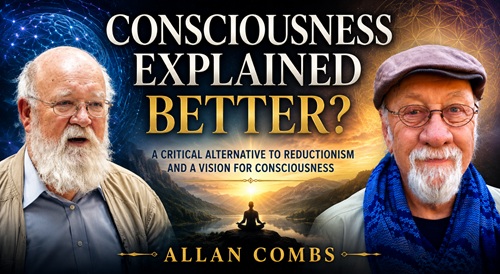 When Consciousness Explained Better (2009) appeared, the title itself announced the agenda. It was an unmistakable rejoinder to Consciousness Explained (1992) by Daniel Dennett, whose aggressively reductionist account of mind had dominated philosophical debates about consciousness since the early 1990s. Allan Combs clearly wanted to signal: Dennett explained consciousness away; I will explain it properly. The problem is that Combs' alternative, while often more humane, expansive, and spiritually sympathetic, never fully escapes the conceptual weaknesses that plague many post-materialist theories of consciousness. His critique of reductionism is frequently persuasive. His positive account is far less so. Dennett as the Necessary VillainCombs positions himself against the mechanistic view that consciousness is merely an emergent computational illusion generated by neural processes. Dennett famously denied the existence of a unified “Cartesian theater” in the brain and treated consciousness as a distributed informational process. Subjective experience, for Dennett, is not some metaphysical essence but a functional activity explainable through cognitive science. Combs finds this deeply inadequate. He argues that first-person experience cannot simply be dissolved into information processing or linguistic behavior. The felt immediacy of awareness—the undeniable fact that experience appears from within—demands a richer explanatory framework. On this point, Combs is largely correct. Dennett's style of eliminativism often gives the impression that consciousness disappears precisely at the moment it is supposedly being explained. The famous accusation against Dennett—that he explains consciousness by denying the thing most people mean by consciousness—still has force. Combs rightly insists that subjective experience is not a trivial leftover variable. Any serious philosophy of mind must grapple with qualia, intentionality, and the irreducibility of lived awareness. But exposing the weaknesses of reductionism is easier than constructing a convincing alternative. The Integral TurnCombs draws heavily from Ken Wilber and Integral Theory, blending neuroscience, developmental psychology, phenomenology, systems theory, and spiritual traditions into a grand synthetic framework. Consciousness is treated not merely as a byproduct of matter but as a fundamental dimension of reality evolving through increasingly complex structures. This is where the book becomes simultaneously ambitious and slippery. Like much integral literature, Consciousness Explained Better operates through accumulation rather than demonstration. Diverse domains—brain research, mysticism, complexity theory, meditation reports, altered states, developmental models—are woven together into a broad tapestry whose coherence is often assumed rather than rigorously established. The result is intellectually seductive. Everything appears interconnected. Science and spirituality seem reconciled. Subjective and objective dimensions are granted equal dignity. Yet the explanatory burden quietly shifts from empirical demonstration to interpretive synthesis. Again and again, Combs implies that because multiple perspectives can be placed side by side, they therefore mutually validate one another. But juxtaposition is not evidence. Correlation between mystical reports and neural states does not establish metaphysical conclusions about consciousness as a cosmic principle. Nor does the existence of subjective depth invalidate material explanations of cognition. The book frequently mistakes inclusiveness for explanatory power. Mysticism as EpistemologyOne of the central assumptions in Combs' work is that contemplative or mystical states reveal something ontologically fundamental about reality itself. Deep meditation, nondual awareness, and transpersonal experiences are treated not merely as psychological phenomena but as disclosures of deeper truths about consciousness and the cosmos. This is a classic move within transpersonal psychology and Integral Theory. But it introduces major epistemological problems. Experiences can feel absolute without being metaphysically authoritative. Human beings routinely interpret altered states through cultural narratives already available to them. A Buddhist experiences emptiness. A Christian experiences divine presence. A New Age mystic experiences cosmic unity. The phenomenology may overlap, but the interpretations diverge radically. Combs often underestimates this interpretive mediation. The leap from “this experience feels profoundly real” to “this reveals the structure of reality” remains philosophically under-argued throughout the book. The authority granted to mystical consciousness frequently exceeds the evidence available. Ironically, in rejecting reductionism, Combs sometimes falls into another form of reductionism: reducing epistemology itself to privileged states of consciousness. Complexity Is Not ExplanationA recurring rhetorical strategy in the book involves appeals to complexity theory, emergence, and holism. Consciousness is portrayed as arising through dynamic systems whose properties transcend mechanistic description. This sounds sophisticated—and often is—but complexity language can easily become conceptual camouflage. Saying consciousness is “emergent” does not explain how subjective awareness arises from physical systems. It merely redescribes the mystery using systems terminology. Likewise, references to self-organization and nonlinear dynamics often create an aura of scientific legitimacy without resolving the hard philosophical problem. Combs is hardly alone in this tendency. Much contemporary consciousness discourse oscillates between neuroscience on one side and metaphysical speculation on the other, with “complexity” functioning as a bridge word connecting domains that remain fundamentally unresolved. The danger is that poetic interdisciplinarity begins substituting for explanatory precision. The Spiritualization of EvolutionThe deeper issue underlying the book is its implicit teleology. Consciousness is not merely evolving biologically or culturally; it appears to be moving toward greater integration, depth, and spiritual realization. This echoes Wilber's evolutionary spirituality almost directly. Evolution becomes subtly moralized and spiritualized. Higher consciousness is associated with transcendence, integration, and expanded awareness. But biology itself provides no evidence for cosmic purpose. Evolutionary processes are opportunistic, contingent, wasteful, and indifferent. Human capacities for self-awareness emerged through natural selection, not through an intrinsic drive toward spiritual awakening. Combs attempts to preserve scientific credibility while retaining a quasi-sacred view of consciousness evolution. The tension never fully resolves. The result is an uneasy hybrid: scientifically flavored spirituality rather than a scientifically grounded philosophy of mind. A Valuable FailureDespite these criticisms, dismissing Combs entirely would be unfair. Allan Combs represents an important intellectual impulse: the refusal to accept crude materialism as the final word on consciousness. He recognizes that subjective experience, meaning, symbolism, introspection, and contemplative practice all deserve serious consideration. He also understands that purely mechanistic models often fail to capture the richness of lived human awareness. The book succeeds as a protest against reductionism. Where it fails is in confusing dissatisfaction with materialism for evidence of spiritual metaphysics. The explanatory gaps in neuroscience do not automatically validate transpersonal ontology. Nor does the mystery of consciousness justify importing cosmic purpose into evolution. In the end, Consciousness Explained Better does not really explain consciousness better than Dennett. It explains consciousness differently: more sympathetically, more spiritually, more holistically—but not necessarily more rigorously. And that distinction matters.
Comment Form is loading comments...
|