|
TRANSLATE THIS ARTICLE
Integral World: Exploring Theories of Everything
An independent forum for a critical discussion of the integral philosophy of Ken Wilber
  Frank Visser, graduated as a psychologist of culture and religion, founded IntegralWorld in 1997. He worked as production manager for various publishing houses and as service manager for various internet companies and lives in Amsterdam. Books: Ken Wilber: Thought as Passion (SUNY, 2003), and The Corona Conspiracy: Combatting Disinformation about the Coronavirus (Kindle, 2020). Frank Visser, graduated as a psychologist of culture and religion, founded IntegralWorld in 1997. He worked as production manager for various publishing houses and as service manager for various internet companies and lives in Amsterdam. Books: Ken Wilber: Thought as Passion (SUNY, 2003), and The Corona Conspiracy: Combatting Disinformation about the Coronavirus (Kindle, 2020).
Check out my other conversations with ChatGPT Ken Wilber and the Impossible Dream of Total IntegrationFrank Visser / ChatGPT
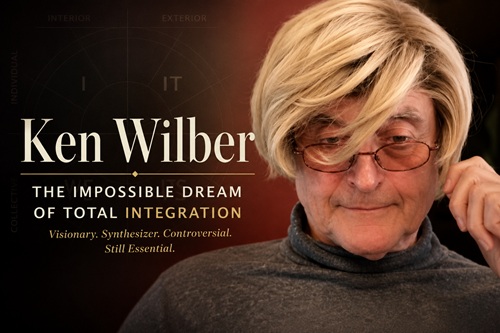 The Unexpected Role: Last Encyclopedist of ConsciousnessThere is a familiar way of writing about Ken Wilber: as a system-builder of consciousness, a synthesizer of East and West, or a controversial figure in transpersonal philosophy. But a more unsettling interpretation reframes him entirely. He can be seen less as a spiritual theorist and more as one of the final encyclopedists of a pre-digital intellectual imagination—someone still committed to the idea that knowledge should form a coherent whole. This makes his work feel less like “new age philosophy” and more like a late attempt to preserve intellectual unity in a world already drifting toward permanent fragmentation. AQAL as a Defense Against FragmentationWilber's AQAL model (“all quadrants, all levels”) is often treated as a conceptual framework, but it also functions psychologically and historically. It is an architectural response to epistemic breakdown. Instead of allowing psychology, biology, sociology, spirituality, and cultural theory to drift apart into isolated silos, AQAL tries to hold them inside a single coordinate system. Each domain becomes a “partial truth” located within a larger map. Seen this way, Integral Theory is not just descriptive. It is defensive. It is an attempt to prevent reality from dissolving into incompatible languages. The Emotional Logic of Total InclusionWilber's ambition produces a distinctive intellectual atmosphere: almost everything is included. Evolutionary theory, Buddhism, developmental psychology, systems theory, feminism, ecology, and mysticism are all given a place. This inclusiveness explains much of his appeal. For readers exhausted by academic specialization and cultural tribalism, the system offers relief: nothing essential is excluded, and every perspective is granted a structural role. But inclusion has its own logic. Once everything must fit, contradiction becomes something to be harmonized rather than confronted. Opposition becomes partial insight rather than possible refutation. This is where the system begins to shift from analysis toward synthesis-as-priority. A Cathedral Model of KnowledgeThe deeper structure of Ken Wilber resembles pre-modern intellectual architecture more than modern scientific theory. Medieval cathedrals did not merely organize space; they organized reality symbolically. Theology, cosmology, ethics, and aesthetics formed a unified order. AQAL performs a similar function in a postmodern context. It is not just a model of consciousness—it is a symbolic container meant to re-establish the possibility that reality is ultimately coherent. This is why debates over whether Wilber is “scientific” often feel slightly misplaced. His work is not primarily competing within science. It is competing with the existential consequences of fragmentation. The Price of Synthesis: Blurred Epistemic BoundariesThe same integrative drive that gives Wilber's work its scope also produces its most persistent criticism. When synthesis becomes the primary goal, distinctions between empirical explanation and symbolic meaning can blur. Psychological development can slide into spiritual hierarchy. Evolution can take on implicit directionality. Mystical states can begin to function as cosmological evidence rather than subjective reports. The system gains coherence and resonance, but it risks losing methodological discipline. What is being integrated is not always kept epistemically distinct. Integral Theory as a Response to Civilizational AnxietyThe historical context matters. Modern intellectual life is not merely complex; it is fragmented into incompatible expert languages. Neuroscience, sociology, economics, ecology, and theology rarely speak to each other in meaningful ways. In this environment, Wilber's project can be read as a response to a deeper anxiety: the fear that no unified picture of reality is any longer possible. Integral Theory answers that anxiety with a firm affirmation: unity is still available if we learn to see at a higher level of abstraction. Whether that claim is true or not, it is psychologically and culturally intelligible. The Paradox of IntegrationThe central paradox in Ken Wilber is that the attempt to integrate everything risks neutralizing the force of genuine disagreement. If every position is a partial truth, then radical critique becomes structurally difficult to sustain. Yet without such critique, integration risks becoming insulation. This tension runs through the entire Integral project: the desire to hold everything together versus the necessity of allowing some things to break the system. Conclusion: A System Built Against Its Own TimeWilber's work may ultimately be remembered less as a final theory of consciousness than as a historically situated response to intellectual overload. He attempted to construct a unified map of meaning at the precise moment when cultural and scientific knowledge was becoming too vast and heterogeneous to map in a single frame. That attempt gives his work both its grandeur and its fragility. The surprise, perhaps, is not that he failed or succeeded, but that he tried at all—and that his attempt reveals something uncomfortable about modernity itself: the continued hunger for coherence in a world structurally resistant to it.
Widget is loading comments...
|