|
TRANSLATE THIS ARTICLE
Integral World: Exploring Theories of Everything
An independent forum for a critical discussion of the integral philosophy of Ken Wilber
  Frank Visser, graduated as a psychologist of culture and religion, founded IntegralWorld in 1997. He worked as production manager for various publishing houses and as service manager for various internet companies and lives in Amsterdam. Books: Ken Wilber: Thought as Passion (SUNY, 2003), and The Corona Conspiracy: Combatting Disinformation about the Coronavirus (Kindle, 2020). Frank Visser, graduated as a psychologist of culture and religion, founded IntegralWorld in 1997. He worked as production manager for various publishing houses and as service manager for various internet companies and lives in Amsterdam. Books: Ken Wilber: Thought as Passion (SUNY, 2003), and The Corona Conspiracy: Combatting Disinformation about the Coronavirus (Kindle, 2020).
Check out my other conversations with ChatGPT Nature's Redundancy or Razor's Edge?Are Species Extinctions Catastrophic or Part of Life's Exuberance?Frank Visser / ChatGPT
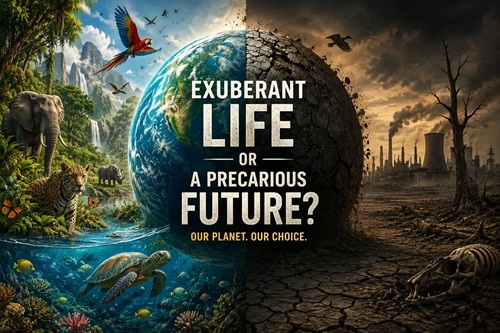 Earth is home to an astonishing abundance of life. Scientists estimate that there may be anywhere from 8 to over 30 million species on the planet, most of them still undiscovered. Against that backdrop, one may reasonably ask: if some species disappear, does it really matter? Is nature so rich and exuberant that losses are easily absorbed? Or is the biosphere a delicately balanced system where every extinction threatens collapse? The answer is neither simple alarmism nor casual indifference. Nature is both resilient and vulnerable. Evolution produces redundancy, experimentation, and overflow, yet ecosystems can also depend critically on particular species and relationships. Understanding this duality requires moving beyond slogans about “saving every species” and examining how ecosystems actually work. Evolution Produces ExcessOne reason extinctions may appear unproblematic is that extinction itself is normal. More than 99% of all species that ever lived are extinct. Entire branches of life have vanished: trilobites, ammonites, dinosaurs, giant mammals, and countless obscure organisms. Evolution is not a museum preserving every form forever. It is a dynamic process of continual emergence and disappearance. Nature also tends toward exuberance. Species multiply, diversify, radiate into niches, and compete. Tropical rainforests, coral reefs, and insect populations demonstrate this explosive creativity. Many species seem functionally similar. There are thousands of beetles, countless grasses, and endless microbial variants. If one disappears, another may occupy a comparable niche. Ecologists call this “functional redundancy.” Several species may perform roughly the same ecological role: pollinating flowers, decomposing matter, dispersing seeds, or controlling pests. This redundancy can make ecosystems robust. If one species declines, another may compensate. This is why ecosystems often survive localized extinctions. Nature is not a fragile crystal vase that shatters from a single crack. It evolved amid volcanic eruptions, asteroid impacts, ice ages, and continental drift. Life repeatedly rebounds. Yet Some Species Matter EnormouslyHowever, resilience has limits. Not all species are interchangeable. Some occupy disproportionately important ecological positions. These are often called “keystone species.” A classic example involves sea otters along Pacific coastlines. Otters consume sea urchins, which otherwise multiply uncontrollably and devastate kelp forests. Remove otters, and entire underwater ecosystems can collapse. Similarly, wolves in Yellowstone altered deer behavior, allowing vegetation and river systems to recover in surprising ways. Pollinators provide another example. Many crops and wild plants depend on bees, butterflies, bats, and birds. If pollinator populations crash broadly, food webs and agriculture suffer. Microorganisms also play foundational roles. Soil bacteria, fungi, and plankton regulate nutrient cycles, oxygen production, and carbon storage. Their loss can destabilize planetary systems. Thus, while some extinctions are ecologically minor, others trigger cascading effects. Ecosystems are not merely collections of species but networks of interactions. Sometimes removing one node barely matters; other times it destabilizes the whole structure. The Difference Between Natural and Human-Driven ExtinctionAnother key issue is scale and speed. Extinction has always occurred, but today's extinction rates are unusually high because of human activity: habitat destruction, pollution, climate change, invasive species, and overexploitation. Natural extinctions typically unfold over long geological periods, allowing ecosystems time to adapt. Today many species disappear within decades. Forests are cleared faster than new ecological relationships can evolve. This rapidity matters. Ecosystems can absorb gradual change far better than abrupt shocks. A slowly changing climate allows migration and adaptation. Sudden disruption can overwhelm adaptive capacity. Human civilization also depends on ecosystem stability in ways people often underestimate. Fisheries, agriculture, freshwater systems, climate regulation, and disease control all rely on functioning ecological networks. Biodiversity loss is therefore not merely an aesthetic concern about preserving beautiful animals. It affects material human survival. Is Nature Balanced?People often speak of “the balance of nature,” but this phrase can mislead. Nature is not static equilibrium. Ecosystems constantly fluctuate. Populations rise and fall chaotically. Species invade new territories. Climate shifts alter habitats. Forests burn and regenerate. In that sense, nature is not precariously balanced like a house of cards. It is dynamic, adaptive, and often surprisingly tough. Yet there is still structure beneath the turbulence. Ecosystems possess thresholds. Push them beyond certain tipping points, and they may reorganize dramatically. Coral reefs can become algae-dominated wastelands. Forests can become grasslands. Lakes can shift from clear to permanently polluted states. The biosphere is therefore neither infinitely robust nor absurdly fragile. It resembles a complex adaptive system: resilient within limits, but vulnerable to large-scale disruption. Human Emotional ResponsesPart of the debate also reflects differing emotional attitudes toward nature. Some environmental rhetoric treats every extinction as an absolute tragedy. This can sound unrealistic given evolution's long history of turnover and replacement. Nature has never preserved every species indefinitely. Conversely, technological optimism sometimes assumes ecosystems are so redundant that losses barely matter. This too is dangerous. Complex systems often fail nonlinearly. Damage accumulates invisibly until thresholds are crossed. A more mature perspective recognizes both truths simultaneously. Evolution is lavish, experimental, and wasteful. But complex ecological interdependence also means that widespread destruction carries unpredictable risks. The Real QuestionThe deeper issue is perhaps not whether every species must survive forever, but what kind of planet humanity wishes to inhabit. A biologically rich world is generally more productive, resilient, and beautiful than an impoverished one. Biodiversity represents billions of years of evolutionary history and adaptive information. Once lost, it cannot easily be recreated. Moreover, humans themselves are products of this living network. We are not external managers standing above nature. We are participants inside it. The extinction of a few obscure insects may not doom civilization. But the cumulative erosion of biodiversity can gradually weaken the ecological foundations upon which civilization depends. ConclusionNature is neither an infinitely redundant machine nor a perfectly delicate equilibrium. It is a vast, evolving, partially redundant web of life that combines resilience with vulnerability. Some species disappear with little consequence. Others are essential threads in ecological systems. Evolution produces exuberant diversity, but ecosystems still depend on intricate relationships built over immense spans of time. The real danger lies less in individual extinctions than in accelerating, large-scale biodiversity loss driven by human activity. Life on Earth will probably continue long after humanity. The question is whether human societies can flourish while steadily unraveling the ecological fabric that sustains them.
Comment Form is loading comments...
|