|
TRANSLATE THIS ARTICLE
Integral World: Exploring Theories of Everything
An independent forum for a critical discussion of the integral philosophy of Ken Wilber
  Frank Visser, graduated as a psychologist of culture and religion, founded IntegralWorld in 1997. He worked as production manager for various publishing houses and as service manager for various internet companies and lives in Amsterdam. Books: Ken Wilber: Thought as Passion (SUNY, 2003), and The Corona Conspiracy: Combatting Disinformation about the Coronavirus (Kindle, 2020). Frank Visser, graduated as a psychologist of culture and religion, founded IntegralWorld in 1997. He worked as production manager for various publishing houses and as service manager for various internet companies and lives in Amsterdam. Books: Ken Wilber: Thought as Passion (SUNY, 2003), and The Corona Conspiracy: Combatting Disinformation about the Coronavirus (Kindle, 2020).
Check out my other conversations with ChatGPT Six 'Miracles' and One Giant MisunderstandingWhy This Popular Creationist Meme Fails Scientifically and PhilosophicallyFrank Visser / ChatGPT
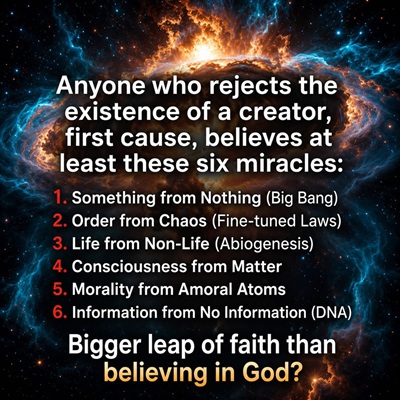 Creationist memes like this one are rhetorically effective because they compress enormous scientific and philosophical questions into emotionally satisfying slogans. The format suggests that science has no answers, while belief in God neatly resolves every mystery. But the meme works largely by misrepresenting what science actually claims, and by redefining unsolved problems as “miracles” whenever natural explanations are incomplete. The deeper problem is that the meme treats “we do not yet fully understand X” as equivalent to “therefore God.” That is not an argument. It is a gap-filling strategy. Let us examine the six claims one by one. 1. “Something from Nothing”—The Big Bang Does Not Claim Absolute NothingnessThe meme begins with perhaps its most common distortion: the claim that science teaches “something came from nothing.” The Big Bang theory says no such thing. The Big Bang model describes the expansion of the universe from an extremely hot, dense early state. It does not explain why reality exists at all, nor does it necessarily imply creation out of absolute nothingness. In fact, physics does not even possess a stable definition of “nothing” in the philosophical sense. Quantum cosmology explores possibilities such as vacuum fluctuations, quantum fields, cyclic universes, inflationary models, or multiverse scenarios. Whether these ideas ultimately succeed remains open. But none of them describe “nothing” as imagined in theology or everyday language. Ironically, creationism often replaces one mystery with a larger one. If complexity cannot arise naturally, then introducing an infinitely complex creator explains even less. One may still believe in God, but God does not eliminate the explanatory problem; it relocates it. 2. “Order from Chaos”—Nature Produces Structure SpontaneouslyThe meme assumes that order cannot emerge naturally from simpler conditions. Yet physics demonstrates this constantly. Snowflakes form intricate symmetries. Crystals self-organize. Hurricanes develop structure. Galaxies emerge from gravitational interactions. Evolution generates biological complexity through cumulative selection. None of this violates natural law. It is precisely what natural laws permit. The phrase “fine-tuned laws” also oversimplifies a complicated discussion. Physicists debate whether constants could differ, whether multiple universes exist, or whether life simply adapts to whatever conditions are available. But even if the universe were fine-tuned, that would not automatically establish a divine tuner. It would merely raise another question: who fine-tuned the fine-tuner? Creationist arguments often stop precisely where the hard explanatory work begins. 3. “Life from Non-Life”—Abiogenesis Is a Research Problem, Not a MiracleAbiogenesis remains an unresolved scientific problem. But “unsolved” does not mean “impossible.” Science has already demonstrated many plausible intermediate steps between chemistry and biology: • Amino acids form naturally under early Earth conditions. • Lipid membranes self-assemble spontaneously. • RNA molecules can both store information and catalyze reactions. • Complex organic compounds exist in meteorites and interstellar clouds. No scientist claims we already possess a complete account of life's origin. But the meme falsely suggests that absence of a final explanation equals supernatural intervention. Historically, this “God of the gaps” strategy repeatedly collapses as science advances. Lightning, disease, planetary motion, and species diversity were once attributed directly to divine action because no natural explanation existed. Mystery is not evidence for miracles. 4. “Consciousness from Matter”—Hard Problem Does Not Mean MagicConsciousness is genuinely difficult. Philosophers and neuroscientists continue debating how subjective experience arises from brain processes. But the meme sneaks in an unjustified assumption: because consciousness is mysterious, matter therefore cannot produce it. That conclusion does not follow. Every known alteration of consciousness correlates strongly with physical brain states: • anesthesia, • brain injury, • drugs, • sleep, • electrical stimulation, • neurodegenerative disease. If consciousness were wholly independent of matter, these correlations would be astonishing. The “hard problem” of consciousness concerns explanation, not evidence for supernatural souls. Science may not yet fully explain subjective awareness, but invoking God explains even less. Saying “God did it” does not clarify how conscious experience works. It merely halts inquiry. 5. “Morality from Amoral Atoms”—Morality Emerges from Social MindsAtoms are not moral or immoral. Neither are stars, oceans, or tectonic plates. Morality emerges within social organisms capable of suffering, empathy, memory, and cooperation. Evolutionary biology, anthropology, and psychology all help explain moral behavior: • cooperation improves survival, • empathy strengthens group cohesion, • reciprocity stabilizes communities, • punishment deters cheating. Human morality is imperfect precisely because it evolved socially and historically, not because it descended fully formed from heaven. Moreover, religious morality itself evolves dramatically over time. Sacred texts once defended slavery, patriarchy, genocide, and holy war. Modern believers selectively reinterpret these traditions through contemporary ethical sensibilities. That process reflects moral development within human culture, not fixed morality descending unchanged from God. 6. “Information from No Information”—DNA Is Chemistry, Not Divine CodeCreationists often use “information” in a vague and mystical way, as though DNA were literally equivalent to meaningful language written by a cosmic programmer. But biological information is not semantic information. DNA does not “mean” something in the way sentences do. It functions chemically. DNA sequences replicate with variation. Natural selection preserves variants that improve reproductive success. Over immense timescales, cumulative selection generates extraordinary complexity without foresight or planning. The meme also ignores a crucial point: evolution does not produce information from “nothing.” Mutations, recombination, duplication, and selection continuously modify genomes. In evolutionary biology, information accumulation is an observable process, not a metaphysical miracle. The analogy to computer code misleads because DNA was not engineered toward a future goal. Evolution is opportunistic, messy, redundant, and full of historical leftovers. Human anatomy alone contains countless examples of inefficient design: • the recurrent laryngeal nerve, • the blind spot in the retina, • wisdom teeth, • vulnerable spinal architecture. These are signs of evolutionary tinkering, not elegant engineering. The Real Leap of FaithThe meme concludes by asking whether atheism requires a “bigger leap of faith than believing in God.” But science is not fundamentally built on faith. It is built on provisional explanation, evidence, revision, and uncertainty. Science says: • “Here is what we currently know.” • “Here is what remains unresolved.” • “Here is the evidence supporting current models.” • “These conclusions may change with new evidence.” Creationist memes often reverse this epistemic humility. They transform unanswered questions into proof of certainty. Yet inserting God into every mystery does not solve the mystery. It merely labels it. In the end, the meme depends on a false dichotomy: either science explains everything already, or God must be the answer. But reality is not obligated to fit into such simplistic alternatives. The universe may still contain profound mysteries. It almost certainly does. But mystery itself is not evidence for supernatural design. It is simply the frontier of human understanding.
Appendix: Ken Wilber's Sophisticated Version of Creationist ReasoningKen Wilber rarely sounds like a traditional creationist. He accepts evolution, deep time, cosmology, and much of modern science. He does not argue for a literal Genesis account, intelligent design biology, or a young Earth. In fact, he often presents himself as deeply aligned with science. Yet beneath the integral vocabulary lies a structurally similar argument to the creationist meme: nature allegedly cannot account for its own creativity, complexity, consciousness, and directionality. Therefore, some deeper spiritual principle must already be active within evolution itself. Wilber simply replaces “God” with terms like: • Eros, • Spirit-in-action, • self-transcendence, • intrinsic drive toward greater depth, • evolutionary telos. The rhetorical structure remains remarkably familiar. From “Miracles” to “Eros”The creationist meme argues: • matter cannot produce life, • life cannot produce mind, • mind cannot produce morality. Wilber agrees with much of this dissatisfaction toward reductionism. He repeatedly insists that evolution displays a mysterious “self-organizing drive” that cannot be explained by chance and natural selection alone. His famous slogan captures this: “Dirt plus chance does not produce Shakespeare.” The implication is clear: purely naturalistic evolution allegedly lacks sufficient creative power. Instead, Wilber introduces “Eros”—a cosmic tendency toward increasing complexity, consciousness, and spiritual realization. Evolution becomes not merely a biological process, but a spiritually charged ascent toward Spirit recognizing itself. This is essentially a metaphysical upgrade of older teleological arguments. Evolution Smuggled Back Toward PurposeMainstream evolutionary theory is fundamentally non-teleological. Natural selection has no foresight, intention, or cosmic goal. Complexity emerges contingently and unevenly. Evolution produces parasites, extinctions, dead ends, and catastrophic waste alongside intelligence and beauty. Wilber resists this radically open-ended picture because it conflicts with his overarching spiritual narrative of ascent. As a result, he frequently reinterprets evolution through directional language: • greater depth, • increasing consciousness, • transcendence and inclusion, • Spirit unfolding itself through matter. But this introduces a major problem: the directionality is largely imposed retrospectively. Humans naturally notice trends leading toward themselves. We selectively focus on complexity-increasing lineages while ignoring the overwhelming reality of extinction, simplicity, stagnation, and biological contingency. Evolution has no obligation to culminate in mystical philosophers. The “Probability Impossibility” ArgumentWilber often echoes creationist-style improbability arguments. He argues that the emergence of highly complex structures is too statistically unlikely to be explained by random mutation and selection alone. This parallels intelligent design rhetoric almost exactly. The flaw is that evolution is not pure randomness. Random variation is filtered cumulatively by non-random selection over immense timescales. Creationist and integral critiques alike often calculate probabilities as though fully formed organisms emerged in a single leap. That fundamentally misunderstands evolutionary dynamics. Complexity accumulates incrementally. Wilber sometimes acknowledges natural selection, but then minimizes its explanatory power whenever it conflicts with his spiritualized evolutionary narrative. “Flatland” and the Rejection of ReductionismWilber's critique of “flatland”—his term for reductionistic materialism—contains legitimate insights. Human experience cannot be exhaustively reduced to physics equations. Culture, consciousness, and meaning require higher-level descriptions. But Wilber moves from: “Reductionism is incomplete” to: “Therefore Spirit is driving evolution.” That leap is philosophical, not scientific. Rejecting reductionism does not automatically validate cosmic spirituality. One may accept emergence, systems theory, complexity science, and multi-level explanation without introducing metaphysical Eros into biology. Eros as a God-TermWilber often presents Eros poetically rather than analytically. It functions less as a testable explanatory principle than as a metaphysical placeholder for perceived upwardness in evolution. This creates a serious ambiguity: • Is Eros measurable? • Does it make predictions? • Can it be falsified? • How does it operate causally? Usually, the answers remain vague. Eros behaves much like a modernized theological concept: an invisible force guiding reality toward greater consciousness and unity. In this sense, Wilber's framework can be understood as a sophisticated re-enchantment of evolution rather than a scientific extension of it. The Emotional Appeal of Cosmic DirectionWhy does this perspective remain attractive? Because purely naturalistic evolution can feel existentially cold: • no guaranteed progress, • no cosmic purpose, • no built-in moral arc, • no assurance that consciousness matters cosmically. Wilber offers an emotionally and spiritually satisfying alternative: the universe is going somewhere, and we participate in its awakening. That vision is psychologically powerful. But its emotional resonance should not be confused with empirical support. The Central ProblemWilber's deepest mistake may be his inability to accept evolution as genuinely open-ended, undirected, and indifferent. Like traditional creationists, he senses that something “more” must secretly guide the process. Unlike creationists, he expresses this through developmental spirituality rather than biblical theology. But structurally, the impulse is similar: nature alone supposedly cannot account for nature's creativity. That assumption remains unproven.
Comment Form is loading comments...
|