|
TRANSLATE THIS ARTICLE
Integral World: Exploring Theories of Everything
An independent forum for a critical discussion of the integral philosophy of Ken Wilber
  Frank Visser, graduated as a psychologist of culture and religion, founded IntegralWorld in 1997. He worked as production manager for various publishing houses and as service manager for various internet companies and lives in Amsterdam. Books: Ken Wilber: Thought as Passion (SUNY, 2003), and The Corona Conspiracy: Combatting Disinformation about the Coronavirus (Kindle, 2020). Frank Visser, graduated as a psychologist of culture and religion, founded IntegralWorld in 1997. He worked as production manager for various publishing houses and as service manager for various internet companies and lives in Amsterdam. Books: Ken Wilber: Thought as Passion (SUNY, 2003), and The Corona Conspiracy: Combatting Disinformation about the Coronavirus (Kindle, 2020).
Check out my other conversations with ChatGPT The Two Eyes of HumanityObjective Knowledge in the West and Subjective Experience in the EastFrank Visser / ChatGPT
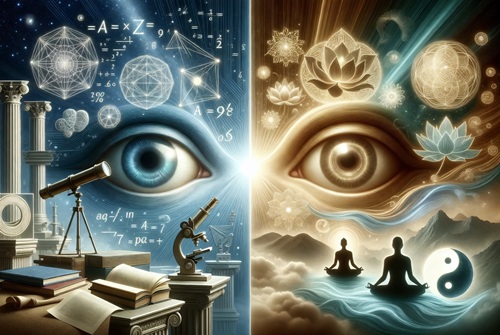 One of the oldest and most persistent cultural contrasts in world civilization is the difference between the Western search for objective knowledge and the Eastern cultivation of subjective experience. This distinction is not absolute—both traditions contain elements of the other—but it is profound enough to shape philosophy, religion, science, psychology, ethics, and even daily habits of thought. The West traditionally asks: What is true about the world? These differing orientations generate contrasting methodologies, notions of truth, and ideals of human fulfillment. The West developed science, logic, and technological mastery. The East developed meditation, introspection, and psychologies of inner transformation. One seeks reliable external knowledge; the other seeks transformed awareness. Neither perspective is complete by itself. Together they represent two complementary dimensions of human inquiry. The Western Quest for Objective KnowledgeWestern civilization, beginning with the ancient Greeks, placed extraordinary emphasis on rational inquiry into an independently existing world. Philosophers such as Plato and Aristotle sought universal principles that could be articulated logically and tested through argument. This tendency matured into modern science during the Scientific Revolution. Figures such as Galileo Galilei, Isaac Newton, and Francis Bacon insisted that truth should be established through observation, measurement, replication, and mathematical formulation. The underlying assumptions of this worldview include: • Reality exists independently of the observer. • Knowledge should be public and verifiable. • Truth is discovered through analysis and evidence. • Personal feelings or mystical states are unreliable sources of knowledge. • Objectivity is achieved by minimizing subjective bias. This orientation produced extraordinary achievements. Modern medicine, engineering, astronomy, chemistry, and information technology all emerged from systematic methods designed to eliminate illusion and personal projection. The scientific method itself reflects this ethos: • Formulate hypotheses. • Conduct experiments. • Measure outcomes. • Replicate results. • Submit conclusions to peer criticism. Truth, in this framework, is correspondence between theory and observable reality. A statement is true because it accurately describes the external world. The Eastern Search for Subjective RealizationClassical Eastern traditions—particularly Hinduism, Buddhism, Taoism, and Zen—developed in a very different direction. Their primary concern was not objective explanation but existential transformation. Instead of asking, “What is the universe made of?” they often asked: • Why do humans suffer? • What is the nature of consciousness? • Can the ego be transcended? • What lies beyond ordinary thought? The laboratory became the mind itself. In traditions associated with Siddhartha Gautama, the Buddha, truth was not primarily conceptual but experiential. Meditation was treated as a disciplined methodology for investigating consciousness directly. Likewise, in Advaita Vedanta, associated with figures such as Adi Shankara, ultimate truth was said to be realizable through inward awareness rather than intellectual analysis. The assumptions here differ sharply from those of the West: • Ordinary perception is distorted by ego and desire. • Conceptual thought can obscure reality. • Inner transformation is required for genuine understanding. • Direct experience outranks abstract reasoning. • Truth is realized rather than merely described. In Zen Buddhism, for example, rational thought is often treated with suspicion because language divides reality into artificial categories. A Zen master may answer philosophical questions paradoxically or even absurdly to disrupt conceptual fixation. Truth here is not correspondence but awakening. Different MethodologiesThese differing orientations produce radically different methods of inquiry. Western Methodology: Analysis and MeasurementThe Western approach emphasizes: • Logic • Quantification • Experimentation • Public verification • Reductionism Knowledge advances by breaking complex phenomena into smaller components. Biology becomes chemistry; chemistry becomes physics; physics becomes mathematics. This analytical method is powerful because it produces cumulative knowledge. Scientific discoveries remain publicly accessible and technologically applicable. A telescope works whether the observer is enlightened or not. Eastern Methodology: Introspection and TransformationEastern methods emphasize: • Meditation • Contemplation • Ethical discipline • Direct awareness • Experiential verification Knowledge here is inseparable from the state of the knower. One cannot simply read about enlightenment in the way one reads about astronomy. The observer must be transformed. A meditation master would argue that consciousness cannot be objectively understood from the outside because consciousness is the very medium through which all experience occurs. Thus the Eastern method resembles phenomenology more than science. It studies lived experience from the first-person perspective. Two Notions of TruthPerhaps the deepest divide concerns what “truth” itself means. Truth as Objective AccuracyIn the Western scientific tradition, truth means accurate representation of external reality. Theories are judged by: • Predictive power • Empirical confirmation • Logical consistency • Falsifiability A scientific claim can be wrong even if it feels spiritually profound. This protects inquiry from fantasy, wishful thinking, and dogma. Truth as Existential RealizationIn many Eastern traditions, truth means liberation from illusion and suffering. A spiritual insight is considered true if it transforms consciousness and reveals a deeper mode of being. The criterion is not external measurement but inner realization. This produces a very different attitude toward knowledge. Intellectual brilliance may even become an obstacle if it strengthens ego-identification. The Zen critique of excessive conceptuality illustrates this perfectly: knowing many doctrines is not the same as awakening. The Strengths and Weaknesses of Both TraditionsEach orientation has remarkable strengths—and serious limitations. Western Strengths• Precision • Technological effectiveness • Public accountability • Resistance to superstition • Cumulative progress Western Weaknesses• Reductionism • Neglect of inner life • Spiritual emptiness • Tendency to treat humans mechanistically The modern West can map the brain in exquisite detail while remaining uncertain about meaning, purpose, or wisdom. Eastern Strengths• Psychological depth • Sophisticated introspection • Attention to consciousness • Emphasis on compassion and self-transformation Eastern Weaknesses• Lack of empirical rigor • Vulnerability to metaphysical speculation • Reliance on authority and tradition • Difficulty distinguishing insight from illusion Mystical certainty can easily drift into unverifiable cosmologies and spiritual grandiosity. This is one reason critics—including many scientists and philosophers—remain skeptical of claims about higher planes, reincarnation, or cosmic consciousness. The Modern Attempt at IntegrationIn recent centuries, increasing numbers of thinkers have tried to bridge these two modes of inquiry. • William James explored religious experience psychologically. • Carl Jung integrated Eastern symbolism into Western psychology. • Alan Watts popularized Zen for Western audiences. • Ken Wilber attempted a grand synthesis of science, spirituality, and developmental psychology. Yet integration remains difficult because the two traditions operate with fundamentally different epistemologies. Science demands public evidence. Mysticism emphasizes private realization. The scientist asks: “Can this be independently verified?” The mystic asks: “Have you experienced it yourself?” These are not identical standards of truth. ConclusionThe contrast between Western objectivity and Eastern subjectivity reflects two enduring dimensions of human existence. The West excelled at understanding the external world through analysis, experimentation, and rationality. The East excelled at exploring consciousness through introspection, meditation, and existential transformation. One investigates matter. One seeks explanation. The danger arises when either side claims total supremacy. Pure objectivism can become spiritually barren and reductionistic. Pure subjectivism can become detached from evidence and drift into fantasy. Human understanding may require both perspectives: the disciplined scrutiny of science and the disciplined introspection of contemplative practice. The challenge for modern civilization is not choosing between them, but learning how to distinguish where each method is appropriate—and where its limits begin. Appendix: How This Dichotomy Plays Out in Integral TheoryFew modern systems attempt to reconcile the Western search for objective knowledge with the Eastern cultivation of subjective realization as ambitiously as the work of Ken Wilber. Integral Theory can largely be understood as an effort to synthesize these two civilizational orientations into a single comprehensive framework. Wilber repeatedly argues that both science and spirituality disclose valid dimensions of reality, but through different methodologies and truth criteria. His famous slogan, “Everybody is right,” reflects precisely this ambition: to create a meta-framework capable of honoring both empirical objectivity and contemplative subjectivity. Yet this synthesis also reveals the tensions—and perhaps contradictions—between the Eastern and Western epistemological traditions. The Four Quadrants: Objectivity and Subjectivity UnitedWilber's best-known model, the AQAL framework (“All Quadrants, All Levels”), divides reality into four perspectives: • Interior individual (“I”) • Exterior individual (“It”) • Interior collective (“We”) • Exterior collective (“Its”) This structure directly mirrors the East-West dichotomy. The “It” and “Its” quadrants correspond to the Western scientific orientation: • observable behavior, • systems, • biology, • sociology, • empirical investigation. The “I” and “We” quadrants correspond to the Eastern and humanistic focus on: • consciousness, • meaning, • values, • introspection, • culture, • spirituality. Wilber's central claim is that modernity became distorted by privileging only the Right-Hand quadrants—the objective domains accessible to science—while neglecting the subjective interiors explored by contemplative traditions. In this sense, Integral Theory presents itself as a corrective to scientific materialism. The Eastern Pole in Integral TheoryDespite its synthetic aspirations, Integral Theory leans strongly toward Eastern spirituality. Wilber consistently treats meditative traditions as sophisticated “interior sciences” capable of revealing higher stages of consciousness inaccessible to ordinary rationality. He often compares meditation to a kind of phenomenological experiment: • follow the method, • perform the practice, • replicate the experience, • confirm the insight. This parallels science structurally, but shifts the domain from external objects to consciousness itself. Wilber draws heavily from: • Advaita Vedanta, • Mahayana Buddhism, • Zen, • Kashmir Shaivism, • mystical Christianity, • and developmental psychology. The underlying assumption is distinctly Eastern: ordinary consciousness is partial and distorted, while advanced contemplative practice reveals deeper truths about reality. Thus enlightenment becomes not merely a personal experience but a mode of cognition. The Western Pole in Integral TheoryAt the same time, Wilber wants to retain the rigor and prestige of Western science. Integral Theory therefore adopts: • systems theory, • evolutionary theory, • developmental psychology, • sociology, • complexity theory, • and structural models of cognition. Wilber frequently invokes thinkers such as Jean Piaget, Lawrence Kohlberg, Jürgen Habermas, and Sri Aurobindo in a single developmental narrative. This gives Integral Theory an unusual hybrid character: • part scientific meta-theory, • part spiritual cosmology. Wilber attempts to translate mystical ideas into quasi-developmental and quasi-evolutionary language, making spirituality appear compatible with modern intellectual discourse. The Core Tension: Public Evidence vs Private RealizationThe deepest problem in Integral Theory emerges precisely at the fault line between Western and Eastern truth standards. Science requires: • public evidence, • reproducibility, • falsifiability, • and methodological skepticism. Mysticism relies on: • first-person experience, • contemplative authority, • and transformative realization. Wilber often argues that critics misunderstand spirituality because they refuse to engage in the necessary contemplative practices. In effect: “You cannot judge higher consciousness without developing it yourself.” But this creates epistemological asymmetry. Scientific claims are open to all competent observers regardless of spiritual attainment. Mystical claims often become accessible only to insiders who accept the practices and interpretive framework. Critics argue this weakens public verification and opens the door to metaphysical inflation. Integral Theory and Evolutionary SpiritualityThis tension becomes especially visible in Wilber's treatment of evolution. He frequently supplements Darwinian mechanisms with notions such as: • Eros, • Spirit-in-action, • evolutionary drive, • or cosmic self-transcendence. Here the Eastern preference for meaning and inward purposiveness enters directly into scientific territory. From a conventional scientific perspective, such concepts appear speculative because they are not empirically measurable. From Wilber's perspective, however, science is accused of excluding interior dimensions from the outset. Thus the East-West dichotomy reappears inside Integral Theory itself: science demands measurable mechanisms, Wilber attempts to hold both simultaneously, but many critics argue the synthesis becomes unstable precisely where mystical metaphysics enters empirical explanation. The Appeal of Integral TheoryDespite these criticisms, Integral Theory remains attractive because it addresses a genuine cultural fragmentation. Modern secular culture often produces: • technological sophistication without existential depth, • information without wisdom, • analysis without transcendence. Conversely, traditional spirituality can drift into: • anti-rationalism, • guru authority, • metaphysical excess, • and immunity from criticism. Integral Theory promises a “both-and” approach: • science without reductionism, • spirituality without irrationalism. Whether it fully succeeds remains debated. ConclusionIntegral Theory can be understood as a grand attempt to reconcile the two great epistemological streams of civilization: the Western pursuit of objective knowledge and the Eastern pursuit of subjective realization. Its brilliance lies in recognizing that human existence includes both exterior systems and interior consciousness. Its vulnerability lies in trying to combine fundamentally different standards of truth. The scientist asks for evidence. Whether these approaches can ultimately be unified—or remain permanently tension-filled—may be one of the defining philosophical questions of the modern age.
Comment Form is loading comments...
|